
Interest rate hike takes effect: how will this affect the cost of car and mortgage loans
Read more
IOL
iol.co.za

Interest rate hike takes effect: how will this affect the cost of car and mortgage loans

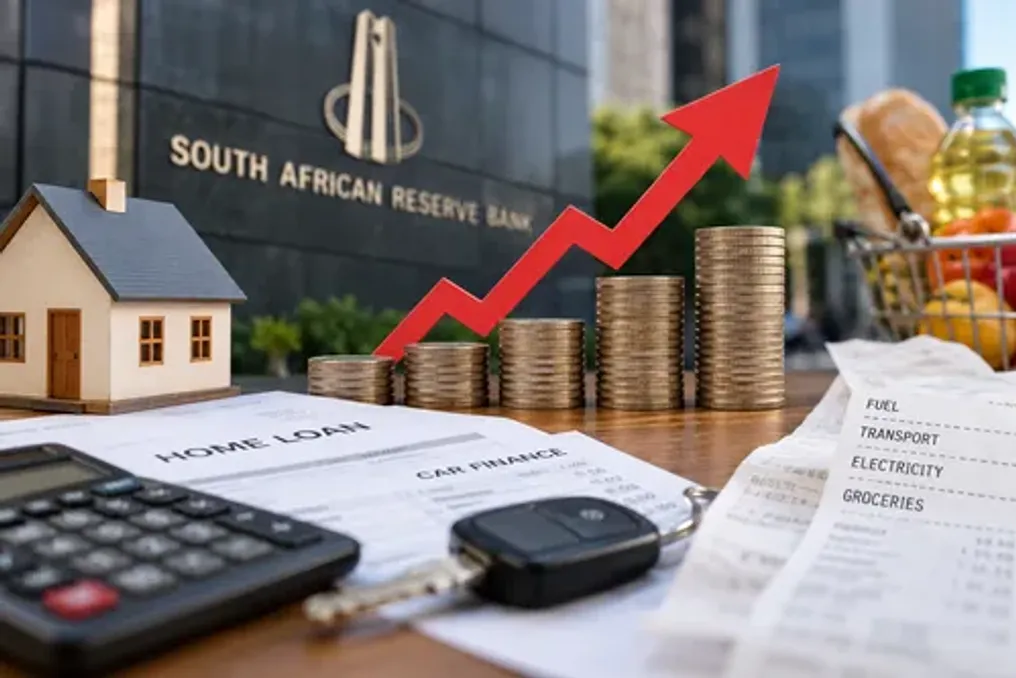
The implementation of the interest rate hike has led to an increase in loan rates. The South African Reserve Bank raised the rate by 25 basis points, increasing the base interest rate from 10.5% to 10.75%, which immediately increases monthly payments on floating-rate debts linked to this rate.

The latest rate hike takes effect today, increasing monthly payments for a R250,000 car loan by as much as R32, and for a R3 million mortgage by approximately R505.

When financing a car for R500,000 over six years at the base rate, the monthly payment increases from approximately R9,389 to R9,453, an additional R64 per month. A car worth R1 million under the same conditions will cost about R18,906 per month instead of R18,779, increasing the payment by R127.

At the lower end, payments for a R250,000 car rise from approximately R4,695 to R4,727, representing an increase of R32 monthly. When financing a vehicle for R750,000, the monthly payment will be around R14,180 compared to R14,084 before the hike, adding R95 to the monthly payment.

Significant impact on large sums

The difference becomes more noticeable when calculating mortgages, which are typically repaid over a much longer period.

A R1 million mortgage over 20 years at the base rate will cost approximately R10,152 per month, higher than R9,984, increasing the monthly payment by R168. For a R1.5 million loan, the payment rises from about R14,976 to R15,228, adding another R253 per month for the homeowner.

A R2 million mortgage will cost about R20,305 per month compared to R19,968 before the increase, increasing the monthly payment by R337. With a sum of R3 million, the monthly payment increases from approximately R29,951 to R30,457, representing a difference of about R505.

Calculations assume 100% financing at the base rate without a deposit or service charges; individual borrowers may pay rates higher or lower than the base rate.

Long-term consequences

The higher rate also affects the total amount borrowers will repay if the rate remains unchanged throughout the loan term.

When financing a R500,000 car over six years, the total repayment amount at a 10.75% rate will be approximately R680,600, compared to R676,000 at a 10.5% rate. Thus, the quarter percentage point difference adds about R4,600 to the total cost of the vehicle.

The effect is significantly greater with a 20-year mortgage. A R1.5 million mortgage at 10.75% will cost approximately R3.65 million over 20 years, including about R2.15 million in interest. At 10.5%, the same loan will cost approximately R3.59 million, including R2.09 million in interest. If the difference persisted for the entire term, the rate hike would add about R60,700 to the loan cost.

Peak rates?

Although the hike was widely expected, PSG senior economist Johann Els noted that the unanimous decision was tougher than he anticipated. He stated: 'I expected the decision to be close, with a strong argument for raising the rate. However, the fact that it was unanimous turned out to be tougher than I expected.'

The SARB's quarterly forecast model also does not foresee further hikes in its base scenario, although Els cautions that the model should not be taken too literally, as circumstances can change.

He believes: 'In my own forecast, the fact that they raised the rate in May and now raised it again in September, acknowledging that monetary policy is already restrictive, means that there should be no further rate hikes under current circumstances.'

Standard Bank Group Head of Macroeconomic Research Dr. Elna Moolman agreed that rates might have peaked. She noted: 'It is very likely that this could be the peak of the interest rate hiking cycle, and it is possible that the Reserve Bank will be able to start providing some rate cuts late next year.'

However, Moolman stressed that this would depend on oil price dynamics and whether higher transportation costs begin to affect other prices.

The role of oil

Future Forex CEO Harry Scherzer similarly suggests that the question is whether the increase in mid-week marks the peak of the tightening cycle. He notes: 'Much will depend on the trajectory of inflation, oil prices, the rand, and global interest rates in the coming months.'

Further hikes are not ruled out. Els reported that SARB considered an alternative scenario where global interest rates rise more than expected in the base scenario, leading to another local rate hike and a longer period of high rates.

A second scenario, where inflation expectations and wages rise, would also lead to another hike. If the situation in the Middle East improves and oil prices drop sharply, the inflation forecast may improve faster than SARB expects, paving the way for an earlier rate cut.

'In this scenario, I think that rate cuts could also happen earlier than currently expected,' says Els. 'Therefore, my expectation is no further rate hikes after this, given the current circumstances.'

Similar stories

Central Bank raises repo rate to 7.25%, intensifying pressure on borrowers
Read more
iol.co.za

Central Bank raises repo rate to 7.25%, intensifying pressure on borrowers

The Central Bank has raised the repo rate to 7.25%, creating an additional financial burden for South African households already grappling with rising prices for fuel, transport, and essential goods. The 25 basis point increase has prompted warnings about financial strain on consumers.

The Monetary Policy Committee unanimously increased the repo rate from 7% to 7.25%, consequently raising the base lending rate from 10.50% to 10.75%. This hike took effect today and marks the second rate increase this year.

Central Bank Governor Lesetja Kanganyo noted that global supply shocks related to conflicts in the Middle East and the war in Russia and Ukraine are contributing to increased inflationary risks. The bank has adjusted its inflation forecast for the current year to 4.4%, expecting overall inflation to exceed 5% later this year and early next year.

Despite GDP contracting by 0.2% in the second quarter, the Bank forecasts annual economic growth at 1.2%.

The Cosatu Federation of Trade Unions criticized the decision, stating that the increased cost of borrowing will negatively affect workers whose finances are already strained. The Federation emphasized that mortgages and other debts tied to the repo rate will become even more expensive and harder to service for millions of struggling workers, further reducing already weak incomes and draining the economy.

Cosatu also pointed out that workers are already battling rising prices for petrol and diesel, increased public transport costs, and electricity tariffs above inflation levels. The Federation stated that most workers are drowning in debt and forced to borrow money to pay for food, electricity, and transport, as well as servicing unmanageable debts.

The Federation argued that inflationary pressure is caused by international events, not strong domestic demand, and called on the Central Bank to refrain from further rate hikes. Furthermore, it strongly recommended that the Ministry of Finance reconsider the fuel levy removal until fuel prices return to pre-war levels.

Sanlam Investments economist Patrick Buthelezi noted that this decision reflects concerns over persistent inflationary pressure, particularly in the services sector and its potential impact on wages and inflation expectations. He added that the concern stems from sticky services inflation, which reached 5.1% in August, as this category typically influences wage and inflation expectations, despite some recent easing in expectations.

Buthelezi also reported that the Bank supports a restrictive monetary policy to minimize the risk of price pressures becoming entrenched. Although the Central Bank's quarterly forecasting model indicates stable rates and possible easing next year, Buthelezi believes the policy will likely remain 'higher for longer.'

PSG Financial Services chief economist Johan Els noted that the unanimous decision was tougher than he anticipated, although he did not expect further increases under current conditions. Els stated that the consensus was more 'hawkish' than he had calculated. He speculated that the Bank is concerned that a prolonged global supply shock could raise inflation expectations, making it difficult to return inflation to the target of 3%.

According to TransUnion South Africa estimates, the rate hike will add approximately R160–R170 monthly to repayments on a R1 million mortgage, and R320–R340 additionally on a R2 million loan. A car borrower of R400,000 can afford to pay about R65 more per month.

TransUnion reported that 38.8% of consumers expect difficulties paying future bills and loans, and the household debt-to-disposable income ratio rose to 62.2% in the first quarter. TransUnion Africa CEO and Regional President Li Naik noted that affordability remains fragile. He stressed that today's rate hike puts pressure on households already facing high costs for fuel, transport, and ongoing affordability issues.

TransUnion cautioned that further tightening of monetary policy could reintroduce repayment pressure, especially in the unsecured lending segment where default rates remain high. According to TransUnion data, consumers are likely to cut discretionary spending, review family budgets, and postpone major purchases as they prioritize debt repayment and essential expenses.

Consequences of a 25 Basis Point Interest Rate Hike for Borrowers
Read more
iol.co.za

Consequences of a 25 Basis Point Interest Rate Hike for Borrowers

A 25 basis point increase in the base interest rate will raise the lending ceiling rate from 10.5% to 10.75%, immediately increasing the cost of both new and existing floating-rate debts.

Many economists predict that the South African Reserve Bank will raise the repo rate by 25 basis points at its next Monetary Policy Committee (MPC) meeting, scheduled for September 23. However, this change has specific implications for debt holders.

For example, an individual purchasing a car worth R500,000 in early October and financing the full amount over six years at the ceiling rate, the monthly payment will increase from approximately R9,389 to R9,453. This is only a difference of R64 per month, but if the interest rate remains unchanged for the full six years, the buyer will repay about R680,600 instead of R676,000 at the current ceiling rate.

Thus, the quarter-percent increase adds approximately R4,600 to the total cost of the car. This difference becomes significantly larger when the debt is stretched over decades.

Consider a mortgage loan of R1.5 million over 20 years at the 10.75% ceiling rate: the monthly payment will be about R15,228, compared to R14,976 at the current 10.5% rate. If the rate remains at 10.75% for the entire term, the homeowner will ultimately pay about R3.65 million through the mortgage. Of this amount, approximately R2.15 million will be interest.

At the current ceiling rate, the same R1.5 million loan will cost approximately R3.59 million over 20 years, including R2.09 million in interest. This means that the quarter-percentage point difference, maintained throughout the term, increases the mortgage cost by approximately R60,700.

The calculations assume 100% financing at the ceiling rate, with no deposit or fees, and intentionally keep the interest rate constant to illustrate the effect of the 25 basis point difference. In reality, interest rates will fluctuate multiple times over the 20-year mortgage term, and individual borrowers may be offered rates higher or lower than the ceiling rate.

Probability of Rate Hike Increases

Investec Chief Economist Annabel Bishop expects the South African Reserve Bank to raise rates by 25 basis points next week, and financial markets are also pricing in a high probability of such an increase.

Bishop noted that the forward swap curve showed nearly an 85% chance of a 25 basis point hike, with a second increase fully accounted for by the end of the year. Rising oil prices have intensified inflation concerns, and the US Federal Reserve's decision on Wednesday to raise the target range by 25 basis points to 3.75% - 4% added another factor for the South African Reserve Bank.

Bishop stated: 'For South Africa, this outcome strengthens the likelihood of an interest rate hike at the Monetary Policy Committee meeting next week.'

Not So Quickly

However, PSG Senior Economist Johann Els still believes that the central bank will keep rates unchanged following the recent BER survey on inflation expectations, which showed stabilization or a decrease in expectations across several indicators.

Household expectations for inflation over the next 12 months have fallen from 6% to 4.9%, and the five-year expectation dropped from 9.1% to 8.3%. The overall BER professional five-year inflation expectation weakened from 4.1% to 4.0% in the third quarter.

Analysts forecast inflation of 3.4% in 2028 and 3.5% over five years. Union expectations are higher but declining: 4.1% for 2027, 3.9% for 2028, and 4.3% over five years.

Els noted that lower expectations reduce the need for another hike, although the Fed's decision has somewhat altered the balance. Nevertheless, Els expects rates to remain unchanged next week.

How Inflation Affects R1

Nevertheless, interest is only one part of the expenses households face over the debt repayment years. Inflation constantly erodes the purchasing power of money remaining after these payments.

If inflation averages 3.5% per year over 20 years—using current analyst five-year expectations solely to illustrate the cumulative effect—R1 at the beginning of the period will have the purchasing power of only about 50 cents in today's money by the end of the period.

An item costing R1,000 today will cost approximately R1,990 in 20 years if its price rises at the same rate. Using the higher union five-year inflation expectations of 4.3% results in an even greater difference: R1 in 20 years will have the purchasing power of about 43 cents in today's money, and an item costing R1,000 now will cost approximately R2,320.

None of these figures are forecasts of inflation for the next 20 years. They illustrate what will happen if today's long-term expectations persist throughout the term of a new mortgage. For a household taking out a R1.5 million mortgage now, this means costs are incurred in two directions: interest charged on borrowed money, and the gradual decline in the purchasing power of money left to cover everything else.

Popular