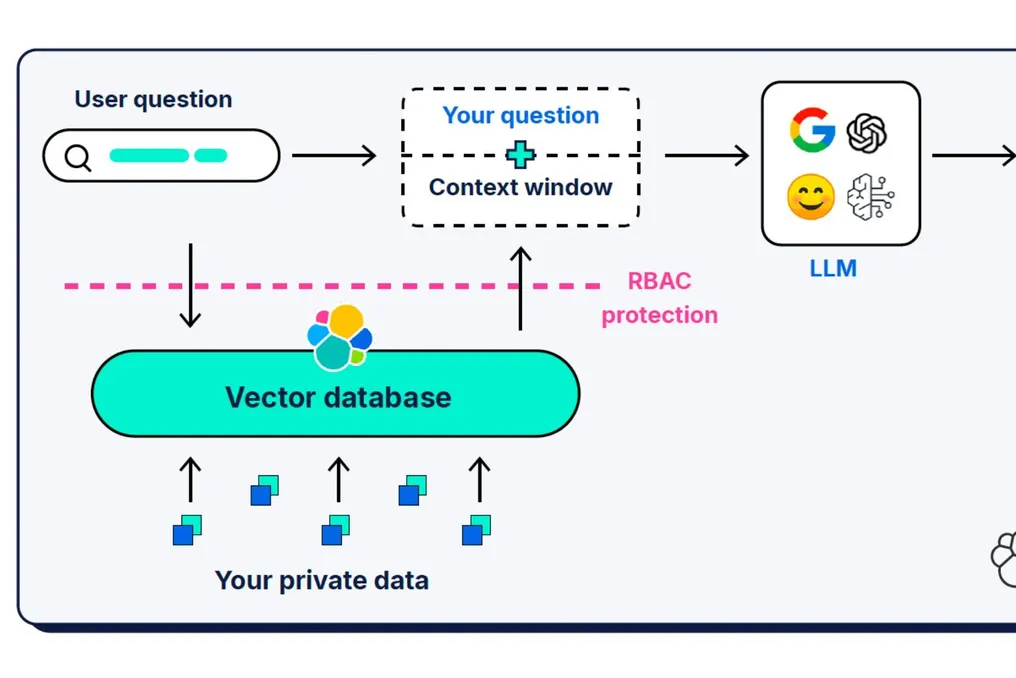
For a long time, the belief in the field of enterprise artificial intelligence was that the more information a model could process, the better its result would be. As context windows expanded from thousands to millions of tokens, large volumes of data became associated with progress. In response, organizations began equipping AI assistants with entire document repositories and conversation histories.
At Elastic, this shift became evident as clients moved from pilot projects to full operation. However, the problem was not the AI's ability to process more data, but how accurately it analyzed the specific data needed.
The trend known as tokenomics emerged in early 2026 in Silicon Valley and involved maximizing AI token consumption as a measure of performance. Some companies created internal employee rankings based on the number of tokens used, and high consumption became a symbol of status, regardless of the final result's quality. This trend faced sharp criticism because it evaluates input data, not achieved results. As Ravindra Ramnani, Head of Field Engineering in India at Elastic, notes, it is 'the equivalent of rating developers by lines of code in the age of AI.'
A similar mistake manifests at the architectural level when teams include unnecessary documents and conversation histories in queries, assuming that additional information will improve the output. Models do not possess the ability to filter extraneous material like qualified analysts, leading to increased noise, slower responses, and the need for significant manual verification of results.
The gap became apparent when organizations transitioned to production systems, where an agent operating on incomplete context leads not only to additional costs but also to serious errors. Ramnani emphasizes: 'The dialogue has thus shifted from the question of 'how much we can give the model' to the question of 'what the model actually needs to know'.' This question is at the core of context engineering.
Context engineering is the discipline that defines what information the model sees at each stage of its reasoning: what instructions frame the task, what tools are available, what is extracted from corporate systems, what is passed from previous steps, and what is intentionally excluded. In an enterprise environment, the most complex part is the information retrieval process, as the model must rely on trusted internal knowledge without being overwhelmed by it.
A simple analogy helps understand the essence: tokenomics is like handing a person an entire card catalog cabinet and asking them to find a specific page. Context engineering is providing them with the three pages they actually need, already marked. Both options contain the same information, but only one allows for more informed decisions.
The importance of relevance goes beyond a simple search function. It is the mechanism that makes autonomous AI safe for decision-making. When an agent reasons based on incomplete data, the risk is not only in wasted computational power. In a banking compliance scenario or in a security operations center, an incorrect autonomous action can propagate before a human can intervene. The correct information should be smaller in volume, have a higher signal level, and be controlled in terms of permissions so that the agent only has access to what it is authorized to.
The combination of relevance and governance ensures the reliability of a production agent, unlike an expensive pilot project. Effective context engineering is based on three levels: data proximity, which means placing the reasoning layer close to the source of truth rather than routing sensitive data through external channels; extraction accuracy, which guarantees the representation of only the information that is a true signal for the given decision, with Elastic's hybrid search—combining vector, keyword, and structured search with semantic re-ranking—ensuring relevance, not just relatedness; and execution grounding, which implies loading agent capabilities on demand instead of equipping every agent with a full set of tools at every step, thereby reducing both token overhead and the risk of unintended autonomous action.
Elastic integrates data retrieval, tool creation, conversational grounding, and agent observability into a single platform. This platform allows deployment fully locally or in isolated environments, and methods such as Better Binary Quantization can reduce the memory footprint for vector retrieval data by up to 32 times while maintaining accuracy.
It is also a business issue before it becomes an engineering one: business teams need to define what success looks like before technical teams start implementing it, otherwise, organizations will end up with elegant pipelines feeding agents incorrect data.
The impact of this is most visible in situations requiring critical decisions: security analysts receive only signals related to a specific threat, not a general feed; financial services and insurance (FSI) teams ground agent work within the regulatory context of a transaction, where there are strict deadlines (CERT-In 12 hours) and RBI frameworks; and developers of global competence centers (GCC) receive answers based on their organization's own systems. These examples are particularly relevant in India, where enterprises operate in diverse data environments covering legacy banking systems and modern cloud applications, often with records in Hindi and regional languages. Given DPDP Act obligations and data localization requirements, deploying the entire AI stack locally or in an isolated environment is not a preference but a procurement requirement for many organizations.
The most common mistake is assuming that connecting a model to corporate data is equivalent to grounding it in the corporate context, as access does not guarantee relevant retrieval; the second most frequent misconception is ignoring agent observability, which deprives the organization of the ability to explain the agent's decisions to regulators.
The choice of model will matter far less than the quality of the context on which the model bases its reasoning. A well-grounded smaller model consistently outperforms a larger model operating with fragmented context. The competitive advantage shifts from purchasing models available to almost everyone at comparable prices to the intellectual level that determines what any model can actually know and do.
Furthermore, enterprises need to rethink AI success metrics. Token usage and model size say little about business value. More significant are outcome-oriented indicators: task completion percentage versus frequency of human intervention, decision accuracy in the working environment versus testing, response time in critical workflows, and auditability in accordance with regulations, meaning an explanatory record of what data the agent consulted and why.
Gartner predicts that by the end of 2026, 40% of enterprise applications will use specialized agents, and systems without a single, trusted database inherit the risks of individual agents, exacerbating them.
The organizations that extract the greatest long-term value from AI are not those that adopted it first or chose the most complex model. They are those that invested in ensuring the availability, accuracy, and reliability of their corporate knowledge so that any reasoning system can act upon it with confidence. The model is not the protective barrier. The data foundation is.