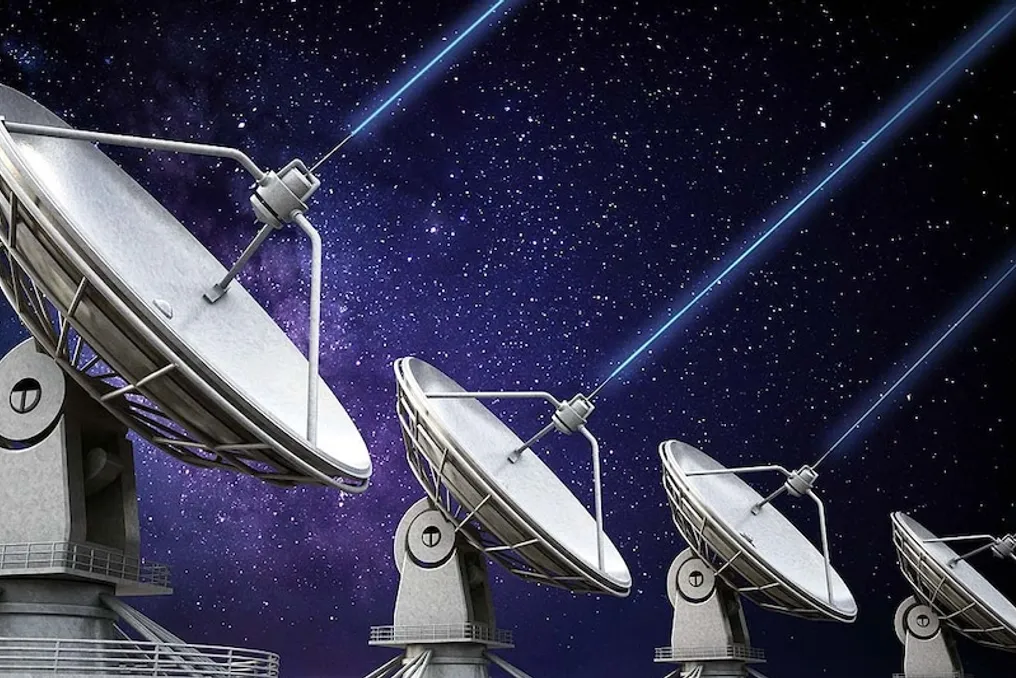
A mysterious radio signal from space is attracting the attention of scientists. This signal originated from a massive planet, Beta Pictoris b, located approximately 63.4 light-years away from Earth. Researchers have successfully linked a radio signal coming from an exoplanet—a planet outside the solar system—directly to that planet for the first time. This significant discovery was made by the MeerKAT Radio Telescope Array established in South Africa.
The team of scientists observed the stellar system Beta Pictoris four times during 2025 and 2026. During this period, they repeatedly received small radio signals at frequencies ranging from 0.85 to 3.5 GHz. The most notable aspect was that these signals were coming from the planet Beta Pictoris b, not its star. Scientists believe these signals are generated by the planet's aurora.
Although radio signals from stellar systems containing planets have been received before, it was not previously certain whether the signal originated from the planet or its star. This time, scientists investigated the location of the signal with extreme precision. To do this, the team used a distant quasar in space as a reference point, which made it possible to pinpoint the actual location of the signal. The investigation determined the signal's location to be Beta Pictoris b, leading scientists to consider it the first direct radio signal received from an exoplanet.
According to the scientists, the radio signal received from Beta Pictoris b is related to its aurora. Auroras are also visible on Earth, known as the Northern and Southern Lights. This phenomenon occurs when charged particles collide with the planet's magnetic field.
Circular polarization was also observed in the signal received from Beta Pictoris b. Scientists estimate that this may be associated with a process called Electron Cyclotron Maser Instability, or ECMI. This same process generates radio signals associated with the auroras of Earth and Jupiter.
This signal also provided important information about the planet's magnetic field. According to the research, the magnetic field strength in the region emitting the radio signal was recorded to be at least 1.25 kilo-gauss, equivalent to about 1,250 gauss. This is thousands of times stronger than Earth's magnetic field.
Beta Pictoris b is a young and massive gas giant, with a mass of approximately 10 times that of Jupiter. It also rotates very rapidly on its axis, completing one rotation in only 8 to 9 hours. Scientists suggest that the planet's rapid rotation and strong magnetic field may play a significant role in the radio signals associated with its aurora.
However, the research related to this discovery has not yet been published in a peer-reviewed scientific journal; it has currently been released as a preprint on arXiv. This means that examination and review by other scientists are still pending. Scientists now aim to search for such radio signals in other large exoplanets, and more planets can be identified in the future with the help of more sensitive radio telescopes.