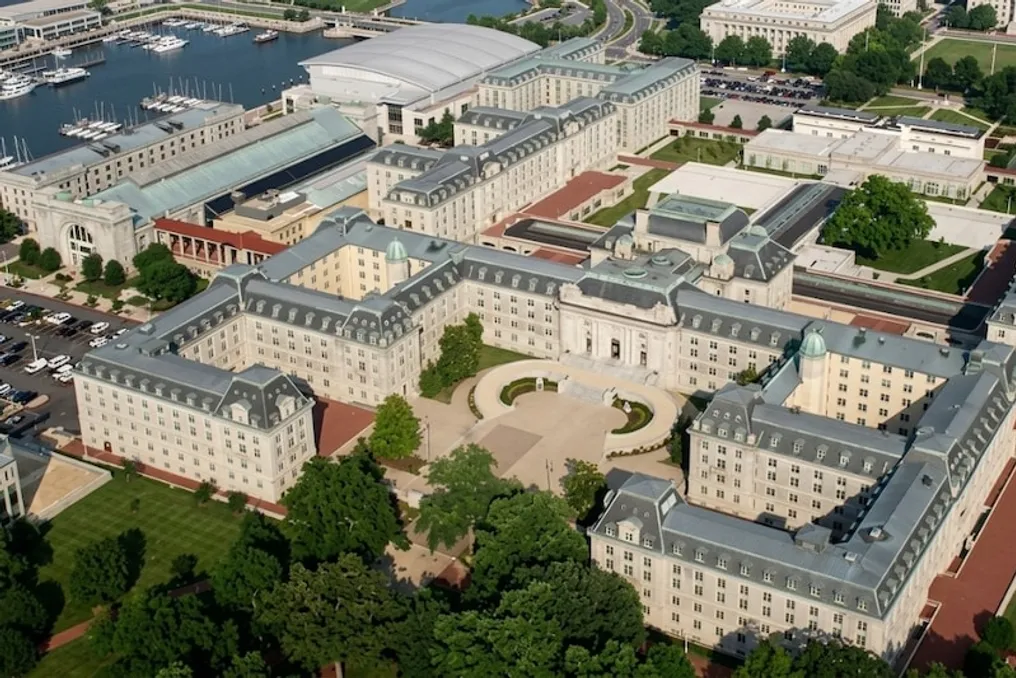
When people imagine a student dormitory, they usually picture a multi-story building with rows of rooms, a communal dining hall, and a laundry facility. However, there is one dormitory that spans 1.4 million square feet, accommodates over four thousand beds, features eight separate wings, and even has its own postal code.
This is Bancroft Hall, located in Annapolis, Maryland, as part of the U.S. Naval Academy. Students living here affectionately call it 'Mother Bee.' It is recognized as the largest dormitory in the world for a single educational institution.
The statistics regarding this dormitory, which trains future officers for the Navy and Marine Corps, are astonishing. The total area of the complex is approximately 1.4 million square feet (equivalent to 33 acres). It houses 1639 rooms and 4663 beds. The total length of corridors and passages inside the hostel reaches 4.8 miles, which is roughly 7.7 kilometers.
Cadets residing here receive mail not at a standard address, but using their own postal code, '21412.'
The history of Bancroft Hall spans over a century. It was designed by the renowned architect Ernest Flagg. Construction began in 1906, and the central section and two wings were completed in 1908. As the number of students at the Academy grew, the complex expanded: two more wings were added between 1918 and 1921, and it was further expanded in 1941 and 1961. Today, the building features eight large wings. The dormitory is named after George Bancroft, a former Secretary of the Navy who founded this naval academy.
Residence at Bancroft Hall is mandatory for all cadets attending the U.S. Naval Academy. However, this place serves not only for sleeping and studying; it concentrates all necessary elements for life. According to the dormitory guide, it includes medical and dental clinics, a gym, a post office, a bookstore, a barbershop and beauty salon, a shoe repair workshop, and a laundry, as well as a uniform shop. Thus, students do not have to leave the dormitory grounds to meet daily needs.
The management of the dining hall, known as 'King Hall,' in Bancroft Hall is admirable. This dining hall, built in 1953, is capable of serving food to 4500 people simultaneously in just 10 minutes. More than 13,500 meals are prepared and served daily, including three meals. Additionally, the complex includes 'Mitcher Hall' with a large auditorium and a prayer area. There is also the 'Uriah P. Levy Center,' which houses a Jewish place of worship (synagogue), a conference room, and a student-run court of honor.
Life in 'Mother Bee' differs drastically from typical student life because strict military discipline is observed here. There are clear rules defining which cadet of which class can use a specific entrance or corridor. For example, freshmen, referred to as 'plebes,' are subject to the strictest restrictions. They can only use the main/central entrances of the dormitory during official or ceremonial events, not on regular days.
The main value of Bancroft Hall lies not only in its colossal size or 1.4 million square feet. Its true strength is that thousands of young people from different parts of the country live together for four years, learning not only academics and sustenance but also becoming part of a disciplined military community. This massive dormitory represents not merely a structure of stone and concrete, but a unique center shaping the future of the American fleet.