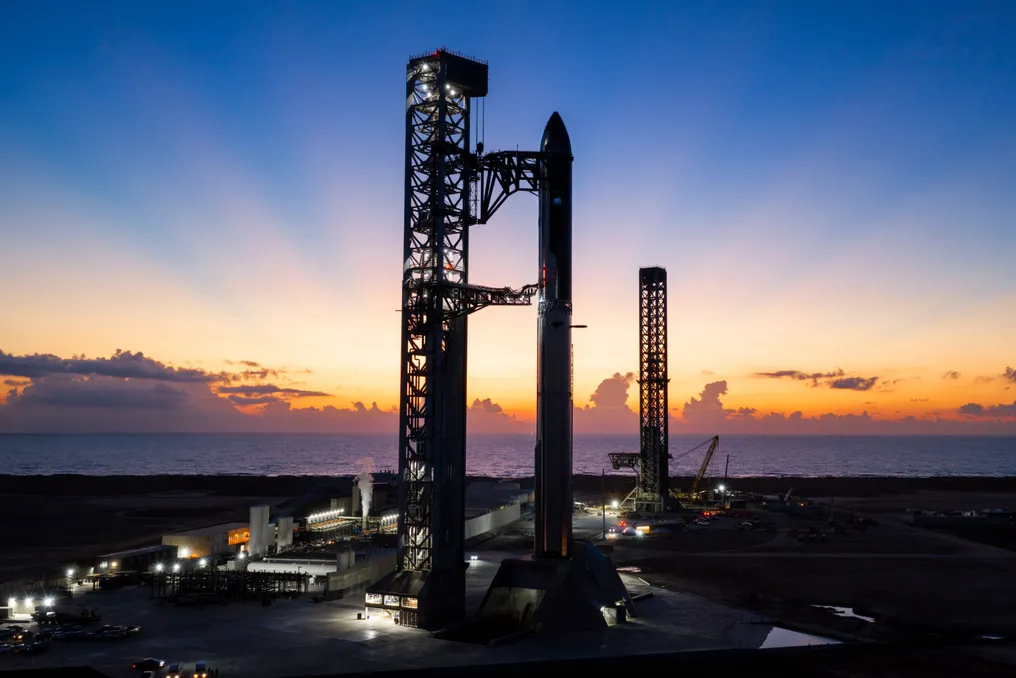
SpaceX is scheduled to conduct the fourteenth Starship test flight next Monday, aiming to place the world's largest rocket into orbit for the first time, marking a significant advancement in the project.
Unlike previous tests, which were limited to suborbital trajectories, this mission aims to extend the spacecraft's operational time in space to evaluate the vehicle's durability in an orbital environment.
The launch window is set for 75 minutes, starting at 9:15 AM, with a deadline for takeoff at 10:30 AM, according to Brasília time. Due to the Earth's continuous rotation, the exact point of space insertion varies with time; any deviation or closure of the window will result in the cancellation of the mission.
To follow this historic space exploration event, Olhar Digital will broadcast live on YouTube and social media starting at 8:30 AM, featuring participation from Bruno Capozzi, the site's executive editor, and astronomer Marcelo Zurita.
The spacecraft is tasked with transporting 26 new satellites belonging to the Starlink network, intended to increase the fleet's capacity. After being deployed in space, these units will activate their solar panels to autonomously navigate to the appropriate operational altitude.
Three of these satellites will be equipped with special cameras focused on the vehicle's thermal shield. The company plans to capture detailed images of the material wear during the flight, in addition to reusing thermal components previously used in preceding missions.
The rocket consists of two stages. The lower stage, named Super Heavy booster, has received engine improvements to prevent failures observed in the previous test, with the goal of ensuring a safe and controlled landing in the ocean.
After the main vehicle launches, the Super Heavy booster will execute its return maneuver, expected to land in the Gulf of Mexico approximately seven minutes after takeoff. On this occasion, the structure will not attempt capture on the ground tower, landing directly in the water.
As for the upper stage, Starship, which names the entire vehicle assembly, it will remain in space for almost ten hours, completing about six orbits at an altitude of 275 km. A pre-flight statement from SpaceX indicated that this test will aid in developing technologies necessary to make the vehicle fully reusable in the future.
At the end of the orbital path, the spacecraft will use one of its six Raptor engines to leave orbit and begin atmospheric reentry. The mission will conclude with a controlled descent and a landing in the Pacific Ocean, located west of Chile.