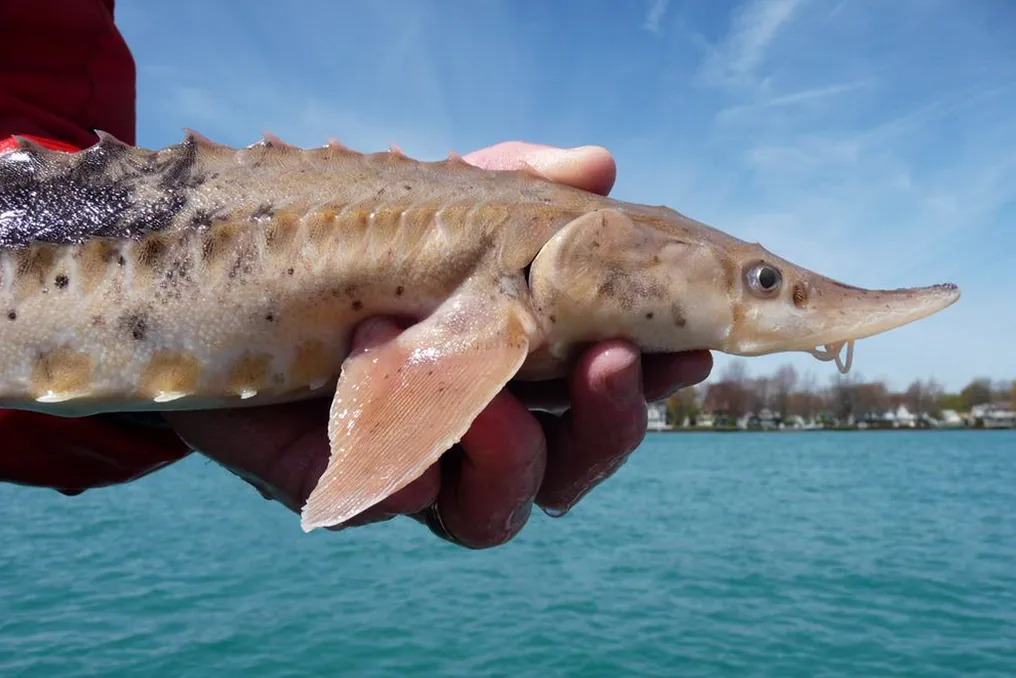
Some specimens of fish from the Great Lakes area in the United States may have achieved a longevity exceeding 400 years. A study published in the Journal of Fish Biology revealed that a male of the lake sturgeon species (Acipenser fulvescens), found in the Black River in Michigan state, reached 435 years, surpassing the age of the previously documented oldest specimen by almost three times.
If this discovery is confirmed, it is notable because this fish would have witnessed significant historical events of humanity, such as the French Revolution, World War II, and the collapse of the Twin Towers. However, the authors themselves emphasize the need for additional investigations to validate these conclusions.
Lake sturgeons are freshwater fish native to North America and have an existence dating back to the dinosaur era, more than 200 million years ago. They are predominantly found in the Great Lakes basin, located on the border between the US and Canada. These fish can reach lengths between 1.2 m and 1.8 m, and their weight varies from 13.6 kg to 36.3 kg.
Initially, researchers estimated that the average life expectancy of these sturgeons would be 50 to 100 years. However, the new study contradicts this notion, indicating that the median age of males may range between 87 and 215 years, while females would be in the range of 90 to 248 years. Specific examples include the 435-year-old male and a 292-year-old female mentioned in the research.
Edward Baker, one of those responsible for the research, speculates that even older fish may emerge in the future. He told Smithsonian Magazine that the age estimates of the largest fish caught in each population do not necessarily reflect the maximum age these animals could reach. Baker adds that both larger and older males and females can exist, and both sexes can reach comparable maximum ages.
This finding establishes the lake sturgeon as the freshwater fish with the longest life expectancy, although other sturgeon species may also possess equally long lives. Nevertheless, the title of the planet's longest-living vertebrate remains with the Greenland sharks (Somniosus microcephalus), which can live up to 500 years under extreme circumstances.
Determining the exact age of wild fish is a complex process. The most common method involves counting each dark ring on the fish's scales, representing one year of life. In the case of lake sturgeons, since they do not have scales, biologists count the spines located on their pectoral fins.
Counting these rings allows for the estimation of the age of fast-growing and relatively young fish. With sturgeons, the opposite occurs: they evolve slowly and live for long periods. This causes their rings to form very close to each other, making them indistinguishable, or even failing to form completely.
Given this, the authors opted for an alternative methodology. They analyzed data from thousands of lake sturgeons collected between 1980 and 2024, monitoring the species in five bodies of water in the Great Lakes region: Black Lake, Sturgeon River, Menominee River, St. Clair River, and Lake Winnebago.
Over these 44 years, the sturgeons were captured, identified, measured, and tagged just beneath the skin for later release into the water. If the researchers captured a fish that had already been tagged, they measured it and released it again, thus building a history of changes in its size over time.
Using these records, known as catch, mark, and recapture data, the authors calculated the average annual growth rates of the lake sturgeon populations in each waterway. To do this, they measured the difference between the sturgeon's length in the most recent capture and the initial capture, dividing this value by the number of years between the two moments.
From calculating this annual growth rate of the fish, it became possible to estimate their total age. One of the hypotheses raised to explain the high life expectancy of the species resides in a state called torpor. In this state, there is a sharp decrease in the metabolic and physiological activity used by the animals to survive unfavorable environmental conditions, such as extreme cold or food scarcity. The authors suggest that this mechanism contributes to the sturgeon's longevity.