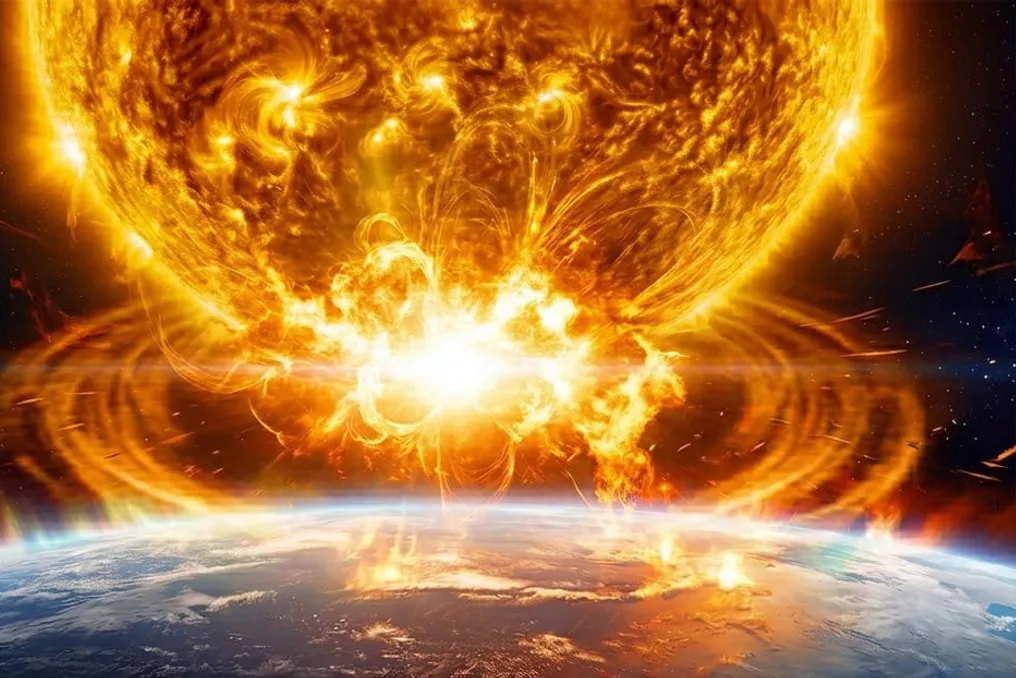
A recent study published in Philosophical Transactions of the Royal Society A indicates that the Sun has the potential to generate superflares, extremely high-energy events that would exceed the largest solar eruptions ever recorded on the star.
The researchers based this conclusion on the investigation of the largest solar spot observed since the notorious Carrington Event, which occurred in 1859. This structure appeared in April 1947, presenting exceptional dimensions, covering about 0.6% of the solar surface and reaching approximately 40 times the diameter of the Earth.
Explanation of solar flares
In conversation with Olhar Digital, physicist Adriana Valio, full professor at Mackenzie Presbyterian University and researcher at the Mackenzie Center for Radio Astronomy and Astrophysics (CRAAM), clarified that a solar flare consists of the sudden release of vast energy stored in the Sun's magnetic fields. She detailed that this energy is primarily released through the process of magnetic reconnection, which occurs when magnetic field lines reconfigure, transforming magnetic energy into radiation, plasma heating, and particle acceleration.
These flares occur mainly in active areas, linked to sunspots, where magnetic fields are complex and intense. The released energy can generate radiation across virtually the entire electromagnetic spectrum, ranging from radio waves to X-rays and gamma rays.
Although the exact strength of the Carrington Event, the largest documented solar storm, is indeterminable due to the absence of modern equipment at the time, estimates point to an intensity equivalent to X45. For comparison, the strongest eruption seen in Cycle 25, the current solar cycle, was X9 level on October 3, 2024.
Definition and magnitude of a superflare
A superflare is defined as a phenomenon with considerably higher energy than the star's usual eruptions. Adriana Valio emphasized that, generally, any event whose total emitted energy exceeds about $10^{34}$ ergs is considered a superflare. This value represents an energy tens of times greater than the most powerful solar flares recorded to date.
This energy level is equivalent to ten to one hundred times the force of a common powerful explosion, exceeding by more than 200 times the energy associated with the impact of the Chicxulub asteroid, responsible for the extinction of the dinosaurs.
The possibility of the Sun generating an event of this magnitude was already a topic of scientific debate. In 2024, a simplified model suggested that the star would need approximately eight years to concentrate enough energy for a superflare in a restricted area. Subsequent research also indicated that stars similar to the Sun can experience such events at intervals of about a century.
The new analysis, conducted by the team at the Max Planck Institute for Solar System Research in Germany, calculated the energy that could have been accumulated in the large 1947 sunspot. The results showed that a typical eruption in this region would release about $2.32 imes 10^{33}$ ergs (which is equivalent to more than a billion years of electricity consumption for the city of São Paulo). In more extreme scenarios, the stored energy could exceed $1.25 imes 10^{34}$ ergs, reaching the theoretical limit of a superflare.
However, Adriana Valio warned that the size of a sunspot does not guarantee a colossal event. It is crucial to evaluate the complexity and configuration of the magnetic fields, in addition to the amount of stored magnetic energy, to determine how and when this energy will be released.
The specialist highlighted that modern technological progress has allowed for continuous monitoring of the star through satellites and ground telescopes, enabling the identification of active regions that accumulate large amounts of energy.
Despite this, precise prediction remains a major scientific challenge. Current instruments allow for identifying potentials for extreme events and tracking their evolution, but it is not yet possible to predict exactly when an explosion of this scale will occur or what its energy will be.
The work of the Max Planck Institute does not imply that the 1947 spot generated a superflare; records indicate that no major eruption was directed toward Earth in that region. The study only demonstrates that the Sun has the physical conditions to create events of extreme magnitude.
Potential consequences for Earth
If a solar superflare of this magnitude occurs and is directed at Earth, the repercussions would be profound, especially if accompanied by a large coronal mass ejection. Adriana Valio made an important distinction between the electromagnetic radiation emitted during the flare and the coronal mass ejection, which involves the expulsion of plasma and magnetic fields into space, warning that these phenomena do not need to occur simultaneously.
Electromagnetic radiation travels at the speed of light and will reach Earth in about eight minutes. This more energetic radiation, particularly in the X-ray and extreme ultraviolet bands, would cause significant changes in the Earth's ionosphere, immediately affecting radio communications and satellite navigation systems, such as GPS, in addition to exposing space operations and astronauts to additional radiological risks.
The effects of a potential coronal mass ejection would take longer to arrive but could be even more severe. The interaction of the plasma and magnetic field with the Earth's magnetosphere would trigger a high-intensity geomagnetic storm. Depending on the nature of the storm, there would be serious disruptions to power grids, potentially causing blackouts, damage to orbiting satellites, failures in global telecommunications, and intensification of the polar aurora.
The Carrington Event serves as a historical example: the geomagnetic storm of that time resulted in collapses in telegraph systems and caused auroras at tropical latitudes. Due to modern dependence on space technologies and interconnected electrical grids, human vulnerability to an extreme event is much higher than in the 19th century.
Despite the risks, the specialist advises against panic, as it cannot be stated that a superflare will inevitably lead to a global catastrophe. The severity of the impacts would depend on the coronal mass ejection, its speed, exact direction, and, above all, the orientation of the transported magnetic field.
Adriana Valio also clarified that the vast amount of energy cited refers to the total energy the phenomenon could release, not the energy that would directly hit the planet, given that Earth would intercept only a small fraction of the solar radiation.
The Earth's atmosphere and magnetic field act as efficient natural shields against most solar radiation and particles. Thus, the primary dangers would not be direct human exposure to radiation, but rather secondary damage caused to technological infrastructure and essential services.
This discovery helps scientists delimit solar activity and the risks it poses to the planet, raising the question of the frequency of these superflares and whether any have reached Earth without technological record.