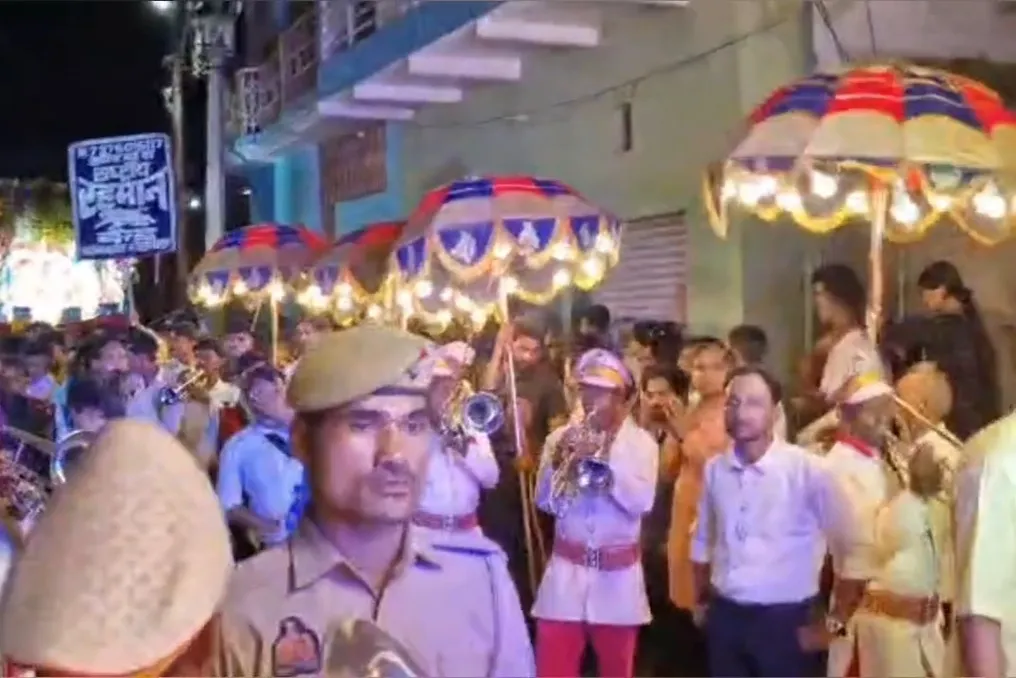
The history of Bundelkhand lives not only in tales of forts, palaces, and battles, but also in local religious traditions and folk beliefs. The Jalvihar festival in Mauranipur is one such historical tradition that has attracted thousands of people for many centuries. Central to this tradition is the procession of Deva Vimaan of Shri Gudhar Badshah.
At night, from the temple of Shri Gudhar Badshah located in old Bailai, the Deva Vimaan of the deity sets out under the sounds of music and religious fervor. Among the pilgrims, there is a special enthusiasm, as the procession of Gudhar Badshah always leads the Jalvihar procession, followed by other Deva Vimanas.
Local residents and temple staff believe that this tradition has existed for more than two hundred and fifty or three hundred years. Although different speakers cite different periods of its antiquity, they all agree that it is a strong connection to faith dating back before the British period.
The history of this Gudhar Badshah tradition is not limited only to religious belief; it is also connected to memories of the time of British rule, when attempts were made to ban religious events. According to local organizers, during the British rule, efforts were made to stop the Jalvihar and the departure of the Deva Vimanas, citing illnesses and other circumstances. However, local mahants decided not to halt the tradition and continued to bring out the deity's vimaan.
One of the temple organizers mentioned that at that time, Mahant Laldas Maharaj promoted this tradition, and the vimaan of Gudhar Badshah was brought out first. After this, the process of bringing out other Deva Vimanas began. Local belief holds that since then, the tradition of Gudhar Badshah's vimaan leading in the Jalvihar has been strengthened.
This is why today, when the Jalvihar is held in the city of Mauranipur (Jahansi), people's eyes are first turned to the vimaan of Gudhar Badshah.
A local resident, Bogdans, reported that initially, the vimaan of Gudhar Badshah used to come out alone. Over time, idols and Deva Vimanas from other temples have also been included in this religious journey. Nevertheless, the leadership of Gudhar Badshah is maintained even today. According to him, other Deva Vimanas follow behind Gudhar Badshah, not before him. Thus, the tradition of maintaining the leading position in the Jalvihar procession has been passed down from generation to generation.
Bogdans also noted that during the British rule, attempts were made to stop this tradition under the pretext of illness and other reasons, but sadhus and mahants stepped forward and continued it. Today, thousands of pilgrims witness this tradition, and security is provided next to every Deva Vimaan.
According to the temple organizer, this year about 70–80 Deva Vimanas are expected to participate in the Jalvihar. Among them are about 40 idols considered ancient and historic by the locals. Additionally, the procession will be decorated with figures of Ganesha and Laddu Gopal. Local resident Sunil Kumar Gupta stated that this Jalvihar tradition is about two hundred and fifty years old. He added that the deity performs the Jalvihar in the river, and Deva Vimanas are brought out annually as part of this religious tradition. In his estimation, this time between 80 and 85 vimanas are expected to participate, including about 50–55 large Deva Vimanas and small idols. This religious caravan, emerging among crowds of thousands of pilgrims, gives special significance to the historical Jalvihar of Mauranipur.
After the night city walks and religious events, the Gudhar Badshah Jalvihar was conducted at dawn (Brahma Muhurta). According to beliefs, the deity of Gudhar Badshah first arrives at the riverbank and performs the Jalvihar. Then follows the religious procession and walk through the city. The morning Brahma Muhurta, the riverbank, the religious chants, and the caravan of Deva Vimanas—this entire scene incorporates the Mauranipur Jalvihar into the traditions of Bundelkhand, where history and faith manifest together.
Given the likelihood of thousands of pilgrims attending the Jalvihar festival, the administration has also paid special attention to safety and organization. According to local residents, police protection is present next to every Deva Vimaan during the event. District Commissioner Gaurang Rati stated that the 158th Jalvihar was inaugurated jointly with the senior police. He emphasized that this event is known far beyond due to its historical heritage and unique character, and a large number of people participate in it. The administration promised to ensure all necessary conditions, including safety, cleanliness, emergency services, power supply, and lighting, at the SDM and CO level.