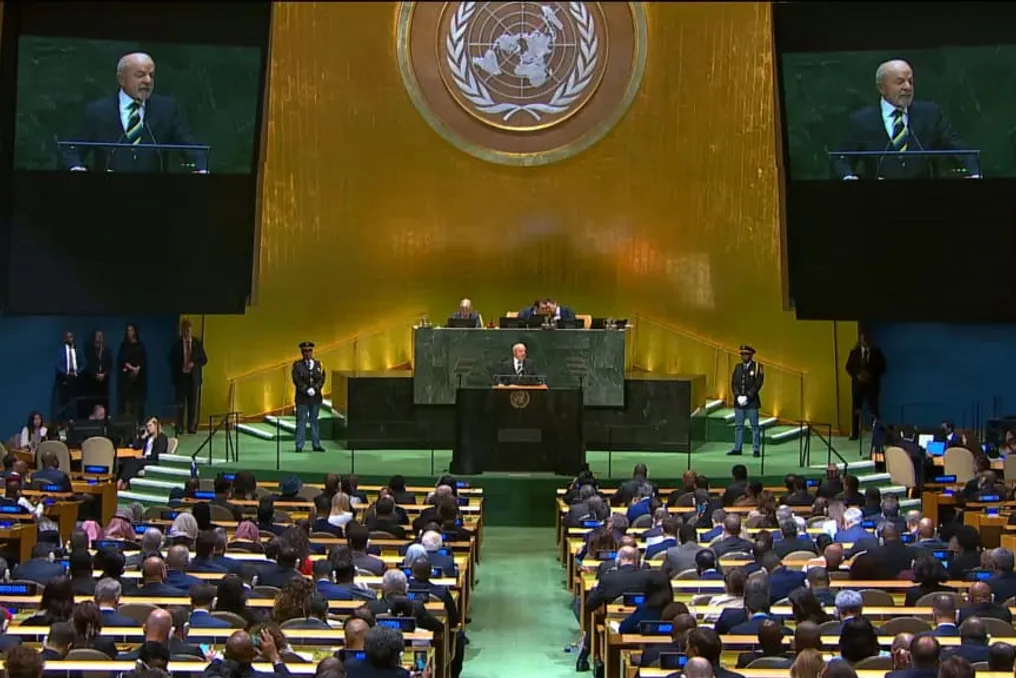
Representatives from 193 nations gathered in New York, United States, for the 81st General Assembly of the United Nations (UN), which began on Tuesday (22). The main focus of this assembly is to debate the future of global security, especially due to the challenges and threats posed by the rapid advancement of artificial intelligence (AI).
Alvaro Machado Dias, a neuroscientist, futurist, and professor at the Federal University of São Paulo (Unifesp), observed that this is the first time in about 80 years that a technological innovation is viewed with the same degree of caution as the emergence of nuclear weapons in the 1940s.
Analyzing the participation of executives in the Security Council, Dias highlighted that technology has begun to be considered an autonomous geopolitical agent in diplomatic discussions. He stated that when the Security Council schedules a discussion on AI, it signals that such an entity, which has no borders, army, or flag, can pose a danger to peace. The closest comparison he made was to nuclear energy, mentioning that there is an 80-year gap since the atomic bomb.
However, Dias pointed out a crucial distinction in the current debate on military security. While the fear of atomic bombs lay in the human decision to activate the device, new virtual systems bring the possibility of a threat that can operate autonomously.
The expert emphasized the disparity between historical arsenals and the uncertainties generated by cutting-edge digital tools. According to him, in the context of nuclear weapons, it was never considered that the bomb could self-destruct; the focus was always on how disagreements could lead to mutual destruction. In contrast, with artificial intelligence, there is the theory that it can evolve to possess capacity and even intent aimed at the annihilation of humanity.
This reclassification had a practical effect on managing negotiations, moving the topic out of the hands of science and technology ministries and transferring it to the purview of defense ministers, intelligence leaders, and high-ranking diplomats. This change profoundly alters the dynamic of pacts between major powers, shifting the focus of national security meetings from job creation to preventing unpredictable social collapses.
Even with warnings about future risks, immediate effects are already being felt in daily life. The lack of established global rules allows for commercial abuses, privacy violations, and the widespread dissemination of fake news in virtual environments.
Roberto Pena Spinelli, a physicist from the University of São Paulo (USP) and a Machine Learning specialist from Stanford University, also participated in the Olhar Digital News program and warned about the seriousness of the absence of direct oversight over corporations. Pena stated that AI is an extremely powerful resource whose impacts are being noted but lacks any specific regulation. He cited problems such as copyright, information manipulation, misuse, and the possibility of AI escaping control and committing crimes, all without regulation.
Spinelli added that although involved companies are issuing statements, this is not enough, as they cannot self-regulate. To mitigate these real problems, European initiatives are seeking to implement mandatory international audits. Proposals led by countries such as Finland and Norway aim to limit the speed of advanced model development and create clear mechanisms for legal responsibility.
Pena stressed that such proposals seek to protect civil society, underlining the importance of independent bodies capable of monitoring technology giants and applying concrete sanctions in case of non-compliance with ethical standards. He emphasized that the body under formation must require audit and control mechanisms for companies, as well as reports on associated risks, making real oversight with sanctioning power essential.
While diplomacy seeks consensus among divided nations, technology continues to advance rapidly. The global challenge in the coming years will be finding a balance between innovation and protection against threats that, until recently, seemed to belong only to science fiction movies.