
Uzbekistan implements regenerative agriculture methods within the FOLUR project
Read more
UzDaily
uzdaily.uz

Uzbekistan implements regenerative agriculture methods within the FOLUR project

In various regions of Uzbekistan, practices such as reduced tillage, more efficient use of water and fertilizers, crop diversification, restoration of degraded lands, and the application of digital monitoring tools are being implemented under the FOLUR–Uzbekistan project.

A correspondent from UzDaily, as part of a group of media representatives, visited the demonstration sites of the FOLUR–Uzbekistan project. Participants in the press tour were able to see the practical application of water and resource-saving technologies, as well as projects aimed at preserving biodiversity and restoring ecosystems.

The main practical achievements of the project were presented during the press tour. One of the key sites was the Baraka Baltimor farm in the Yangibazar district, located in the Khorezm region. On this 30-hectare site, traditional cotton cultivation methods are being compared with reduced tillage systems.

The 'Program on Nutrition Systems, Land Use, and Land Restoration Impact in Uzbekistan' (FOLUR–Uzbekistan) is financed by the Global Environment Facility (GEF) and is implemented in collaboration with the National Committee of the Republic of Uzbekistan for Ecology and Climate Change, the Ministry of Agriculture of Uzbekistan, and the Food and Agriculture Organization of the United Nations (FAO).

At the demonstration site, specialists are studying the possibility of achieving stable yields while simultaneously reducing the number of agrotechnical operations and consumption of production resources. When using traditional technology, cultivation is performed twice, whereas the experimental approach eliminates this operation entirely. The number of loosening and sieving operations has been reduced from three to one, and the number of irrigations—from five to three.

The use of phosphate fertilizers has also significantly changed: under the traditional method, 300 kg of ammonium phosphate is applied per hectare, while 100 kg is used on the reduced tillage plot. According to current calculations, the new method allows saving about 35 liters of fuel and 200 kg of ammonium phosphate per hectare, while production costs decrease to 4.07 million soms. The application rates of nitric acid, ammonium sulfate, and potassium chloride remain unchanged; the number of slurry applications has also decreased from five to three.

Similar stories

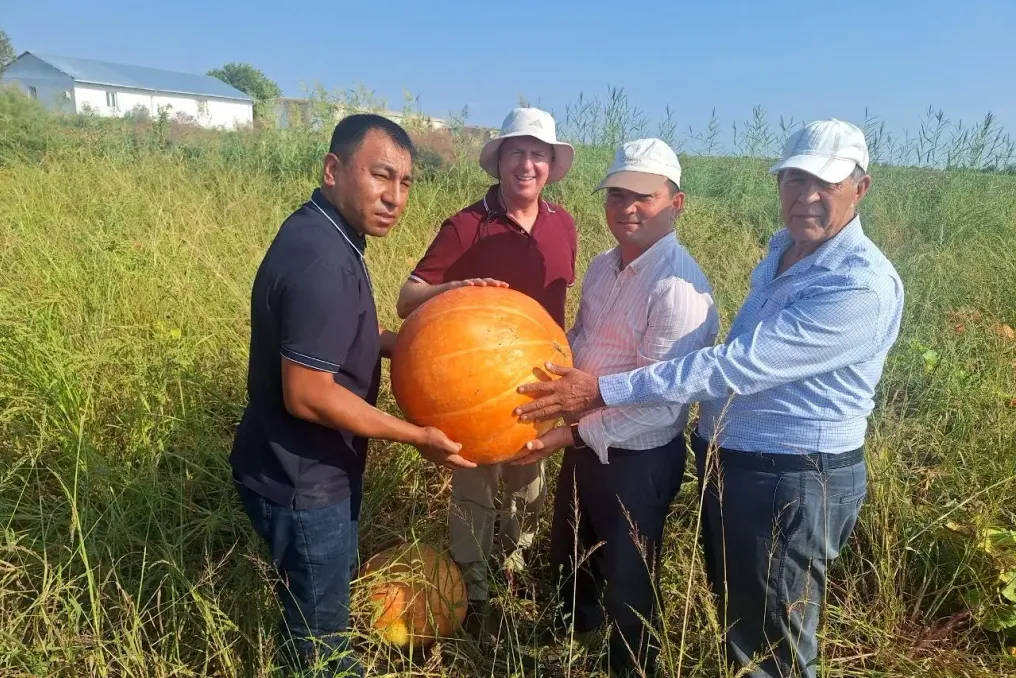
Uzbekistan implements technologies for growing large pumpkins and establishes seed production
Read more
uzdaily.uz

Uzbekistan implements technologies for growing large pumpkins and establishes seed production

The Ministry of Agriculture of Uzbekistan announced the start of implementing international methods for cultivating large-fruited pumpkins and establishing primary seed production.

A practical seminar on this topic was held at the station of the Research Institute of Vegetable Farming, Land Reclamation, and Potato Farming in the Khanka district, Khorezm region. The event was attended by international expert Alan Walters, specialists from the research institute, the regional Agroservices Center, and the regional AKIS, as well as heads of farms specializing in crop production and animal husbandry.

Participants reviewed modern agricultural technologies for growing large-fruited pumpkin varieties, crop care methods, preparation of high-quality seed material, and organization of primary seed production. Special attention was paid to increasing yield and adapting international experience to local conditions.

The institute in the Khanka district is also conducting practical experiments on growing large-fruited pumpkins in cooperation with scientists from the USA.

This year, 600 kg of seeds for large-fruited pumpkin varieties Big Max, Atlantic Giant, and Mammoth Gold were imported into Uzbekistan from Italy. These seeds were distributed across the country's regions for further implementation.

According to estimates, the plantings will cover a total area of 150 hectares. The average expected yield is up to 500 centners, or 50 tons, per hectare. As a result, about 75,000 centners, equivalent to 7,500 tons of large-fruited pumpkins, are expected to be harvested by the end of the season. The Ministry of Agriculture reported that initial observations show promising yields, as the planted crops are currently maturing in the fields.

Uzbekistan and Georgia plan to expand cooperation in the agricultural sector
Read more
uzdaily.uz

Uzbekistan and Georgia plan to expand cooperation in the agricultural sector

Uzbekistan and Georgia held their first meeting of the Working Group on Agricultural Issues via video conference to discuss new directions for joint cooperation in the agrarian sphere.

The meeting was attended by the Deputy Minister of Agriculture of Uzbekistan, representatives of the Ministry of Environmental Protection and Agriculture of Georgia, as well as specialists from relevant scientific research institutions, according to the Ministry of Agriculture of Uzbekistan.

The main focus of the participants was on exchanging experience in the field of animal husbandry. The parties discussed the development of this sector, the interaction between scientific research and practical application, and the introduction of advanced methods into production processes.

Furthermore, the topic of creating and cultivating olive groves was raised. Georgia's experience, modern agrotechnologies, and approaches to creating such plantations were reviewed, as were the prospects for developing scientific methods in horticulture, vegetable farming, and gardening.

At the end of the meeting, the participants emphasized the need for continuous development of mutually beneficial cooperation, strengthening existing ties, and implementing new joint projects in the agricultural sector.

Uzbekistan and UC Davis to Expand Cooperation in Horticulture
Read more
uzdaily.uz

Uzbekistan and UC Davis to Expand Cooperation in Horticulture

Uzbekistan and the University of California, Davis (UC Davis) plan to deepen practical interaction in the fields of viticulture and pistachio cultivation.

Discussions on this cooperation took place during a working trip of an Uzbek delegation to the United States. The parties met to focus on testing promising planting material adapted to Uzbekistan's conditions, its subsequent propagation in the country, and the development of scientific and practical partnerships.

Pistachio Cooperation Details

Specifically, regarding pistachio cultivation, the possibility of introducing the UCB-1 rootstock was discussed, which is considered promising for local conditions. Participants examined the potential of importing seed material into Uzbekistan for testing, followed by establishing an internal seed breeding system based on parent lines.

Viticulture Issues

Viticulture was another topic of discussion. Participants considered the option of importing and testing modern grape rootstocks developed for various soil and climatic conditions. These materials possess resistance to drought, salinity, nematodes, and diseases.

Furthermore, the parties discussed the possibility of direct propagation of promising material in Uzbekistan before applying it in agriculture. The prospect of testing next-generation rootstocks from the UCD GRN series, created by UC Davis scientists, in different regions of the country was also considered.

At the conclusion of the meeting, an agreement was reached to continue practical cooperation. This will include the import of promising planting material into Uzbekistan, its testing under local conditions, and subsequent propagation.

Popular