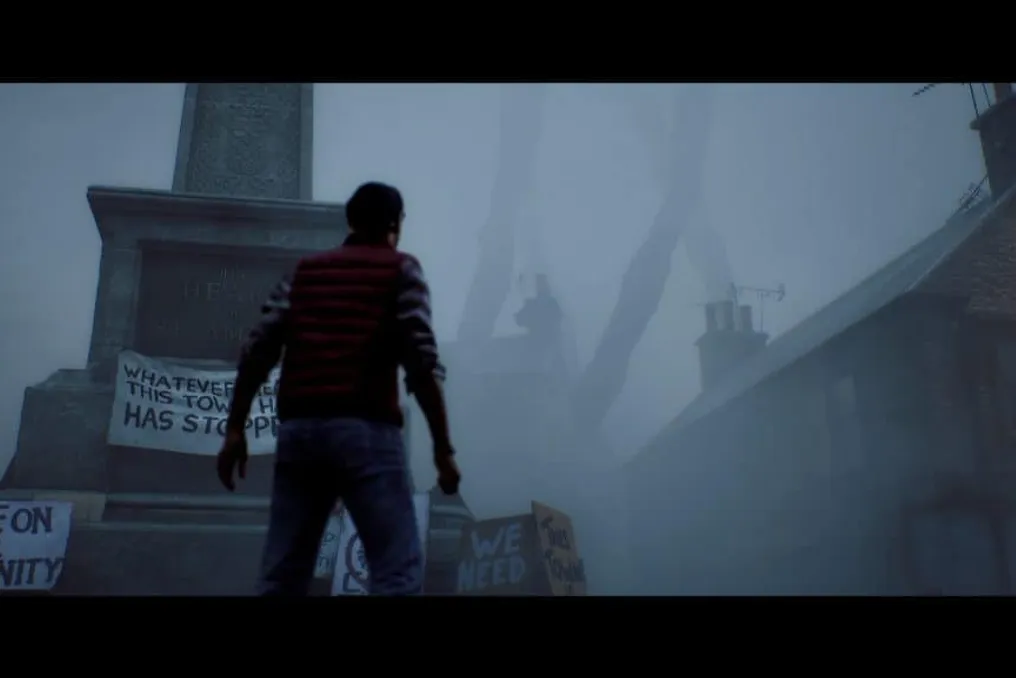
This review was prepared after approximately ten hours of playing the PC version via Steam. The Silent Hill franchise has never needed constant jump scares to evoke fear; much of its identity is built on the player not understanding, being unable to clearly see, or simply not knowing if they want to find out.
Silent Hill: Townfall perfectly captures this logic. During my ten hours of gameplay, one simple question captivated me: what happened in this town? The answer is not revealed immediately; it must be sought by walking the streets, finding clues, solving puzzles, and uncovering new areas. The more the town is revealed, the more information appears, and the stronger the desire to keep moving forward.
This gradual presentation is where Townfall finds its main strength. Instead of constantly frightening the player, the game creates enough tension to make you want to know what's around the next corner, even if your inner voice tells you it's better not to know.
A significant part of the experience in Silent Hill: Townfall involves wandering through the town and trying to understand what happened there. Exploration functions almost like an investigation. As you progress, you find evidence and puzzles that help gradually piece together the story's context. Solving these tasks also allows you to move on and reach new zones.
One should not expect a game that constantly throws enemies at you. There is a lot of walking, observing, and investigating, and the pacing works precisely because the narrative sustains curiosity throughout the process.
However, this exploration system could be deeper. Although the town functions excellently as the main space, there was a lack of opportunity to explore some interior spaces in greater detail. There were moments when I wanted to enter a specific place or examine a building more closely, but the game directs exploration into narrower spaces. This does not detract from the experience, but such a well-built town naturally sparks a desire to learn more about it.
Puzzles are key to progression and among the most enjoyable elements. They require attention to clues and in several cases genuinely make you stop and think about the solution. They are not just minor obstacles between parts of the story; they become part of the feeling of investigating this town, which aligns very well with the concept.
The signal finder device, the CRTV, also deserves attention. This mechanic fits perfectly into the investigative concept and gives the experience its own identity, turning the search for information into an active part of the gameplay.
Nevertheless, as hours pass, a problem arises: some puzzles begin to feel repetitive. This doesn't mean the puzzles are bad—on the contrary, I consider the system one of the game's strengths. The issue is more about the lack of variety in some situations; after several hours, the similarity of certain structures starts to become noticeable.
Still, when Townfall presents a good mystery, it is incredibly satisfying to finally figure out what the game required.
There are monsters in the town that can be fought in close combat, but this was certainly not my preferred option. Resources found during exploration are relatively scarce, forcing every encounter to be a small decision: is it worth it? In most of my impressions, the answer was no. I preferred using stealth whenever possible, avoiding creatures and trying to pass through certain areas unnoticed. This pairs well with the sense of vulnerability that Silent Hill often explores.
At the same time, the game heavily relies on this approach. After many hours, the number of stealth moments becomes tiring, and there could be more alternatives to avoid this monotony.
Audio plays a big role in these situations. Listening to monster footsteps while trying to locate them creates a tension that works better than simply placing a creature in front of the player. The call of the CRTV also contributes to this structure, making sound a tool for both narrative and gameplay.
Those looking for constant jump scares may find an experience different from what they expect. Silent Hill: Townfall deals much more with psychological horror. Of course, threats and creatures are present, but the tension comes mainly from the atmosphere, the story, and the feeling that something is deeply wrong in this place. I consider this a positive point. The game doesn't need to flash something on the screen every few minutes because the narrative itself sustains the anxiety. You want to move forward because you want answers, but every answer reinforces the feeling that something worse awaits ahead. It is horror built with patience.
If there is one element that sustains Townfall throughout the experience, it is its narrative. I really liked the presented journey and, above all, how the information is delivered gradually. There is always a new clue or revelation capable of sustaining curiosity about what happened in this town. The protagonist also fits well into this story. His decisions seem consistent in the presented situations, and he has an interesting path behind him. His motivations are easy to understand, and it is easy to follow the story, wanting to know how it will end.
The problem lies not so much with the character as with his visual representation. The facial expressions still leave much to be desired. There is a lack of diversity and naturalness in the facial features, which is especially noticeable in a game so dependent on atmosphere and narrative. It's a shame because the story has enough emotional power to warrant a bit more acting.
Visually, the town is one of the main strengths. The environment very well conveys the necessary sense of discomfort for a horror game. Scenery, lighting, and audio work together to turn even relatively calm moments into situations where you expect something to happen. The lighting, in particular, adds the final touch. The graphics are good, although they could strive for more realism, especially regarding characters. Nevertheless, the overall visual presentation works because it has a clear direction. The most noticeable technical issue relates to system load. Townfall demands a lot from the PC, which needs to be considered, especially for those playing on modest hardware. It is a visually competent game, but this quality comes with a significant performance cost.
No. And perhaps this is one of the best characteristics of the game. Those familiar with the franchise will surely find references and Easter eggs that escape new players. But the narrative does not depend on this knowledge to function. You can start Townfall without knowing previous games and still understand its story normally. At the same time, old fans find enough familiar elements to understand that they are in the Silent Hill universe. This makes the game quite interesting entry for those who have always been interested in the franchise but never knew where to start.
After about ten hours, Silent Hill: Townfall provided exactly what I expected from a good psychological horror game. Its main quality lies in how the narrative, exploration, puzzles, audio, and environment work together. The town sparks curiosity, the story provides reasons to keep searching for answers, and the puzzles turn this investigation into gameplay. Not everything works equally well. Some puzzles start to repeat, too many moments rely on stealth, interior exploration could be broader, and above all, the protagonist's facial expressions need more diversity and naturalness. Performance on PC also deserves attention due to how demanding the game is on the machine. But none of these issues significantly diminished my experience. Townfall understands that horror doesn't necessarily mean making the player jump out of their seat. Sometimes it is enough to create an uncomfortable place, place something moving in a spot you cannot see, and provide enough clues so you want to know what happened there. And it was this curiosity that drove me throughout the entire journey. For those who already love Silent Hill, there is a lot to appreciate. For those who love psychological horror, puzzles, and gradually built stories, it is also a light recommendation. And for those who have never played Silent Hill? Perhaps it is a good town to get lost in for the first time.