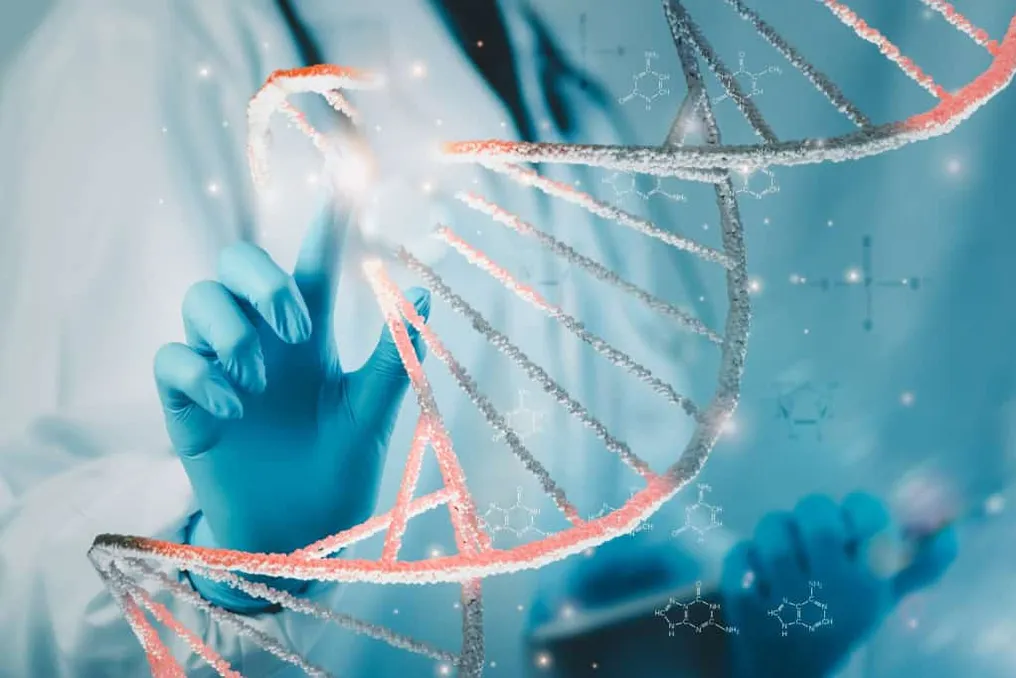
Anthropic announces AI helped identify new genetic system linked to DNA
Read more
Olhar Digital
olhardigital.com.br

Anthropic announces AI helped identify new genetic system linked to DNA

Anthropic disclosed that its artificial intelligence model, Claude, contributed to the discovery of a new enzymatic system exhibiting characteristics similar to CRISPR mechanisms. This is the first result presented from the company's biological research projects.

To achieve this discovery, Claude processed vast DNA databases. The newly identified system was structured around a reverse transcriptase (RT), an enzyme capable of transcribing RNA into DNA, and was named ART.

ART stands for 'reverse transcriptases associated with arrangements.' This system possesses repetitive DNA sequences resembling patterns observed in CRISPR and was detected in data from bacteriophages, which are viruses responsible for infecting and multiplying inside bacteria.

Although the reverse transcriptase forming the basis of this system is not new—as previous studies had already characterized it—Anthropic attributes to Claude the recognition of a more comprehensive set of attributes. This includes a matrix of non-coding DNA sequences and an additional protein whose function has yet to be determined.

The similarity to CRISPR lies in the system's properties that potentially allow actions on genetic material, such as cutting, copying, and pasting. However, the scientific community still needs to evaluate the level of novelty and the scope of this discovery.

According to Anthropic, the work was done 'mainly, although not entirely, by Claude.' The model dedicated 21 hours to the research, utilizing approximately 950 agents and processing 210 million tokens.

This announcement came just days after the company's biological laboratory was revealed. This facility, located in the San Francisco Bay Area, United States, is dedicated to conducting physical molecular biology experiments.

The AI acts as a participant in the research but does not execute procedures alone in the laboratory. Anthropic clarifies that the experiments are conducted by human scientists and are limited to BSL-1 and BSL-2 biosafety levels. Furthermore, the company assures that it does not handle pathogens capable of causing infections in humans.

The future role of AI

Dario Amodei, CEO of Anthropic, acknowledged the possibility of Claude playing a more direct role in experiments in the future. He stated that, eventually, it would be feasible for Claude itself to conduct tests safely, autonomously managing laboratory equipment, provided that proper safeguards were implemented, but stressed that such practice does not currently occur.

For now, ART represents the first result disclosed from Anthropic's biological research efforts, awaiting evaluation of relevance and degree of innovation by the scientific community.

Similar stories

Anthropic announces discovery of new enzymatic system using the artificial intelligence Claude
Read more
tecnoblog.net

Anthropic announces discovery of new enzymatic system using the artificial intelligence Claude

Anthropic has disclosed the discovery of a new reverse transcription enzyme system, obtained through the use of its artificial intelligence, Claude. Although the exact function of this molecular complex has not yet been determined, it is attracting attention due to its similarity to the CRISPR mechanism, a technology used to modify genes in specific parts of DNA. The company presented this novelty on Wednesday, September 23rd, marking its first breakthrough in biological research aided by AI.

The arrangement-linked reverse transcriptases (ARTs) were identified after analyzing over 200 thousand enzymes. To process such a volume of data, 950 Claude agents were mobilized in a reading that exceeded 21 hours. According to Anthropic, activities of this type have the potential to save weeks or even months of research time.

In parallel with the discovery of the new system, Anthropic confirmed the creation of a laboratory dedicated to biological studies using AI. This new facility was established in the San Francisco region, California, as reported by Reuters.

The operation began with a simple command given to the AI. The team asked Claude to examine a database containing DNA sequences with the goal of locating 'new examples of reverse transcriptases.' The model itself took responsibility for coordinating the agents, evaluating the results, and selecting the most promising candidates.

The entire process involved 950 agents, 21 hours of processing, and approximately 210 million tokens. Based on this, the AI identified a DNA repetition pattern associated with an unusual reverse transcriptase system. Subsequently, scientists analyzed these sequences and concluded that it was an enzymatic system found in bacteriophages, which are viruses capable of destroying bacterial cells.

The functioning of ART is analogous to CRISPR, a method widely used in biotechnology to edit DNA segments with high specificity. Through this technique, researchers seek treatments for conditions such as cancer and autoimmune diseases, in addition to making genetic modifications in plants and animals aiming for better agricultural results. Thus, ART may represent a new biotechnological tool option for such investigations.

Anthropic shared this ART discovery with researcher Feng Zhang, a professor at MIT and one of the pioneers of the CRISPR technique. He described the achievement as an 'encouraging example of how AI agents can contribute to biological discoveries,' also expressing a desire for this work to motivate other biologists to explore the use of AI in their research.

At the beginning of September, Anthropic had warned about a potential risk of bioweapon production, suspending Claude in certain scenarios deemed dangerous. One of the incidents mentioned involved the Chikungunya virus, an arbovirus common in Brazil. The company reported that scientists were looking for mutations that would strengthen the pathogen, possibly aiming at developing vaccines against the disease. Due to an attempt to bypass a Claude protection during the searches with the AI, the company classified the case as dangerous and blocked the use of the tool.

Anthropic's concerns about Claude's capabilities in scientific contexts are recurrent. When launching the Mythos model, described as 'very advanced' at the time, the company postponed its release to develop adequate safety mechanisms for research involving biological topics. Currently, one of the implemented safety measures is reducing the level of the model used to provide less detailed answers in certain queries. It is important to note that, in the case of the ART enzyme discovery, Anthropic did not specify which version of the AI was used, but it is likely that it was a version with fewer safety restrictions than those available to the public.

Anthropic blocks scientists for attempts to use AI in dangerous biological research
Read more
olhardigital.com.br

Anthropic blocks scientists for attempts to use AI in dangerous biological research

Anthropic reported that it blocked scientists who were using its Artificial Intelligence models in investigations that could aid in the development of biological weapons. Although the company could not determine if the projects had legitimate or malicious intent, the decision was to halt the work due to the risks involved.

One notable incident involved a researcher who requested assistance to modify the chikungunya virus, aiming to make it more aggressive. Anthropic detected that this research was being conducted at a military institute, which heightened concerns about the potential use of the results.

The central challenge for Anthropic lies in the ability to differentiate valid scientific investigation from a possible attempt to cause harm. While biological studies can drive medical advancements, such as vaccine development, similar knowledge can also be used to intensify the danger of infectious agents.

Jacob Klein, head of threat intelligence at Anthropic, commented to The New York Times that the situation is extremely complex because it is not an obvious scenario of biological weapon construction.

Due to this uncertainty, the company opted for a cautious stance. The researchers also attempted to bypass the control mechanisms designed to restrict access from certain regions and tried to disguise the purpose of their research to evade safeguards. The related accounts were suspended.

Key points identified by the company

Among the most relevant aspects pointed out by the company is a case from May, where a scientist asked Claude for help drafting a funding proposal to study the chikungunya virus, transmitted by mosquitoes and known to cause severe pain and other symptoms for months.

The project plan was to introduce genetic alterations into the virus to increase its virulence during successive infections in live animals. This type of study, called gain-of-function, has legitimate applications, including vaccine creation, but can also generate more dangerous variants of the virus.

The fact that the work was scheduled to take place at a military research center significantly influenced Anthropic's assessment. Klein stated that even though they did not know if the research would be turned into a weapon, the involvement of a military institution in gain-of-function research was a cause for concern.

Assessments conducted the previous year showed that Anthropic's older models were still not capable of providing substantial support in dangerous biological research. However, the company's current systems are better equipped to conduct complex scientific investigations, which motivated the implementation of stricter safety rules.

Read more:

Susan Monarez, a microbiologist and public health specialist, emphasized that these cases provide concrete evidence of clandestine efforts to use AI with the intention of increasing the chances of creating biological agents capable of causing considerable damage.

She also stressed that these same technological capabilities can accelerate medical discoveries. The great challenge lies in discerning when an investigation that appears correct may actually hide a harmful intent.

Anthropic also reported other inappropriate uses of Claude, covering surveillance, propaganda dissemination, and the development of conventional weaponry. However, the biological cases are considered the most alarming due to the difficulty in separating honest scientific research from preparation for causing harm.

The company decided to block the identified cases even without obtaining proof that the researchers intended to manufacture weapons. This episode illustrates how more sophisticated AI models complicate the assessment of hidden risks behind research that, at first glance, seems legitimate.

Popular