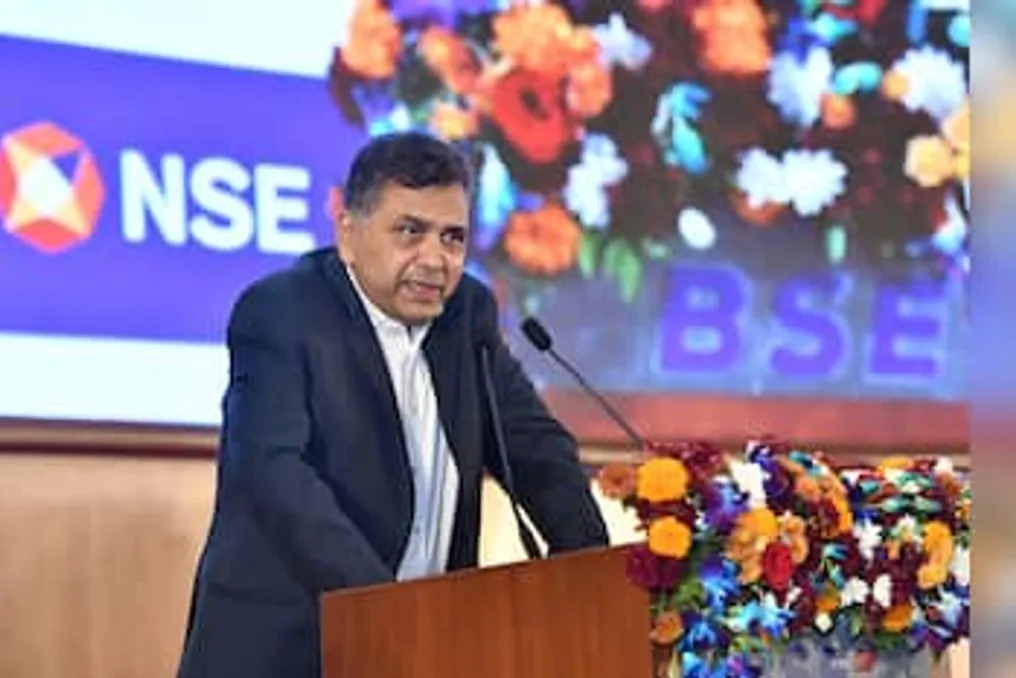
NSE Chairman states that the exchange's duties remain unchanged after listing, market role takes precedence
Read more
Business Standard
business-standard.com

NSE Chairman states that the exchange's duties remain unchanged after listing, market role takes precedence

NSE Chairman Srinivasa Indjeti emphasized that the exchange's duties as a trading platform and commercial entity have not changed following its listing; however, in case of any conflict, the market function will take priority.

He noted that NSE has made a huge contribution to transforming the Indian capital market from a small market serving a narrow group of people into a modern, vibrant nationwide market. Earlier that same day, the National Stock Exchange (NSE) debuted on the BSE when its shares were listed at ₹1800 per share, which was 0.84 percent higher than the issue price of ₹1785.

The public offering marked an important milestone for NSE, whose listing plans had been delayed for nearly a decade due to regulatory hurdles, including disputes over co-location. During the listing ceremony, Indjeti stated: 'There are often many debates about whether a public utility like an exchange should be listed. There is an inherent tension between public interest and stakeholder interests. Although there may seem some competition on the surface, we believe that if you look deeper, there is complete alignment between them.'

He clarified that NSE performs a dual function: fulfilling a regulatory obligation to maintain market integrity and protect public interests, as well as the responsibility of a business entity to promote its own interests. Srinivasa firmly stated: 'It is important that the structure focuses on its financial activities and generates returns for our shareholders. But it is quite obvious that if two lines intersect, if two duties intersect, the first one will have the predominant advantage.'

Indjeti added that it is impossible to conduct business without protecting public interests, and that there is no competition. He concluded: 'If something is not beneficial to the market, it is not beneficial to you either. Therefore, guided by the philosophy of responsible and sustainable business, I think we are only just beginning our ascent.'

NSE's Initial Public Offering (IPO) of ₹22,569 crore, which became the country's second-largest IPO, attracted nearly a sixfold subscription on the last day of trading on Monday, aided by strong demand from institutional buyers. This offering became the second-largest public issuance in India after Hyundai Motor India's IPO of ₹27,870 crore in 2024 and surpassed LIC's offering of ₹21,000 crore in 2022.

He mentioned that despite being a large offering, it was oversubscribed in all categories, and it was particularly gratifying to see the oversubscription among retail and institutional investors. Indjeti stressed that the final decision was that the market valuation does not matter; what matters is the intrinsic value of the company, and if you believe in this value, there is no good or bad time to launch.

Similar stories

NSE debuted on BSE at 1800 rupees; CEO stated that India's growth will stimulate the exchange
Read more
business-standard.com

NSE debuted on BSE at 1800 rupees; CEO stated that India's growth will stimulate the exchange

The National Stock Exchange (NSE) made its debut on the BSE on Thursday at a price of 1800 rupees per share. The price rose by 0.84 percent compared to the initial offering price of 1785 rupees, reaching a daily high of 1878 rupees before stabilizing at 1818 rupees per share.

This listing concluded a decade-long wait for the exchange. The issuance of NSE shares worth 22,561 crore rupees, which was the second largest after Hyundai India, was subscribed more than 5.7 times. Additionally, a block deal worth 1,353 crore rupees involving more than 7.45 million shares was executed in the open auction.

In addition to the BSE, the shares are now also traded on the Metropolitan Stock Exchange of India (MSE). This has made NSE the seventh most valuable stock exchange in the world, with a market capitalization of 4.5 trillion rupees.

Continuation of the Listing Process

Regarding valuation, Srinivasa Injetti, Chairman of NSE, noted that there had been discussions about whether to wait or proceed with an IPO because the markets were 'not in the best condition.' The decision was made to proceed with the offering now because the intrinsic value of the exchange itself is important.

Injetti emphasized: 'What we ultimately came to and reached a consensus on is that market value does not matter—the intrinsic value of the company matters.' The exchange received regulatory approval from the Securities and Exchange Board of India (Sebi) in January to submit draft documentation. NSE submitted the documents in June and received a letter with observations, or permission, at the beginning of this month, completing the entire process in seven months.

Responding to questions about obtaining regulatory approval for trading NSE shares on the NSE itself, Injetti stated: 'We all know that rules are evolving. Until 2012, even listing was not permitted for market infrastructure institutions. Therefore, as markets develop, as circumstances change, if the regulator deems it appropriate to align with global practice allowing an exchange to list or trade on its own platform, we will certainly voice our opinion.'

Concerning concerns about derivatives volumes, management noted that while the regulator recognizes the importance of this segment in the capital market, small investors are losing money, and intervention will be required to protect public interest.

NSE Public Share Offering: Analyzing the Growth Potential of the Largest 2026 Offering
Read more
business-standard.com

NSE Public Share Offering: Analyzing the Growth Potential of the Largest 2026 Offering

The NSE share offering was entirely structured as a sale by existing shareholders. Market indicators suggest a potential price increase of 4 percent at the time of listing.

The momentum for the NSE listing is approaching as India's largest exchange prepares to list on the competing BSE on Thursday, September 24, following a significant response to its share sale. However, investors aiming for quick profits from the IPO should temper their expectations. The offering, valued at 22,562 crore rupees, is the largest this year and the second largest after Hyundai's offering of 27,870 crore rupees.

The Grey Market Premium (GMP) for NSE shares stands at 68 rupees per share, which is lower than the pre-offering level of 310 rupees, according to unofficial market tracking websites. At the current GMP, NSE shares could be listed at 1,853 rupees, representing only a 3.8 percent premium over the IPO price of 1,785 rupees.

Shivani Nyati, Head of Wealth at Swastika, noted that NSE might show modest growth upon listing, but 'the IPO remains suitable for long-term investments,' citing NSE's strong market positions, scale, and relative valuation advantage. The brokerage firm assigned the IPO a 'subscribe' rating.

She also pointed out that at prices of 1,700–1,785 rupees, the IPO is valued at approximately 40.9–42.9 times earnings per diluted share for fiscal year 26, which is a discount compared to BSE's multiple of 54.28, supporting the valuation. Nevertheless, about 79 percent of revenue is derived from trading activities, making profits sensitive to market volumes and regulatory changes.

NSE IPO Details

The primary demand for the NSE IPO was driven by Qualified Institutional Buyers (QIBs), with the total subscription reaching 5.71 times by the end of the last trading day on Monday. According to BSE data, the IPO attracted applications for 505.8 million shares against 88.6 million shares offered for sale.

The QIB portion was booked 12.68 times, and the Non-Institutional Investor (NII) segment also showed strong interest, subscribing 6.55 times its reserved quota of 18.9 million shares. Retail individual investors applied for 61.3 million shares against a reserved quota of 44.1 million shares, equivalent to a 1.39 times subscription.

It is important to note that the NSE IPO was exclusively a sale offering by existing shareholders. The price band was set at 1,700–1,785 rupees per share, and the lot size for retail investors was eight shares.

Ventura analysts stated in their IPO review that NSE is well-positioned to capture long-term growth opportunities in India's financial markets due to its leadership position, strong brand, technological capabilities, and expanding capital market ecosystem.

Meanwhile, Choice emphasized that there is no other way to own Indian market infrastructure on such a scale. The company noted: 'The offering is valued at 47.3 times trailing twelve months earnings. BSE, the only comparable listed peer, trades higher—at 48.9 times—with a business that is less than a third the size of NSE, and with earnings supported by very large option volumes that NSE has lost. What this price provides is market infrastructure without a real substitute.'

Popular