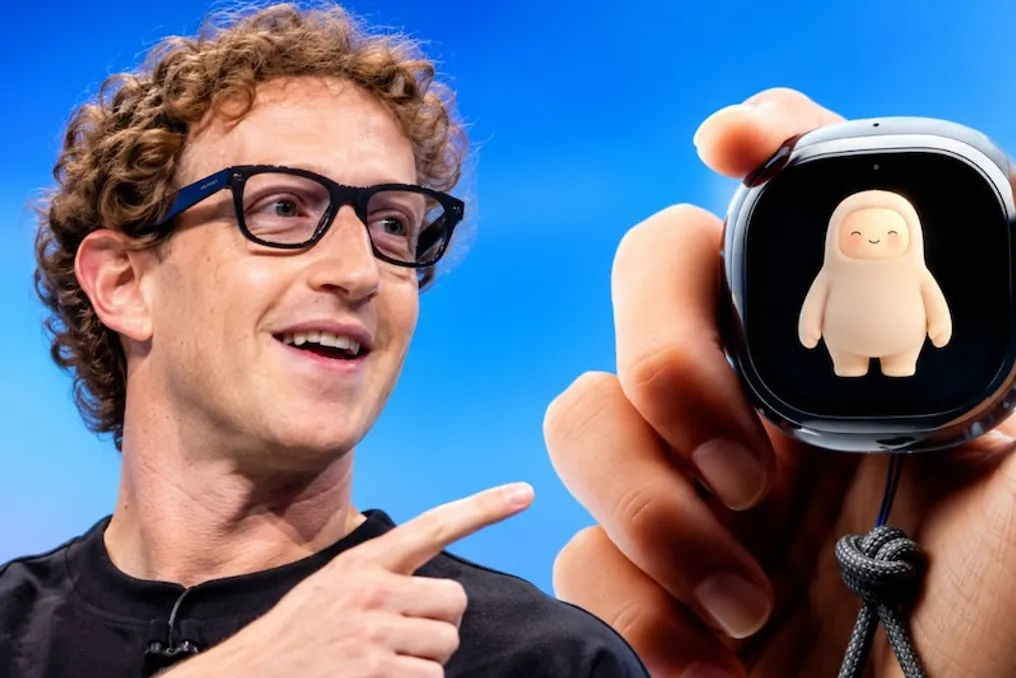
Meta is actively promoting the concept of reducing dependence on smartphones when interacting with artificial intelligence. The company has introduced Muse Charm—a small device that can be carried in a pocket or attached to keys, allowing users to communicate directly with AI without needing to take out their phone or open applications.
Meta CEO Mark Zuckerberg announced the development of this device. Following the announcement, his net worth increased by $4 billion. Muse Charm was unveiled at the Meta Connect 2026 event. This is not just a standard Bluetooth gadget; it integrates Meta's Muse AI agent.
The company first introduced Muse in early September. This AI goes beyond simply answering questions; it is capable of performing digital tasks on behalf of the user, such as sending emails, booking travel, and working with websites.
What the device can do
Muse Charm can be seen as a miniature AI control panel. According to Meta statements, it features Muse and its voice interaction system in a compact body. It can be worn in a pocket or attached to keys. The device is equipped with a small screen that displays Muse's digital avatar.
Mark Zuckerberg demonstrated that communication with Muse can be initiated by pressing a sensor located on the corner of the device, eliminating the need to unlock a phone or launch an application. This marks Meta's transition from using the phone as the primary access channel to AI to integrating AI into all aspects of the user's life.
Muse Charm Functionality
Muse Charm itself is only part of an ecosystem; its foundation is Muse AI, which Meta launched on September 8th. Meta claims that Muse functions differently from ordinary chatbots: the user can assign it a task rather than just asking a question, and the AI will attempt to execute it.
Examples of tasks include sending emails, assisting with trip planning, and filling out website forms. When performing complex operations, Muse can break down a large task into smaller steps. Furthermore, in the case of long processes, it can continue working even after the application is closed, requesting user permission when necessary.
To ensure security, Meta has created a separate Secure Virtual Machine (Secure VM) for Muse. User data and the AI itself are stored in this isolated virtual environment. Before executing sensitive actions, such as purchases or sending emails, the system requests user consent.
Meta's goal is not only to create conversational AI but also AI that acts within the user's digital world. The company's response to the question of needing a separate device if Muse is already available on the phone lies in convenience: the company aims to eliminate the need to constantly pull out a smartphone to access AI.
This approach is similar to the concept of smart glasses. Meta is already integrating AI into its glasses, and it was announced at the Connect event that Muse would also be integrated with these AI glasses. Muse Charm represents an alternative option: a quick way to access AI if glasses are not being used.
Muse Charm is not yet available for purchase
It is important to note that Muse Charm is not currently on sale. A prototype version was presented at the Connect event, and Meta stated that more detailed information will be released later this year. Zuckerberg hinted at a possible release during the holiday season in December, but the price and full technical specifications have not been disclosed.
Therefore, it is currently impossible to provide a complete picture regarding battery, connectivity, full functionality, and cost. It is more accurate to consider Muse Charm not a finished product, but a demonstration of Meta's future hardware strategy for AI.
What are Meta's big plans?
The overall picture becomes clearer when considering all announcements from Meta Connect 2026. The company does not intend to limit Meta AI only to phones or computers. It is expanding AI's presence onto glasses, audio devices, and now onto portable devices that can be carried in a pocket.
Meta has also expanded its line of AI glasses, stating plans to offer over 100 styles of AI glasses by the end of the year. The key change is that AI is no longer exclusively software visible on a screen; it is gradually becoming a constant assistant accessible through surrounding devices.
Muse Charm is the smallest and perhaps most interesting example of this shift. If Meta can bring it to market with an acceptable price and quality of experience, the way we interact with AI will no longer be limited to opening apps on a phone. However, the main question remains open for now: how ready are people to carry an extra device with them?