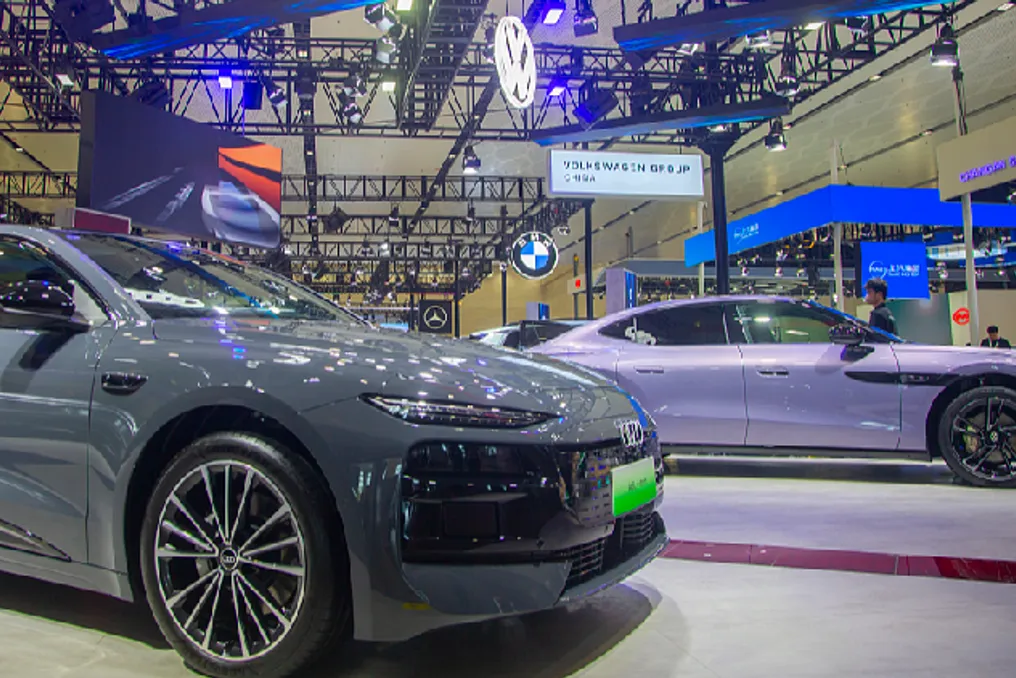
Chinese New Energy Vehicle Market Becomes Key Factor in Global Growth
Read more
CGTN
cgtn.com

Chinese New Energy Vehicle Market Becomes Key Factor in Global Growth

The global new energy vehicle (NEV) market is demonstrating rapid growth, with official representatives from China's Ministry of Industry and Information Technology stating that NEVs now account for over 25% of global car sales. This information was presented at the World New Energy Vehicle Congress in 2026 on Tuesday.

China's automotive market has entered a phase where NEVs have become a significant driver of growth in the country's automotive sector. Experts note that China has transformed into the main engine for global large-scale NEV development. In the first eight months of 2026 alone, NEV production and sales in China exceeded 10 million units.

Nevertheless, the development of the NEV market is uneven across different regions. The transition to electric mobility in Europe is steady: China Media Group (CMG) reported that in August 2026, registrations of battery electric vehicles in 16 major European markets exceeded 200,000 units, accounting for over 30% of the market. However, in developing regions such as Southeast Asia and the Middle East, NEV penetration remains below 10%, similar to major automotive markets including the US and Japan.

Zhang Xiuming, Secretary-General of the World Organization for New Energy Vehicle Development, pointed out that limited competition, relatively high prices, insufficient charging infrastructure, and policy fluctuations can influence the development of NEV markets and consumer confidence.

As the Chinese NEV industry expands rapidly, cooperation with international markets is deepening. Cooperation between China and Germany in the NEV sector is developing in a direction described by industry experts as 'bilateral strengthening,' moving beyond traditional market and production partnerships to joint research and technology development, as well as industrial chain coordination.

A recent survey by the German Chamber of Commerce in China showed that over the past two years, the share of German automakers conducting R&D in China to serve both Chinese and global markets has increased from 12% to 33%. Furthermore, 81% of German companies operating in China stated that localized R&D accelerated their development process.

Chinese NEV companies are also expanding into foreign markets, including Southeast Asia, bringing their manufacturing capabilities and industrial chains to local markets. CMG reported that seven Chinese automakers invested in factories in Thailand with a total investment exceeding $3 billion, according to information presented at the event.

Chinese companies are also engaging with local suppliers. Changan Automobile's plant in Thailand has established connections with over 40 Thai auto parts suppliers and attracted 10 key suppliers to open operations in Thailand.

According to the International Energy Agency's forecast in its Global EV Outlook 2026 report, global electric vehicle sales will reach 23 million units in 2026, accounting for nearly 30% of global new car sales. By 2035, the share of electric vehicles could approach 50% of global vehicle sales.

Experts believe that over the next decade, China will continue to leverage its strengths in the NEV industry, strengthen international cooperation, and offer more NEV product options to global markets.

Similar stories

China's purchasing power stimulates the development of world trade
Read more
cgtn.com

China's purchasing power stimulates the development of world trade

The growing assortment of foreign goods, including Spanish ham, Malaysian durians, Nepalese woolen products, and African handicrafts, is reaching Chinese consumers.

In the import market of Yiwu International Trade City, Zhejiang province, in eastern China, there are about 150,000 items from over 100 countries and regions, demonstrating the expansion of China's import landscape. As China opens its market and utilizes the potential of domestic demand, it acts as the world's 'super-buyer,' giving a new impetus to global trade and economic growth.

Historically, Yiwu, known as the world's largest wholesale market for small commodities, specialized in selling products manufactured in China globally. However, recently the city has become a gateway for goods from all over the world entering the Chinese market. Thanks to sustained growth in imports to Yiwu, the customer base has expanded to cover major Chinese markets such as Beijing, Shanghai, and Hangzhou. Now, goods, such as pigeons from Malaysia, clear customs in Yiwu in just three days, reach warehouses, and arrive at consumers in China.

In the first half of 2026, Yiwu's total external trade volume reached 486.42 billion yuan ($72.5 billion), an increase of 19.9% compared to the previous year, with imports rising by 39.1% to 65.7 billion yuan ($9.8 billion).

Hainan's policy promotes increased imports

Further south, the island province of Hainan, China, is also seeing an increase in imports due to the implementation of new policies and improved logistics infrastructure. After launching provincial-wide independent customs operations in December 2025, the share of goods falling under the province's 'zero tariff' policy was increased to 74%, and the number of non-duty categories expanded to over 6,600.

These policy advantages have contributed to the growth of both consumer spending and imports. In the first seven months of 2026, duty-free offshore sales in Hainan reached 21.6 billion yuan ($3.2 billion), an increase of 17.9% compared to the same period last year, thereby stimulating warehouse storage and turnover of imported goods. Meanwhile, by the end of July, the volume of imports under the zero tariff rate reached 3.624 billion yuan ($540.4 million), an increase of 40.14% compared to last year, with 598 million yuan ($89.2 million) being tax-exempt.

With the addition of three new international trade routes, the Yangpu port in the Yangpu Economic Zone, Hainan, now has a total of 38 ports to handle growing volumes of fresh produce from Southeast Asia, strengthening its role as a key distribution hub for imported goods.

Behind this growth is a faster and optimized customs clearance system. Haikou Customs has carried out a series of institutional reforms to improve customs efficiency, including simplified procedures for goods covered by zero tariff and warehousing conditions. The number of items required in customs declarations has been reduced from 105 to 33, and the average customs clearance time for imports has decreased by 20%. For companies importing raw materials from countries such as Indonesia and South Africa, simplified procedures allow goods to be released almost immediately after declaration, significantly reducing logistics costs. As barriers weaken and supply chains accelerate, Hainan is becoming another important gateway connecting foreign producers with China's vast consumer market.

China's automotive industry attracts global suppliers

Beyond consumer goods, China's role as a 'super-buyer' is also evident in high-tech manufacturing. Chinese automakers have become key clients for global auto parts suppliers, which deepens ties between domestic manufacturers and international industrial chains.

On August 23, Christophe Perilla, CEO of French automotive supplier Valeo, led a senior management team to China to seek new business opportunities in the market. Over the past five years, Valeo has invested a cumulative 26 billion yuan ($3.88 billion) in China, adapting to the country's rapidly changing market, technological innovations, and price advantages. More than 80% of the group's new orders in the first half of this year came from Chinese automakers.

In an interview with CMG, Perilla compared the Chinese automotive market to a 'gym' for the global automotive industry, noting that it 'combines the highest level of innovation, the strongest competitiveness, and the fastest pace.' He added that 'to stay ahead in such a market, companies have to stay fit. For Valeo, this means becoming more localized and a company that better understands China.'

Popular