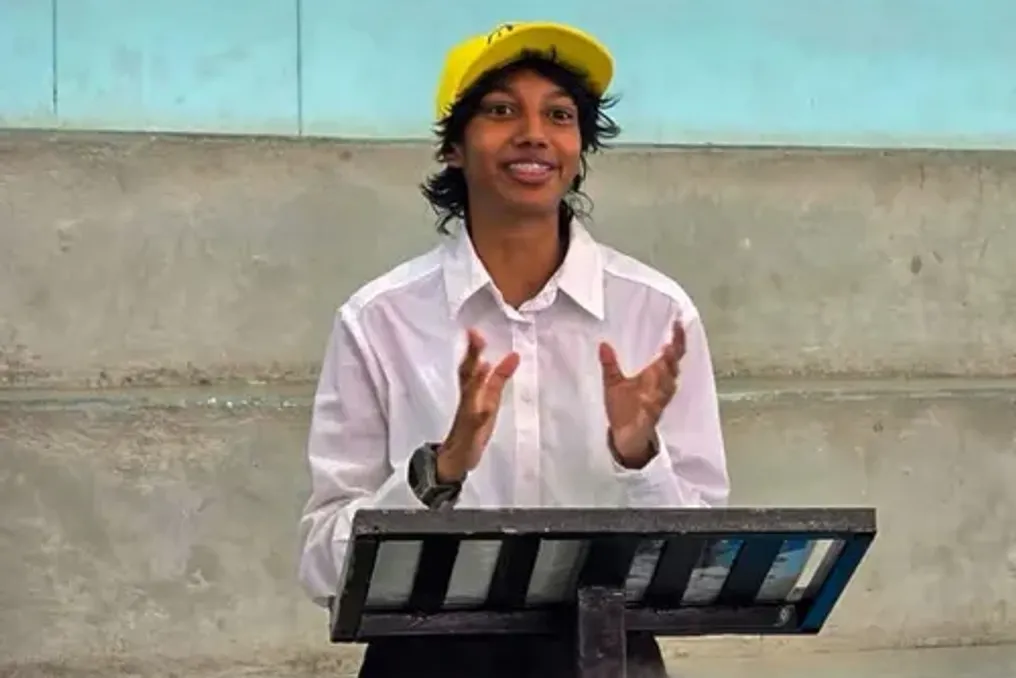
Youth in South Africa celebrates Indian and South African heritage as an integral part of their identity
Read more
IOL
iol.co.za

Youth in South Africa celebrates Indian and South African heritage as an integral part of their identity

Heritage Day is a time when South Africans gather to celebrate the rich diversity of South Africa's cultures, languages, and traditions. During shared meals and in traditional attire, young people spoke to POST about how they navigate a dual identity—South African and Indian—and how this affects their self-awareness and cultural appreciation.

Abigail Pillay, a 20-year-old Christian from Queensburg, is a great-great-granddaughter of Padavatan Six, who helped rescue people during the Umngeni River flood in Durban in 1917. She believes that knowing her family participated in helping others in a difficult time makes the heritage very real. For her, heritage is the story of ancestors and the values they left behind, which gives her an understanding of her origins and a connection to generations of people who lived and built life in South Africa.

Abigail's great-grandfather, Gangan Padavatan, embodies values such as courage, resilience, compassion, and helping others. She emphasizes that heritage is not just a memory of ancestry but also a remembrance of what kind of people they were.

Abigail does not separate her Indian heritage from her South African identity. She sees them as 'two sides of one story': her Indian background represents the roots, and South Africa is the country where those roots grew. Her great-grandfather, being part of the Indian community in Durban, became part of the broader history of South Africa through his actions during the 1917 floods, which she takes pride in.

Dinisha Danaee, a 30-year-old travel consultant from Durban, states that heritage serves as a 'living compass that anchors my identity and guides my path forward.' She defines heritage as a vibrant tapestry of culture, values, family stories, and traditions passed down through generations, encompassing both material things (recipes, photographs) and intangible aspects (music, language).

Danaee notes that heritage provides a sense of rootedness in a rapidly changing world, offering context to her personality and reminding her of belonging to something larger. She believes that maintaining heritage is a conscious responsibility that requires actively passing down stories and values to the next generation.

Junaid Rahim, a 23-year-old sports science and management specialist from Phoenix, shares that through sports, he has made friends of different races, many of whom have been interested in his Indian culture. He notes that for him, heritage means his identity as an Indian Muslim in South Africa, including cultural beliefs, values, faith, and traditions. He practices his heritage through prayer and striving to follow the core values of Islam.

Darshan Reddy, a 30-year-old entrepreneur from Durban, upholds his heritage through family, traditions, food, and religious practices. He believes that the beauty of South Africa is that individual cultures can be embraced while remaining part of one diverse nation. He stresses the responsibility of each generation to preserve positive traditions and values.

Timika Keandra Reddy, a 27-year-old lawyer from Queensburg, says that her Indian roots and South African identity do not contradict each other. Her Indian heritage speaks to her origins, while her South African identity speaks to where she belongs. She mentions that South African Indians endured forced labor, discrimination, and apartheid, but also fought against injustice.

Kelita Shaidin Singh, a 19-year-old model and content creator from Phoenix, believes that heritage is a reminder of her roots, the people, and the values that shaped her personality. She says that heritage must not only be preserved but also carried forward by creating one's own story.


Similar stories

South Africa's Heritage as a Bridge Between the Continent and the World
Read more
iol.co.za

South Africa's Heritage as a Bridge Between the Continent and the World

Heritage is often perceived as what we inherit from our predecessors, found in monuments, museums, archives, languages, traditions, and places of memory. However, heritage extends beyond a mere reference to the past; it is also connected to understanding one's own identity, interacting with others, and shaping a desired future.

For South Africa, heritage plays a particularly significant role, as its history is closely linked to the history of the African continent and the global struggle for dignity, human rights, and freedom. The experience of liberation, transition to democracy, and constitutional settlement has generated lessons that extend beyond national borders.

The Constitution itself reflects this forward-looking goal. Its Preamble speaks to the necessity of healing past disagreements and building a unified, democratic South Africa capable of occupying its rightful place among the nations of the world. It is here that heritage can transform from a simple remembrance into a form of cultural diplomacy.

Although diplomacy is usually associated with governments, ambassadors, and formal negotiations, nations also communicate through their culture, history, people, and institutions. The realm of heritage can create a different diplomatic context where people meet not only as representatives of governments but also as individuals striving to understand one another. South Africa possesses a compelling history that can be shared.

Furthermore, it should be remembered that heritage should not be presented as a collection of isolated national stories, as African histories have always intersected. Movements, languages, ideas, cultures, and struggles crossed borders long before the emergence of modern nation-states. Therefore, South Africa has the opportunity to use its heritage to strengthen connections on the continent. Institutions such as Freedom Park serve as platforms for studying, documenting, and embodying these connections. Their mandate includes presenting African history from an African perspective and collaborating with African and international organizations in this field.

Such work can take many forms: joint research, exhibitions, conferences, educational programs, cultural exchange, memorial events, academic partnerships, and heritage tourism. These activities may seem diverse, but they share a common goal—creating opportunities for people and institutions to meet through history and culture. There is also an important opportunity to enhance the production of African knowledge.

For a long time, African history was interpreted through external frameworks. While international scholarship is important, African institutions must also have the capacity to research, preserve, and interpret their own historical systems of knowledge. Recognizing this, UNESCO highlights the importance of Africa's living heritage for strengthening cultural identity and shared values, and UNESCO's current work on African World Heritage involves capacity building and collaboration among heritage specialists. Thus, heritage institutions can become centers of knowledge, rather than just repositories of objects and memories.

This is especially relevant for youth. A young South African should have the opportunity to visit a heritage institution and learn not only about the origins of their country but also about how its history connects to the rest of Africa and the world. Similarly, a young person from another African country should have the opportunity to see aspects of their own history reflected in South Africa's heritage spaces. In this way, heritage can contribute to developing a stronger sense of African identity without diminishing the diversity of individual nations and communities.

There is also an economic aspect. Heritage-based tourism can create opportunities for local communities, cultural practitioners, researchers, entrepreneurs, and youth. International partnerships can expand these opportunities by linking heritage institutions with tourism networks, universities, museums, and cultural organizations worldwide. Recent initiatives supported by UNESCO in South Africa demonstrate the potential of partnerships that unite culture, heritage tourism, sustainable development, and community benefit.

However, perhaps the greatest diplomatic value of heritage lies in its ability to create spaces for complex conversations. South Africa's reconciliation experience does not offer a simple formula that can be exported to other countries, as every society has its own history and circumstances. Nevertheless, our experience demonstrates the importance of confronting complex historical events, rather than erasing them. The constitutional project was explicitly aimed at healing divisions, establishing democratic values, and creating a society based on human rights and social justice. These discussions remain relevant far beyond South Africa.

Shared histories between countries serve as a powerful reminder of humanity's interconnectedness. For example, our own Truth and Reconciliation Commission (TRC) drew inspiration from Chile's National Commission for Truth and Reconciliation, established by President Patricio Aylwin to investigate serious human rights violations resulting in death and disappearance during the military dictatorship from 1973 to 1990. Parallels also exist between our Freedom Park and Chile's Museum of Memory and Human Rights.

Our heritage is not just a record of where we have been. It is a resource for understanding where we are and a bridge to where we can move together. For South Africa, this bridge must extend beyond its borders, into Africa and the wider international community. If we invest in heritage as a platform for research, education, cultural exchange, tourism, and dialogue, we can ensure that our places of memory do more than just preserve yesterday. The vision of Freedom Park becoming a leading national and international icon of humanity and freedom directly points to this possibility. Consequently, we have a responsibility not only to remember the past but to make that memory useful, using it to deepen understanding, strengthen relationships, and promote a more connected Africa and a more understanding world.

Dr. Hilton Fischer is the Executive Director of the Freedom Park heritage site, located in Pretoria. He previously served as an ambassador to Chile and Indonesia, respectively.

Checklist for Celebrating South African Heritage Day
Read more
iol.co.za

Checklist for Celebrating South African Heritage Day

Heritage is reflected in the stories we tell, the traditions we preserve, and the memories we create together. For some South Africans, the feeling of home is associated with familiar music, the smell of barbecue, a family recipe, a Sunday dinner at the table, or the sound of wild birds in the distance.

Angelique Yse van Rensburg, one of the finalists of the Mrs South Africa 2026 competition, believes that heritage is the feeling of being surrounded by loved ones. This is reflected in the way we communicate, the jokes, the support, and daily life, as well as the feeling of coming home. Angelique Yse van Rensburg highly values family traditions that unite generations.

Gather Around the Table

A family meal can become a tradition without a formal announcement. Several Mrs South Africa finalists shared their views on the importance of shared meals. Megan Kaister recalls family dinners as a time for conversation and sharing stories, while Angelique aims to continue the tradition of family breakfasts and dinners. On this Heritage Day, it is worth setting aside time for a meal that is often postponed. Put away phones and spend more time at the table.

Megan Kaister is convinced that shared experiences create memories worthy of passing on.

Light the Barbecue Fire

A South African celebration would be incomplete without a barbecue. The finalists repeatedly mentioned barbecue, including boerewors, steak, ribs, braaibroodjies, and potato salad. Behind these dishes are the people who make the celebration unforgettable: the family barbecue master, the grandmother with the legendary recipe, or the person insisting on the best marinade. The essence here is not the perfect menu, but bringing people together.

We should not forget the four-legged members of the family. Angelique notes that in her family, dogs are treated like children, and Karika Beb describes pets as a source of unconditional love. For Aleche Landman, growing up surrounded by animals also meant learning responsibility and care for nature. Therefore, it is worth adding treats for beloved pets and lots of affection to the checklist.

Create a Memory Worth Passing On

The finalists spoke about the values they hope to see in the next generation: kindness, dignity, hard work, humor, resilience, and responsibility. These qualities are formed in everyday moments—through how we treat people and care for the places we call home. Heritage is also what we choose to continue doing. It could be a Sunday tradition or a story told again and again.

Aleche Landman highly values the lifelong connection with nature and animals. Mrs South Africa 2026 promoter and advocate for Soft Landings, Dotsure, believes that the most valuable thing in us is reflected in how we care for everything we hold dear. Although Heritage Day may fall on September 24th, there is no reason for the entire checklist to fit into one day. Brew tea, light the fire, call family, let the dog onto the couch. Then create memories worth inheriting.

Popular