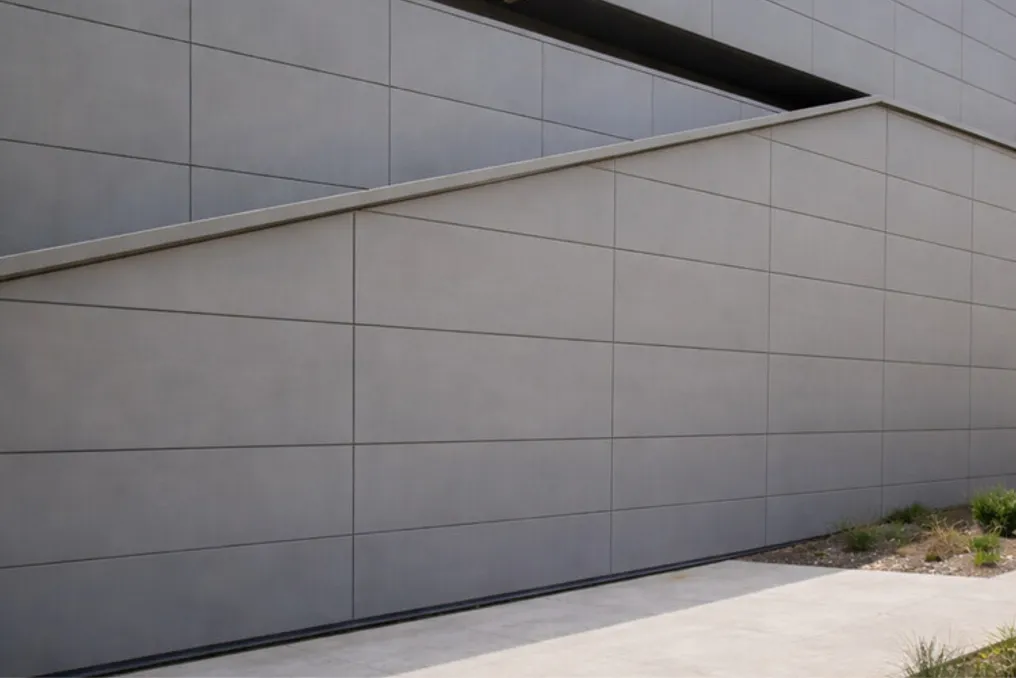
Continuous surfaces with minimal joints have become a prominent feature of modern architecture, appreciated for lending clean lines and uniformity to building envelopes. However, in facade engineering, the consideration goes beyond mere aesthetics. Regardless of the material used, increasing panel size affects durability, recyclability, performance against external elements, as well as impact resistance and long-term maintenance.
Monomaterial facade systems utilize large-dimension panels, balancing ease of assembly and transport efficiency with design flexibility, while also solving practical issues related to flatness, thermal movement, and structural support. Nevertheless, questions arise about which other material factors in large format panels are crucial in the construction of current building envelopes.
By harmonizing aesthetics, performance, and installation efficiency, contemporary architectural facades create envelopes that respond to environmental conditions through distinct operational strategies and performance characteristics, depending on their scale and function. The demand for a clean, large-format aesthetic allows for results that surpass mere sophisticated appearance, as certain design decisions, based on material composition and installation needs, can reduce the building's environmental impact in ways not immediately perceptible to users.
The MA-X system, developed by Dri-Design, is a modular, drained, and ventilated facade system designed for large format panels and available in anodized or painted finishes. These single-layer aluminum panels can reach dimensions of 4' x 12' in vertical or horizontal orientations and can support different depths, allowing for a wide range of geometric and architectural expressions.
The Challenge of Single-Sheet and Large Format Panels
A single sheet of aluminum extended over a large area is inherently susceptible to the phenomenon known as oil canning, which is a visible waviness when a thin, flat material lacks sufficient rigidity to resist small stresses caused by handling, thermal variation, or wind pressure. This risk intensifies with increasing panel size. The traditional solution in the construction industry for this problem has been Aluminum Composite Material (ACM), which consists of a sandwich panel where two thin aluminum sheets are bonded to a plastic core. This core provides the rigidity missing in the single sheet, allowing for larger and flatter panels. However, this alternative brings disadvantages in terms of durability and end-of-life performance, since the plastic core introduces the risk of delamination over time and complicates, if not prevents, complete panel recycling.
The Dri-Design MA-X system addresses this issue differently: instead of using a composite core, the panels incorporate structural reinforcements directly into the aluminum sheet itself, with thicknesses ranging from 0.063'' to 0.080''. This ensures the necessary mechanical rigidity to combat oil canning in large formats without the need to add a second material, keeping the panel entirely aluminum, from surface to core.
When Design Directs More Than Performance
The panels are designed to withstand high wind loads of up to 130 PSF, meet projectile impact requirements of the HVHZ (High Velocity Hurricane Zone), and offer longevity. To facilitate construction, they are designed for sequential installation. This approach reduces complexity on site and the number of installation phases, promoting faster and more predictable project delivery. The modular installation methodology optimizes efficiency and coordination on the construction site, helping teams execute projects with greater agility, respecting defined deadlines and budgets.
Each panel consists of a single metal sheet with an integrated interlocking gutter and drainage system, as well as a single fixing point intended for dry joint ventilated facade installation. Installation follows a progressive interlocking method, where the bottom of each panel is coupled to the top of the preceding panel, progressing from bottom to top and left to right. This method adapts to the various orientations, dimensions, and positioning requirements of the system. The system also requires secure anchoring, designed to absorb structural and thermal movements. Installation includes components ranging from watertight sealants to custom finishing profiles, where fasteners, whether visible or concealed, must ensure that all joints and connections remain waterproof and weather-resistant.
How Material Recyclability Influences the Building's Life Cycle
Choosing material finishes and installation systems that minimize continuous maintenance and permanent rework throughout a project's life cycle can ensure consistent performance not only in design and construction but also regarding environmental impact. Since the MA-X system obtains its rigidity through integrated reinforcements rather than a composite core, it completely eliminates the plastic layer present in Aluminum Composite Material (ACM), offering the potential for a high recycled content index and total recyclability, thus supporting sustainability goals and reducing life cycle impacts.
Made entirely of aluminum, the panels also eliminate the risk of long-term delamination and material failure, proving that high durability can be achieved without neglecting the environmental impact of material choices. Dri-Design integrates with Kingspan, whose Planet Passionate initiative focuses on three major global themes: climate change, circularity, and nature protection. Additionally, the 2025 Planet Passionate report details advancements toward 2030 goals, including a 70% reduction in Scope 1 and 2 emissions compared to 2020, 63% use of renewable energy, and 1.05 million metric tons of recycled and renewable raw materials.
Concealed fastening systems, combined with large format panels and enhanced structural capabilities, manage to simplify facade design while promoting the durable performance of building envelopes. The MA-X system implements this philosophy through a reduced number of components, efficient installation, and durable finishing, demonstrating how monomaterial facades can balance unique architectural expression with lasting performance.