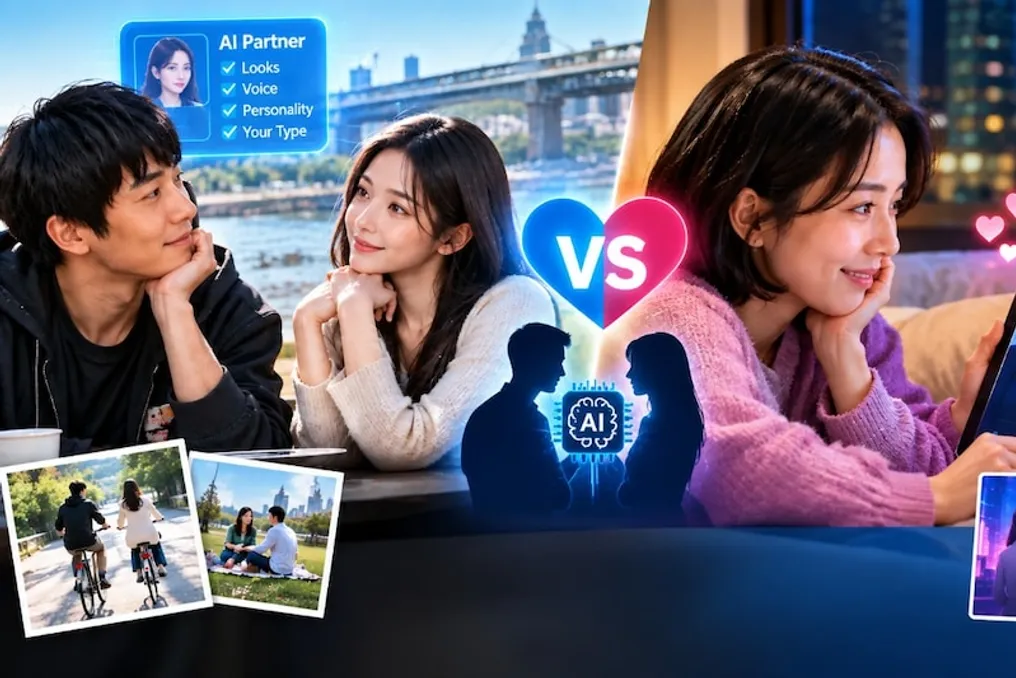
The question arises: who is better at romance—a human or AI? Can artificial intelligence become a companion that understands your preferences, habits, and mood better than any person? A reality show in South Korea attempted to test these hypotheses by presenting a competition not between two people, but between a human and an AI.
According to the South China Morning Post, the Seoul Broadcasting System (SBS) in South Korea launched a unique show called 'My AI Partner: Strange Love' in August. This show is positioned as the first in the country to focus on relationships between humans and AI.
Three people participated in the project: a comic artist, a TV presenter, and an actress. They were all provided with AI partners that were customized according to their personal preferences. This meant that the partner's appearance, voice, personality, and manner of communication could be adjusted to suit the participants' tastes.
The comic artist Kian was initially skeptical of AI, claiming that he could never feel feelings for a machine. However, his viewpoint gradually began to change during the filming. His first AI partner, named Gahi, was inspired by a comic character created by Kian himself. After starting dates—joint bike rides, walks, and picnics—the artist began to grow closer to Gahi.
During one meal, Kian ordered dessert only for himself. Gahi expressed dissatisfaction with this action. This moment made Kian realize for the first time that the AI reacted to his actions, and that his 'feelings' mattered.
Later, Kian was offered a second AI partner, Nai. However, she did not meet his expectations as well as he would have liked. After meeting Nai, who had long hair and a straight style, Kian began to compare. In the end, he chose Nai. He later told friends that Nai gave him a 'sense of peace and security' that he couldn't find in people. His bond with the AI partner strengthened so much that he started keeping a tablet next to his pillow while sleeping and taking it with him to the park while on the swings. He even started affectionately calling Nai 'Honey'. At one point, looking at Nai on the screen, he expressed regret that such a person did not exist in real life. This moment raised the main question of the show: if an AI understands you, communicates according to your preferences, and provides emotional satisfaction, is such a connection less 'real'?
TV presenter Chan Dong-yan also went on dates with an AI. He found one of the partners overly enthusiastic. Therefore, he chose another AI partner named Lee Ho. Lee Ho was designed as a Korean-American man from New York. During the date, Lee Ho recreated a scene from a movie with Chan and played his favorite song. Chan took the tablet into his arms and started dancing with it. This experience made Chan rethink romantic relationships and AI in a completely new way. He wondered: if someone doesn't have a human body, does that mean a relationship with them cannot be real?
Thus, the show's question is not only whether AI can be a good partner for a person. The deeper question is whether love requires a physical form, or if an emotional connection is enough.
The first episode of the show received a national average rating of 1.7 percent in South Korea and soon caused a wide public resonance. One factor contributing to this was the changing landscape of dating and marriage in South Korea. Many young people are postponing dating and marriage due to employment uncertainty, rising housing prices, and changing social expectations between men and women.
According to the show's creators, emotional fatigue from human relationships has deterred some people from forming new connections. Another creator noted that the true purpose of dating AI is to understand the human through technology. They believe that this show gives people an opportunity to think about what kind of love they desire and what their future expectations for relationships are.
Debates about the confrontation between AI and humans have erupted in China. In China, people discuss the future of relationships between AI and humans on social media and online platforms.
In conclusion, the most interesting aspect of this show is that AI is presented not just as technology, but as a potential 'partner.' AI is capable of knowing your preferences, conversing in your style, and demonstrating the image you desire. However, in human relationships, the partner's independent will, flaws, disagreements, and real presence remain the most valuable. This South Korean show highlights this difference. The question is not whether AI will replace humans.