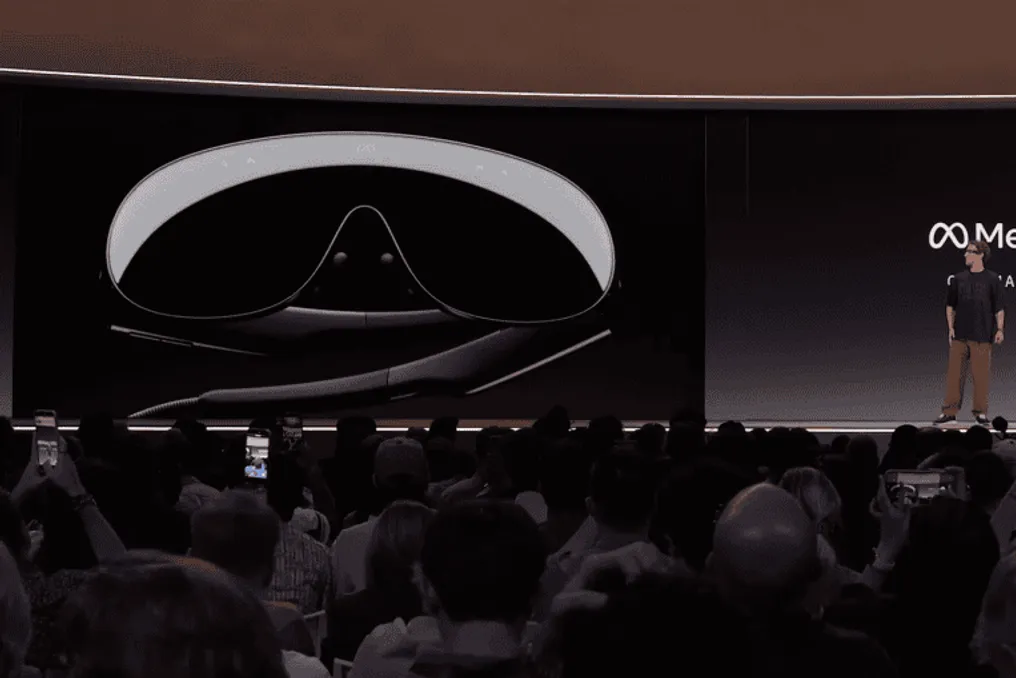
Meta unveiled its new smart glasses on Wednesday, September 23rd, introducing the third generation of Ray-Ban Meta, a camera-less model, and the Meta VR Glasses, which succeeds the Meta Quest and aims to compete with the Apple Vision Pro. These innovations were revealed during the Meta Connect event, led by the company's CEO, Mark Zuckerberg.
During the event broadcast, Zuckerberg also announced that the glasses will feature private processing, which promises to enhance security in functions such as automatic translation. Furthermore, the inclusion of the Muse artificial intelligence agent in the smart glasses was confirmed.
There was also an official announcement regarding the arrival of Meta Glasses in the Brazilian market. The third generation of Ray-Ban Meta is already available for purchase on the company's official website, with prices starting at R$ 3,699. The Meta VR Glasses are forecast to launch between March and June 2027, with a cost of US$ 1,299.99, which is equivalent to approximately R$ 6,710 in direct conversion.
The new Ray-Ban Meta Audio model presents a significantly simpler design compared to previous smart glasses versions. This accessory does not have a camera and offers greater autonomy, reaching up to 60 hours (12 continuous hours plus 48 hours in the charging case). Additionally, it is lighter than other products from the brand, weighing only 43 grams. Meta also mentioned the reduction in temple thickness and availability in two styles: Clubmaster and Burbank. Users have the option to install corrective lenses.
The new third-generation Ray-Ban Meta versions have not brought major changes to the hardware aspect. One notable improvement is the addition of a customizable action button, facilitating access to Meta AI. Meta also guaranteed longer battery life.
Regarding design, the line received the new Aviator and Zena models, expanding the possibilities for combining colors, frames, and lenses. These glasses are already available for purchase in Brazil, both at the official Ray-Ban store and national retailers, with prices starting from R$ 3,699.
One of the central points of Meta Connect was the Meta VR Glasses, the company's new virtual reality glasses. This device is considerably lighter than the Meta Quest 3, weighing only 100 grams, about five times less. Although the company has not confirmed whether this model will replace the existing line, its initial proposal is quite similar, offering access to 360-degree content and the functionality to act as a virtual computer, among other capabilities.
The general impression is that the new product comes to meet all the expectations that the competitor Apple Vision Pro had at the time of its launch. During the event, Zuckerberg demonstrated various uses, such as gaming or simultaneous viewing of matches on virtual screens. It was also possible to observe a virtual keyboard operated directly by hand, dispensing with the typical controls of the Meta Quest 3.
The Meta VR Glasses are expected to reach stores between March and June 2027, but there is no confirmation yet of their distribution in Brazil. The suggested price is US$ 1,299, corresponding to about R$ 6,710 in direct conversion, excluding taxes.
The event also served to present software updates. Private processing is one of these advancements, functioning similarly to end-to-end encryption used by WhatsApp. The distinction lies in the fact that the device will execute artificial intelligence on private servers, just as occurs in Muse's Secure VM, ensuring that even the company itself cannot access the processed content in this manner.
Another relevant feature revealed at Connect is auditory assistance, which allows recording real-time interactions to amplify conversation volume. It is important to note that Meta holds FDA certification, the U.S. agency equivalent to Brazil's Anvisa, which allows this technology to be offered as a solution for individuals with mild to moderate hearing loss. This novelty costs US$ 150, which is equivalent to approximately R$ 775.