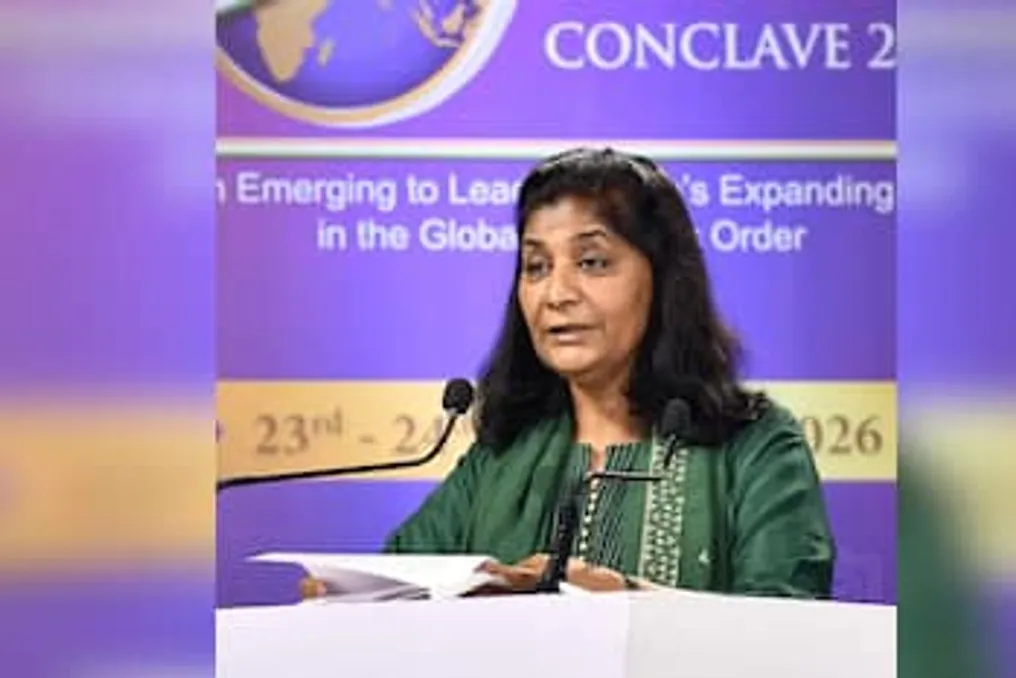
Deputy Governor of the Reserve Bank of India (RBI), Poonam Gupta, stated on Wednesday that there is a valid argument for the strengthening of the Indian currency, not just its stabilization, as the current account deficit narrows and capital inflows improve, which could happen later in the current fiscal year.
Gupta noted that the 13 percent fall of the rupee over the last eighteen months can be viewed as a temporary phenomenon. She forecasts a further reduction in the Current Account Deficit (CAD), which will be supported by oil price stabilization after the resolution of the Middle East conflict. Furthermore, the capital account is expected to become more favorable closer to the end of the current fiscal year.
Speaking at the SBI Banking and Economics Conclave 2026, Gupta emphasized that the current market dynamics do not appear particularly justified, given the RBI's commitment to maintaining order in the foreign exchange market and the availability of resources to cover multi-year CAD or Balance of Payments (BOP) deficits.
On Wednesday, the rupee reversed its five-day upward trend, closing at 95.75 per dollar, which was 0.16% lower than the previous close. In September, it fell by 0.6%. Gupta added that rather than the reverse, there are grounds to believe that the rupee may not just stabilize but even rise from its current level, as market analysts suggested when initial capital movement measures were announced.
Previously, the rupee faced pressure following the war in the Middle East, losing more than 4% against the dollar in March. However, thanks to several steps in subsequent months, its decline was limited to less than 1% between April and the present, despite rising oil prices. Gupta explained that recent shocks in oil and gold prices temporarily increased the CAD.
Highlighting that India traditionally has a small current account deficit and a larger capital account surplus, leading to a net positive balance of payments, she pointed out that over the last two years, the capital account surplus has been less than the CAD, resulting in a negative BOP of about $5.0 billion in 2024-25 and $23.6 billion in 2025-26.
Prospects for economic growth and trade
Commenting on the direction of the BOP and exchange rate, especially for an economy poised to grow by 7-8% in real terms and 11-12% in nominal terms, Gupta offered the following assessment: firstly, the CAD must continue to narrow in the coming years, maintaining traditional strengths and emerging new ones, including growing success in commodity exports.
This is because India's dependence on imported oil should decrease through alternative energy sources and the search for domestic oil reserves, which will further strengthen the trend of reducing the share of oil in GDP. Additionally, she noted that oil prices will stabilize once the Middle East conflict is resolved. Moreover, the rest of the trade basket is responding well to new trade opportunities being utilized, and this strength will continue due to the positive impact of implementing recent free trade agreements and a favorable exchange rate.
Factors contributing to the improvement of the capital account
Secondly, Gupta stated that the capital account should also become more favorable starting from the end of the current fiscal year and remain so. She cited several factors, such as weakening ratings in other regions, the saturation of the 'AI mania,' strong domestic macroeconomic fundamentals, high real and nominal GDP growth, which helps improve revenue forecasts. The cycle of domestic investment is also gaining momentum amid healthy bank and corporate balance sheets.
Gupta considers India's inclusion in global bond index funds inevitable, which will attract capital inflow. She stressed that AI history is an 'untapped force' for India, and the country can leverage the potential of digital innovation and AI while avoiding risks. Furthermore, Gupta sees no reason why India cannot continue to grow at 7% or higher, pointing to the breadth of the economy. Unlike countries dependent on one or two sectors, several sectors are performing well simultaneously in India, serving both domestic and external demand. This diversification is evident among states, where some specialize in high-tech manufacturing, while others are still developing, with each state investing in skills, infrastructure, and ease of doing business.
She added that growth would reach 8% if external conditions were more favorable. A simple regression of India's growth relative to global growth shows a positive correlation, but currently, India is not receiving an 'additional boost' from the world economy. This impetus will come if conditions improve, noting that artificial intelligence remains an untapped driver of growth, and India has not yet reached saturation in either regions or sectors.