São Sabas School Project by Guido Otero Arquitetura in Chácara Flora
Read more
ArchDaily Brasil
archdaily.com.br

São Sabas School Project by Guido Otero Arquitetura in Chácara Flora

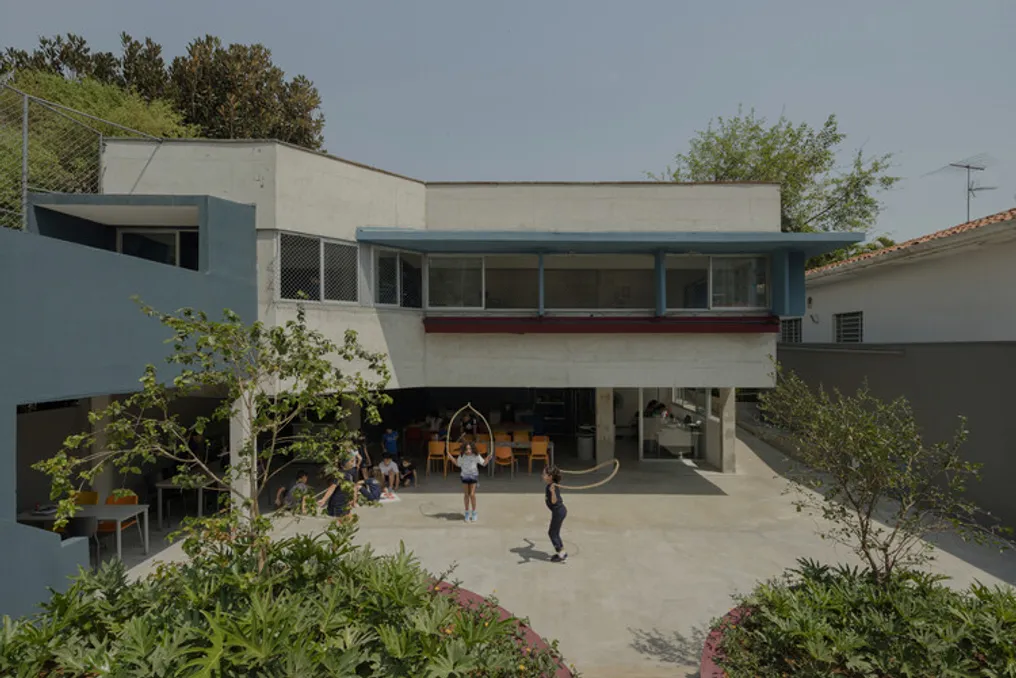
The design team presented the conversion of a residence located in the Chácara Flora neighborhood to host a new unit of Colégio São Sabas. This project aims to adapt an existing house on a standard urban plot to accommodate the Middle School (Ensino Fundamental II) of Colégio São Sabas.

The architectural concept foresees the distribution of four classrooms within the original volume of the residence. Additionally, two more rooms were implemented on the lower part of the lot, a space created by raising the yard to an intermediate level.

The project also includes the creation of a cafeteria and a multi-purpose area with outdoor access. In addition to these main areas, support zones such as the secretariat and the coordination room were developed.

Similar stories

Former student speaks about the existence of an unwritten caste system at IIT in the 80s
Read more
www.aajtak.in

Former student speaks about the existence of an unwritten caste system at IIT in the 80s

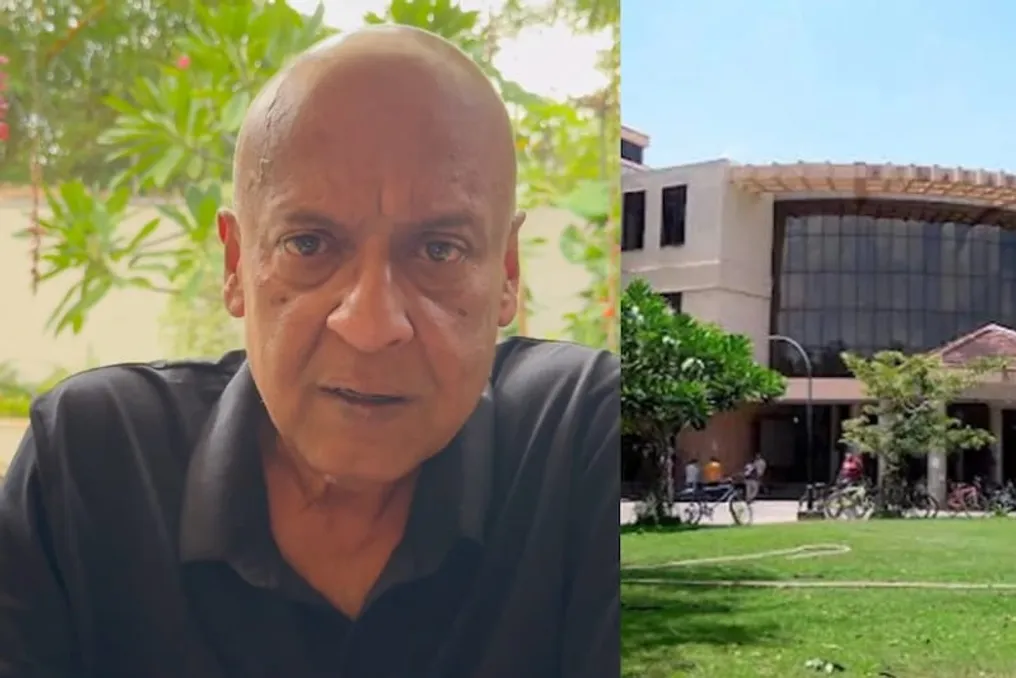
A former IIT Madras student, Ramesh Srivastava, shared his experience and described the reality of campus life in the 80s, revealing the existence of an implicit caste system.

His statement, recently made on the social platform X, attracted attention, especially against the backdrop of recent unrest at IIT Bombay following the suicide of student Sahil Wakode, whose relatives filed a police complaint alleging caste harassment against Professor Suryanarayan Dulla. In this context, Srivastava explained how an 'invisible caste system' (hierarchy) functions within the institutes, which, although not social, can cause severe stress to students.

Srivastava noted that when he enrolled at IIT Madras in the 80s, social or family background was not discussed; however, there were unspoken levels of competition and discrimination. Immediately upon arrival, the 'caste' was determined by JEE exam results: students with single-digit and high ranks were considered representatives of the 'upper caste,' while others were 'lower.'

Six months after admission, the influence of 'department pride' began. The ranking of departments was as follows: Computer Science (CSE) was at the top, followed by Electronics, Electrical, Mechanical, and the rest of the specialties were at the bottom.

Srivastava recalled an instance where he failed physics in his first year and sought consultation from a professor during the summer course with a friend. The professor asked him about his department, to which Srivastava replied that he was studying Computer Science. The professor expressed surprise, asking what he was doing there. Then the professor asked the friend, who replied that he was studying metallurgy. The professor immediately joked: 'Well! Then you have a good reason to be here!'

By the second and third years, the hierarchy became more complex and intertwined with the GPA system. According to Srivastava, this was assessed not just by the number of points obtained but in two categories. The 'Genius' group consisted of those who achieved high GPAs without putting in much effort or studying at all, and they were considered the 'supercaste.' Another group, the 'Cash Cow,' comprised those who achieved high GPAs through diligent cramming and studying. Meanwhile, there were those who received low grades despite hard work, and at the very bottom were those who engaged in neither studying nor scoring. Srivastava humorously placed himself in this last group.

By the fourth year, neither the ranking nor the GPA mattered. The real 'caste' was determined by where the student planned to go: to a university in America, to receive an invitation to IIM, or to join a major tech company. Srivastava remembers how one of his classmates, who enrolled in an American university, threw a party, and they joked that he had acquired an 'American accent' as soon as he left the limits of Madras.

He concludes his story with a profound observation: the worst aspect of this 'invisible caste system' of his time was that people ignored this hierarchy. However, a positive aspect was that it changed annually and was not predetermined by family or birth. Nevertheless, the current grim reality is that this unspoken race, based on 'rank, GPA, and department' from the 80s, has reached a fatal threshold of social recognition and mental distress, where young people are ready to commit suicide. The question arises: when will this suffocating competitive culture in IIT end?

UAE Schools Urge Students to Use AI as an Assistant, Not for Completing Homework
Read more
www.khaleejtimes.com

UAE Schools Urge Students to Use AI as an Assistant, Not for Completing Homework

In many schools across the United Arab Emirates (UAE), artificial intelligence is becoming a popular tool for assisting with homework. It helps students grasp complex concepts, catch up on missed material, or solve problems when adults are not nearby.

However, as tools like ChatGPT become more accessible, educational institutions are drawing a clear line between using AI to support learning and allowing it to complete work for students. School principals emphasize that children can use this technology to find information, generate ideas, clarify concepts, and check their own work, but they must take responsibility for the final submission.

Seventh-grader Yahya Mohammed shared how AI proved useful after returning to school and missing two weeks due to a trip home. Since it was difficult for him to catch up through classmates and friends, he turned to ChatGPT to explain the missed topics in simpler language.

He recounted his experience: 'I missed two weeks of classes right before the summer holidays because I went home. I tried to catch up by talking with classmates and friends, but I still couldn't fully understand some topics.' Then, Yahya input these topics into ChatGPT and asked the tool to explain them more simply, adding: 'It really helped me understand and catch up on what I missed.'

Nevertheless, parents express concerns about the convenience of instant explanations, as this raises questions about how much of the learning process children might skip. Amal Khalil noted that her son uses AI when facing difficulties with homework, especially when no adult is around.

She explained: 'My son uses AI to help him solve problems while doing homework. If he doesn't understand something, he turns to ChatGPT for clarification or to resolve doubts, especially when there is no adult nearby.' While acknowledging that AI is 'incredibly useful,' Khalil warned against the risk of children becoming overly dependent on technology.

'AI provides instant answers and gratification, but in the process, children might miss out on the effort associated with research, trying different approaches, and finding solutions independently,' she stated. 'I believe that struggle and hard work have their value because they are part of the learning process.'

Schools are increasingly distinguishing between using AI as an aid versus using it to create work that the student then presents as their own. David Williams, principal of Regent International School, believes that a complete ban on AI is not the solution, given the growing role of this technology in students' lives.

He stated: 'We recognize that AI will become part of our students' lives, both now and in the future. Therefore, we do not think the answer is simply to ban it.' Instead, students are taught how to use the technology 'correctly and responsibly,' establishing clear boundaries for its role.

Williams clarified that AI can assist in generating ideas, supporting research, explaining complex concepts, or checking work, but it should not replace the student's own thought process. He stressed: 'For us, there is a very clear distinction between using AI to support your learning and asking AI to do your homework and then presenting that work as your own. Students must openly state when and how they used AI, especially where it contributed to graded work.'

He also noted that teachers assess more than just the finished assignment. 'Our teachers know their students very well, so we don't look at the completed work in isolation,' Williams said. 'We look at what students can explain, discuss, and demonstrate in class, as well as the process they went through to create their work.'

At Woodlem Park School in Ajman, the approach is similarly focused on keeping AI in a supportive role. Shayne Davison, principal of Woodlem Park School in Ajman, says that students are encouraged to conduct independent research, use reliable sources, and develop their own ideas. However, using AI to create or complete homework and presenting it as one's own 'is not considered proper use of AI.'

'Our clear AI usage policy is communicated to students, parents, and staff, ensuring a general understanding of responsible and ethical practice. Teachers continuously assess student comprehension through questioning, discussions, classroom assignments, and authentic tasks.'

Davison emphasized the school's core principle: 'AI can support learning, but it must never replace thinking.'

Williams also highlighted that students must understand the limitations of AI, rather than accepting every response as truth. 'We also want our students to understand that AI is not always right,' he concluded. 'The ability to question information, verify sources, and draw one's own conclusions is incredibly important. Use AI to support your thinking, not to do your thinking.'
Popular