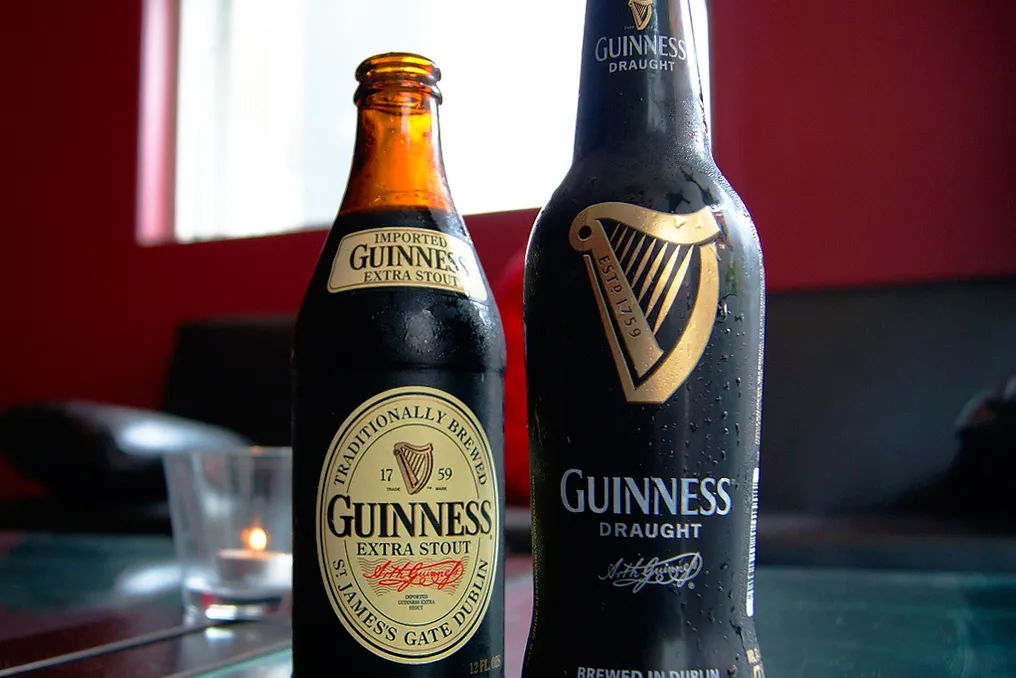
Guinness, one of the world's oldest breweries, was founded in 1759 in Dublin, Ireland. Its most famous drink, Extra Stout, derives from the Superior Porter beer, for which Arthur Guinness II established detailed specifications in 1821. The longevity and quality of modern Guinness are the result of the continuous preservation and improvement of this recipe over two hundred years.
This find is particularly significant because much of Guinness's early history remains obscure; for example, the record of using yeasts, a vital component of modern beer, only appears in 1809. Many of the brand's recipes were preserved thanks to the first Arthur Guinness, or possibly one of his descendants, who noted the recipes in a notebook dated 1801.
Eibhlin Colgan, the brand's archivist, comments that the notebook contains recipes for various types of beer, emphasizing that at that time, Guinness had not yet been invented, despite today being known for its creamy foam and smooth texture. These modern characteristics only emerged after the introduction of nitrogenation in 1959.
However, possessing only the recipes is not enough to recreate a Guinness from centuries past, as equivalent ingredients would be necessary. This is complex, especially with yeasts, which are living organisms subject to mutations and genetic changes over generations. Historically, brewers often reused yeasts from one fermentation to another, causing lineages maintained over long periods to gradually change, even if the species, Saccharomyces cerevisiae, remained the same.
Recent events have motivated scientists to try and replicate a Guinness exactly as it was in 1864. In 2025, divers investigated the wreckage of a 19th-century ship off the coast of Dover, England, and located a sealed bottle of Guinness Extra Stout. The ship, named Mindoro, a British vessel, sank on November 27, 1864, giving the bottle approximately 162 years of age.
Although the first bottle was at the bottom of the ocean, the divers discovered others inside overturned wooden crates. The marine pressure created, according to the explorers, a 'perfect natural hydraulic seal,' preventing saltwater infiltration. Tests are underway to confirm the absence of contamination.
If it is confirmed that the beer is intact (tests are ongoing), the divers plan two actions. The first is to taste this nearly bicentennial Guinness. The second is to extract the DNA from the present yeasts to identify a similar contemporary culture, enabling the production of a beer identical or very close to the original from the wreck.
The project has been nicknamed 'Jurassic Beer' and was described by Pawel Truszynski, one of the divers, on Instagram: 'We are contacting microbiology laboratories and the official Guinness Archive in Dublin to extract samples in a sterile manner and try to resurrect living yeast strains from the 19th century. The goal? To decipher the DNA and reproduce this beer, recreating exactly the flavor it had 162 years ago!'
To achieve this feat, the divers are relying on the assistance of microbiologist Kevin Verstrepen from KU Leuven, a university in Belgium. The scientist expressed initial skepticism but stated that it is possible to recover the DNA of the historical 1864 yeast. More formally, he told The Washington Post that with DNA sequencing, it will be possible to map the yeast's position in the family tree and thus search for modern relatives.
For its part, the Guinness brewery informed that it is evaluating the experiment and has not made an official statement about the proposal. In the specific context of Guinness, there is an additional reason to seek the 1864 yeast: the modern lineage of Guinness yeast can be traced back to a preserved sample from 1903, whose origins are unknown. The Mindoro bottle would allow tracing back an additional 39 years.
The project is still in its early stages, but Pawel documents everything on his Instagram, including further research on the Mindoro and its shipwreck. There is a possibility that, if all goes well, Guinness may decide to relaunch its 1864 version.