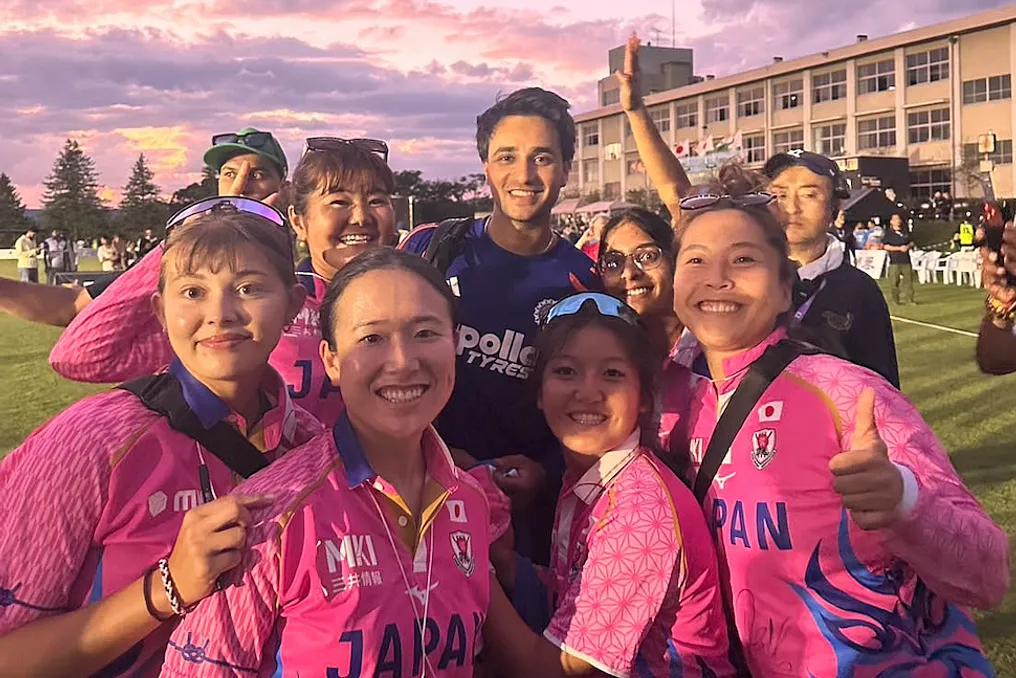
Vineet Iyer, a former club-level player from Mumbai who played against Rohit Sharma and Cheteshwar Pujara in his youth, now captains the national women's cricket team of Japan. He is proud of the small victories achieved in the recent women's cricket tournament at the Asian Games in Nagoya.
Although his team did not win a medal despite their energetic performance, they created unforgettable moments. 41-year-old Iyer recalled these moments in Nagoya when the Japan Cricket Association asked him to move to Sano to help organize the first official match between the men's teams of both countries.
This event was significant because the country, known for its love of baseball, hosted an Indian cricket superpower for the first time in a men's international T20 match. The match was organized to commemorate the 75th anniversary of diplomatic relations between Japan and India.
The Sano International Cricket Stadium, located in the city of Sano, 60 kilometers from Tokyo, does not have ultra-modern amenities. However, the stadium has a natural grass pitch, which is rare in Japanese cricket, where the sport is in its early stages of development. The stadium capacity was barely two thousand people, but the arrival of Shreyas Iyer's team was met with thunderous cheers from the spectators, most of whom were residents of India.
However, one problem arose: there was a group of Japanese VIPs among the spectators, belonging to sponsors, who were attending a cricket match for the first time. Since none of them knew what a 'no-ball' or 'wide-ball' was, let alone the roles of a batter or bowler, the responsibility fell on the shoulders of Vineet Iyer's Japanese women's national team, who acted as guides. They explained the rules, as well as the meanings of fours, sixes, and wickets, while the spectators watched the international match live for the first time.
Twelve members of the Japanese team voluntarily wore national colors to help VIP guests follow the game between the men's teams of India and Japan on Tuesday. Vineet Iyer told Khaleej Times by phone from Tokyo: 'The women's team was originally supposed to stay in Nagoya longer, but we were transferred because of the India-Japan match. The girls helped as volunteers, and I helped the CEO of Japan Cricket manage everything on the field.'
He added: 'Our players acted as volunteers in the sense that there were many VIPs and VVIPs from various companies and Japanese organizations attending the match. Many of them were unfamiliar with the rules of cricket, so our female players were there to help them understand the game while they watched.'
While Iyer's players were helping the VIPs, his task was to attend to the needs of the Indian team on the field. However, a more difficult task was avoiding contact with Indian fans in the temporary stands. Iyer noted: 'Many of them are from Tokyo and know me well. If they saw me, they would ask me to help them take photos with Indian stars.'
He was struck by the obsession with Jasprit Bumrah, the Indian fast bowling superstar. 'Everyone was chanting his name. They really wanted to see him. He wasn't playing in the game, but every time he came out of the dugout, people went crazy. He made a few ball movements, as if he was about to bowl, and the crowd just erupted. They were so happy,' Iyer recounted. 'After the match, he said he wanted to approach the fans. It was a big moment. Everyone went wild. He approached to take pictures with them and meet the fans.'
For someone who has been involved in Japanese cricket for several years, Iyer was also surprised by the level of curiosity among the local media regarding the Indian team. 'The Japanese media was very excited to see what the fuss around Indian cricket was all about. They had heard about it and seen it, but experiencing it was something completely new for them,' he shared.
He mentioned that the interest from the local media already existed when the Indian team arrived in Tokyo with the trophy; Japanese media and cameras were present during the captain's photo with the trophy, as well as at the post-match press conference.
In the match, which was shortened due to rain, Japan fought heroically before losing to India by two runs. Iyer believes this historic match served as a great stimulus for cricket in Japan. 'There were also quite a few Japanese fans on the field. It was incredible for them to see the team play so well,' he stated. 'It was a moment that will go down in history, and you know, at one point the Japanese players went crazy, they wanted to take photos with Indian stars, and then they took their wickets, almost winning the match on the last ball. We were lucky to be present at this game.'
Iyer also noted that the Japanese women's team was impressed when playing against India in the Asian Games. 'Our players were very nervous because they knew they were playing against India. But at the same time, they were incredibly excited,' he said. 'They could see all the superstars they admired standing next to them. It was a huge moment for the girls.'
'So running almost 20 (19.5) overs and scoring 57 was fantastic for them. It was one of the small victories. We took a couple of wickets, one of our bowlers even bowled a maiden, and the girls were very happy about these small things.'
Smriti Mandhana became the main star for the Japanese players. 'They really wanted to see Smriti Mandhana, but unfortunately, she did not come onto the field. After the match, they took many photos with the Indian players. Everyone was delighted with Smriti and Harmanpreet Kaur.'
Iyer expressed hope that the first experience of playing against an elite team would inspire Japan to invest more in the sport. 'I think this is a moment when people in Japan truly realized how big cricket is. Before, they didn't know that. I hope this is the beginning of something big in Japan, and we will see more boys and girls playing cricket, and more cricket fields and grounds.'
Perhaps Iyer also hopes that his women's team will never have to act as volunteers to help the Japanese understand the rules of cricket in the middle of a men's international match.