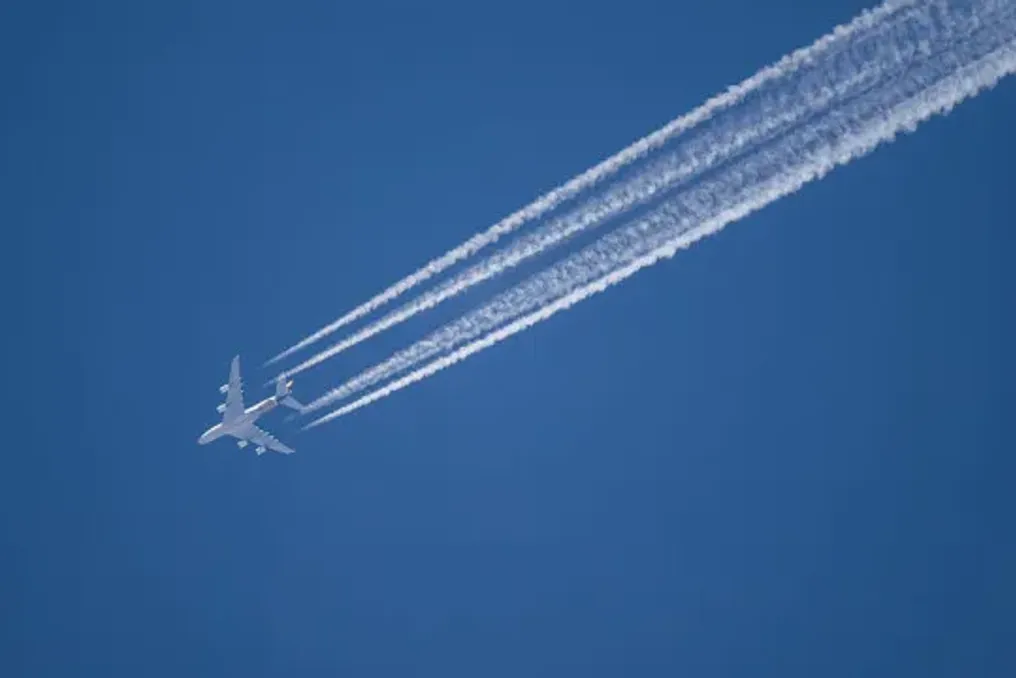
According to a study prepared by Klima Consulting for the environmental organization Transport & Environment (T&E) and signed by former Intergovernmental Panel on Climate Change (IPCC) scientist Olivier Boucher, adopting this measure would reduce the projected temperature increase by 0.025 degrees by 2050.
The report, published on Tuesday, calculated that if heat emissions caused by these trails are halved starting in 2030, aviation's contribution to global temperature rise will reach 0.08 degrees in 2050, instead of reaching this level a decade earlier, in 2040.
According to the study's estimates, the cumulative reduction will be about 0.049 degrees by 2070. Furthermore, it is suggested that preventing the formation of these trails could free up 3 to 5 percentage points of the world's temperature budget between 2025 and 2050 to limit temperature growth to 2 degrees.
These trails form when water vapor released by engines condenses and freezes under specific humidity and temperature conditions at high altitudes, which can lead to the formation of clouds that trap heat in the atmosphere. It is important to note that their climate impact is concentrated on a small number of routes.
Studies cited by T&E showed that in 2019, only 3% of flights were responsible for 80% of the warming associated with these trails, with the highest concentration observed at night and in winter.
Therefore, the report's authors believe that minor adjustments to the routes or schedules of certain flights to avoid atmospheric zones conducive to their formation could be one of the most cost-effective ways to reduce aviation's climate impact in the short term.
At the current level of air traffic, reducing heat caused by contrail emissions is equivalent to preventing 67 to 225 million tons of CO2 equivalent annually—which accounts for 7% to 23% of projected global carbon dioxide emissions from aviation in 2025.