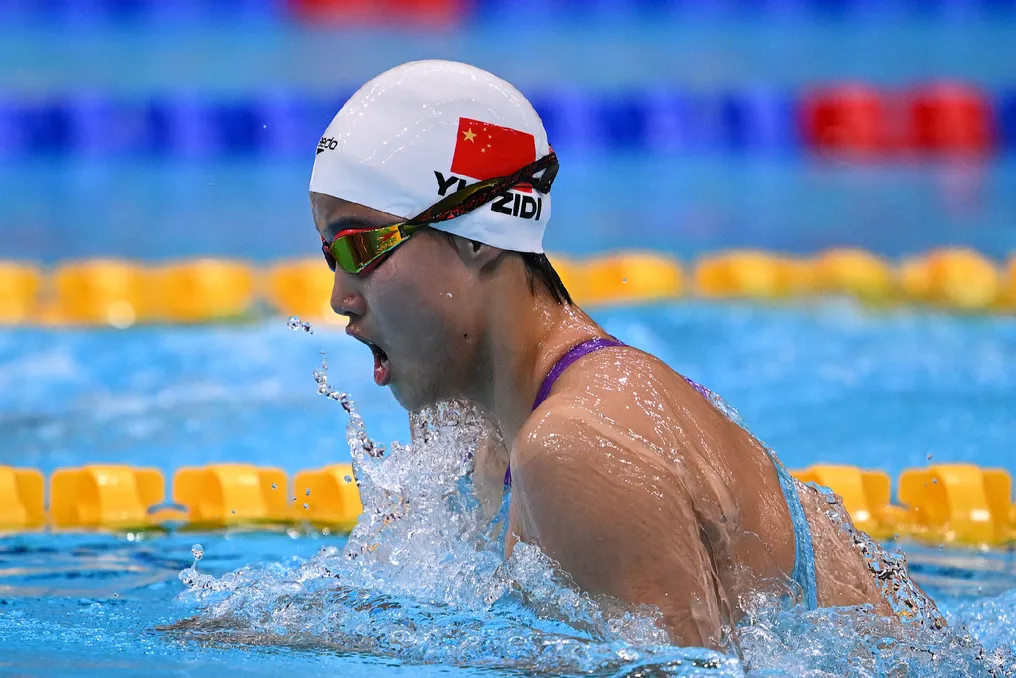
At the 2026 Asian Games in Aitih-Nagoa, China secured 12 gold medals on Monday. This day was marked by several sporting achievements, including setting multiple records and successfully defending the title in the men's all-around gymnastics event by Zang Boheng, marking the second consecutive day of strong performances by the delegation.
Swimmers contributed to China's haul of five gold medals, setting two Asian records and one Asian Games record from Tokyo.
The most prominent individual performance was the victory of Yu Jidi in women's swimming in the 200-meter individual medley. The thirteen-year-old athlete won with a time of 2:06.10, improving the previous Asian record held by her compatriot Yu Yiting, who finished second with a time of 2:07.99. Mio Narita from Japan won the bronze medal.
Yu Jidi's winning time was only 0.40 seconds faster than the world record of 2:05.70 set by Summer McIntosh from Canada. This victory was the second gold for the teenager at the Asian Games following her previous triumph in the women's 200-meter butterfly.
China also broke another Asian record in the evening's final race—the men's 4x200-meter freestyle relay. Although Japan led early in the competition, Pan Zhanle closed the gap in the third leg. Then Zhang Zhanshuo delivered a powerful final sprint of 1:42.92, overtaking his Japanese rival in the last 50 meters and securing the win for the Chinese quartet after trailing.
Xu Haibo, Fei Liwei, Pan, and Zhang finished with a time of 7:00.17, thereby lowering the Asian record and beating Japan by 0.88 seconds. Athletes from the Republic of Korea took the bronze medal with a time of 7:06.76.
Swimming veteran Xu Jiayou was also recognized in the record books as he successfully defended his title in the men's 50-meter backstroke. The 31-year-old athlete covered the distance in 24.04 seconds, breaking the Asian Games record, while his compatriot Wang Zhining took second place with a time of 24.49.
Xu's time was slower than his own Asian record of 23.92 set earlier this year, so his achievement is counted as a Games record rather than a continental standard.
China also won gold in the women's 50-meter backstroke thanks to Wang Letian, and Dun Zhixiao shared the title in the men's 100-meter breaststroke with Japan's Shinon Ohashi, as both finished with a time of 58.64 seconds. Chinese swimmers concluded the evening with five gold medals across seven finals.
In Nagoa, Zang Boheng managed to retain his title in the men's all-around gymnastics, defeating two Olympic champions from the host country—Japan. The reigning champion scored 85.065 points across six apparatuses, surpassing Shinnosuke Oku from Paris, the Olympic gold medalist, who finished second with 84.698 points. Tokyo Olympian Daiki Hashimoto placed third with 83.865 points.
Zang climbed in the rankings after starting the pommel horse and took a strong position with 14.700 points on the parallel bars. Knowing he needed to secure the final ring, the 26-year-old athlete reduced the difficulty of his routine and scored 14.033 points to ensure gold. This victory brought China its third consecutive Asian Games championship title in the men's all-around and a total of 12 golds.
Thanks to these 12 victories on Monday, China's overall tally reached 23 gold, 10 silver, and five bronze medals after two full days of competition.