Angel One began its operations in 1996. At that time, brokerage trading was a high-adrenaline process conducted in 'pits,' where brokers communicated with loud shouts and used complex gestures to execute stock deals. Angel One pioneered the use of radios, which allowed investors to track trades executed on their behalf.
Today, in 2026, noisy trading floors have given way to silent algorithms that execute operations in milliseconds. Retail investors can now receive real-time analytics via smartphone. Despite significant technological changes that have marginalized outdated companies, Angel One has managed to maintain its relevance.
Currently, Angel One boasts a user base of 39.5 million, despite strong competition from new players such as Zerodha and Groww. The company is actively exploring the possibilities of artificial intelligence for further enhancing the user experience.
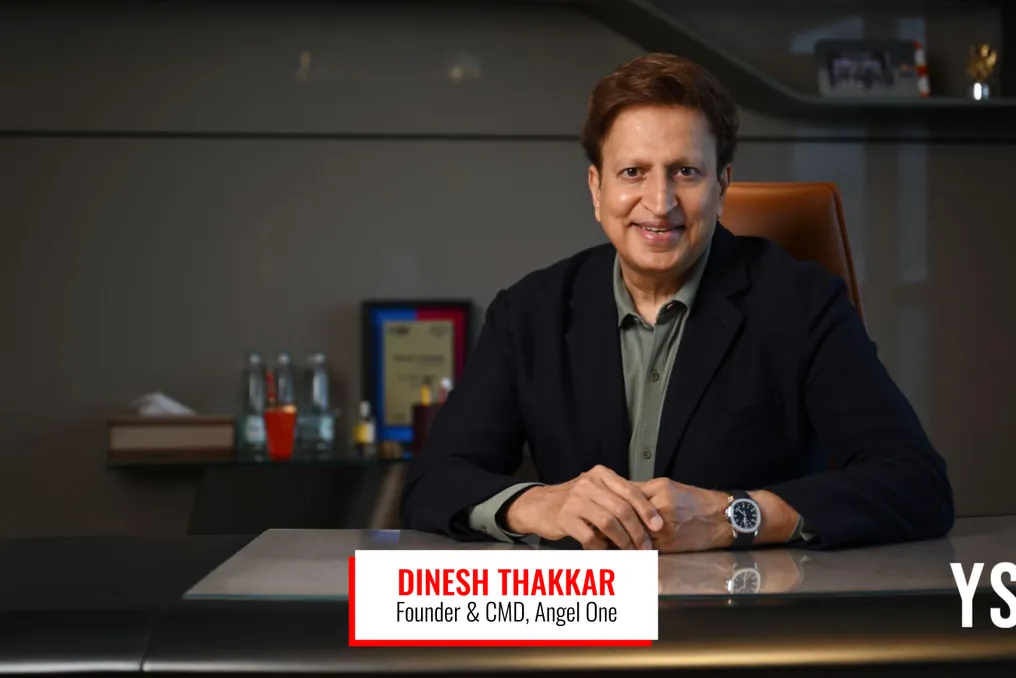
In an interview with YourStory, Founder, Chairman, and Managing Director Dinesh Thakkar and Group CEO Ambarish Kenge discussed Angel One's journey, future plans, and, most importantly, the company's approach to AI. Thakkar noted: 'Today, thanks to AI, one can present the personalization of every path exactly as a person wants, which I cannot imagine otherwise.'
Origins of the Idea and Early Development
Before the official establishment of Angel One, in the mid-1980s, as India prepared to open its market to computer usage, Thakkar read about computers and pondered how this powerful tool could be applied to business. He borrowed money from friends and entered the stock market but suffered serious losses, losing 50% of his capital. For a newcomer, there was a problem in obtaining information on how and when trades were being made.
The first step was ensuring process transparency so that the client could receive confirmation of a stock purchase or sale in real-time. It was then that he introduced a radio, which allowed order confirmation within five to ten minutes. Furthermore, they developed software that provided clients with contract notifications by the end of the day. Thakkar's philosophy was always to focus on user needs rather than getting carried away by technology for technology's sake.
When screen trading began, the company invested in routers, VSATs, and modems to expand services to other terminals. Learning about the popularity of internet trading in the US, he started working on how to bring this experience to India. In 2000-2001, he acted very aggressively, excited by this technology. This was the first mistake, as he failed to consider that the technology was available to other users. They invested in internet trading, but the provider could not supply the necessary software due to other priorities of the parent company, leading to huge losses and a large amount of unused equipment.
It was then that he realized he was too focused on the technology itself, while users did not have personal desktop computers for internet trading. As a result, they decided to use their unused equipment to connect to other sub-brokers outside Mumbai via a leased line. Through this technological utilization, the company began to operate nationally.
Transition to Mobility and Digitalization
In 2010-2011, he saw the potential in creating mobile-based solutions. Having learned a valuable lesson from the internet trading experience, he clearly understood that while the number of mobile phone users at the time was insufficient, a solution for mobile devices was still required. By 2015-2016, amid discussions about 'Digital India,' e-KYC, UPI, and Aadhaar, the company saw a good opportunity to activate mobile phones in real use.
In 2016-2017, they had a fully integrated mobile platform ready, while maintaining a profitable branch model. During this period, many people from third and fourth-tier cities, where the company had no offices, began using stock market services through the mobile application. This prompted the company to make a decision: either become a major player and capture a significant share of the new user segment, as the old base was small and the digital base was growing rapidly, or miss this opportunity.
The decision was made to close all physical offices and transition to a fully digital format. In 2018, the company became fully digital and focused on attracting and serving clients online. This was a bold move because transitioning to a digital format required them to match the pricing of digital brokers, which impacted revenue by 65%. Simultaneously, they calculated the acceptable level of loss to achieve profitability. The second question was whether they could grow faster than 65%. Calculations showed that growth was possible higher, although it would require several quarters of losses. They decided to go fully digital, and their client base grew by approximately 100-120%, without experiencing a single quarter of losses.
However, this proved insufficient. They calculated that if a client used their application, they might have other needs, such as mutual funds, insurance, and credit products. Therefore, in 2022, they decided to abandon the current application and create a new one, naming it a 'super-app,' which allowed clients to switch between stocks, mutual funds, insurance, and other products within a single application.
The Future with Artificial Intelligence
The company is currently examining how to utilize AI. Thakkar emphasized that he himself is not obsessed with new technologies, viewing them merely as another tool in the arsenal, but stressing the importance of knowing how to use them. Today, there is a significant group of so-called 'latent users' who hesitate to invest in stocks or mutual funds for various reasons. Their task is to understand how AI can solve this problem.
Knowledge of AI alone is not enough; it is crucial to create something useful for the user that helps attract these latent users to the platform. Even in wealth management practice, which requires an omnichannel approach involving client relationship managers, they use technology to serve clients who are not in the affluent category.
It is not far off until asset tokenization begins, when even a small amount will allow access to an experience comparable to that of top wealth managers. That is when AI and everything else will play a role.
Thakkar added that when he started the business, there were only a few communities in India involved in trading and investing. With the advent of screen trading, participation from different parts of the country increased. Then came the era of mobile phones, when the registration process became completely digital. They witnessed an influx of clients from tier three and lower regions—people they thought would never enter the market—massively joining.
The country's demo client base is around 20 million and has the potential to reach 30-35 million. Can AI be the step that creates such awareness? Today, access to knowledge and information exists, but how to personalize this journey? This is where AI must come in to solve this problem. This is what they strive for—to eliminate all user anxieties. He believes that AI personalizes paths in such a way that a person does not need large investments to enter the stock market.
Ambarish Kenge's View on Growth and AI
Ambarish Kenge noted that the growth potential is extremely high, especially in tier three and lower regions, where there is significant economic activity generating wealth. Previously, residents of these areas lacked access to information or knowledge, but the internet has become a great equalizer. AI is reaching a new level, enabling the provision of information and knowledge to the retail user. This will lead to the creation of a more efficient market and a level playing field.
Thakkar clarified that they want people to ask them questions and not take everything at face value. Therefore, their wealth management app has an 'Ask Angel' feature, which includes an AI-based agent. It can be verified if a client relationship manager gives advice, as this can be verified using an LLM model. They try to understand client goals and then assess the results of their investments. If they deviate from the main goal, there should be certain limits or prompts to guide them toward using the platform rather than leaving the stock market. Now, with AI, one can see whether their investment approach aligns or if portfolio rebalancing is required. Users always appreciate it when they are recommended the right things.
He also noted that people can make mistakes, but at any time they can return to check their actions and find out which path leads to their goal. Thakkar concluded that AI will inevitably transform all industries, creating a perfect experience for the user, although AI is still in its early stages, and it is necessary to understand exactly how to apply it. He reiterated that he can envision the personalization of every path, something he couldn't imagine before, and AI can determine what to buy or sell by analyzing human requirements, or which product will be suitable.
Kenge added that at the organizational level, they have AI tools that are used not only to increase efficiency but also to ensure effectiveness. AI is applied across all production areas. In customer support, they are already experimenting with AI-based voice calls in some areas. They have developed a data agent that continuously improves working methods. Cultural changes are also occurring as people begin to think about what they can do differently. There is an internal transformation in how business is conducted, but true success will come when they can change how customers perceive their product.
Thakkar emphasized that people create everything, and people use AI. He stated that it is impossible to create a solution without human involvement. If one needs to create a good fund for the user, a lot of human intelligence must be included. AI will make people more productive; perhaps some tasks will no longer require human involvement, but they will have to upskill and learn something new. AI can facilitate people's participation in capital markets by providing entrepreneurs with access to venture capital. When these entrepreneurs gain easy access to capital, they will create more jobs. Many industries can use AI to boost productivity and create new competencies. Some tasks may disappear, but in his opinion, jobs will increase.
Kenge noted that in the short term, rapid growth will cause some turbulence. However, in the long term, he believes many problems remain unsolved. Thakkar concluded by stating that he does not see competition in such an untapped industry. They act as an 'enabler' and are trying to expand the market, so they need other players willing to spend money on customer acquisition. The focus must be on how everyone can attract more users and expand the market, as there are enough opportunities for everyone. Kenge agreed that there is a large gap between the user base and active users, and if more players enter the market, people will become more aware of these investments. Nevertheless, he warned that if players act unfairly towards customers, the entire industry will suffer reputational damage, and everyone must ensure that each acts correctly towards the consumer. Thakkar reminded that his approach to action is based on calculated risk management: the risk lies in the inability to determine what might go wrong and how severely. But if a 5% risk experiment yields 500% profit, it is justified.
} , 3.