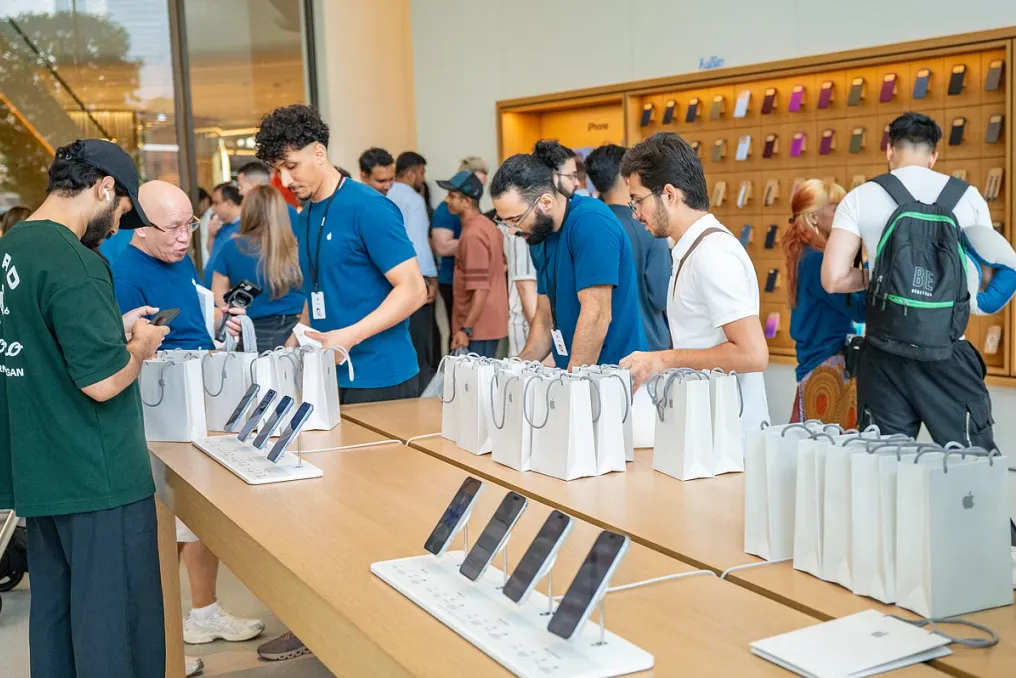
On Friday morning, hundreds of United Arab Emirates residents lined up outside Apple stores across Dubai. Some slept in their cars, while others arrived before dawn. Their common goal was to get the iPhone 18 on its release day.
Despite the option to order the phone online and receive it within minutes, many preferred to queue, with some even spending the night in their cars to guarantee receiving their devices as early as possible.
Pakistani expatriate Sadaf shared that buying a new iPhone on launch day has become a family tradition. She queued at an Apple store with her brother's wife and their two-year-old niece to purchase three devices. She noted: 'We have been doing this for years, but we still haven't found a way to get the first slot on launch day. When the Apple Duo comes out in October, we plan to buy that too. Maybe then we can get the first slot.'
According to Dr. Sara Percy, an assistant professor of marketing at the University of Birmingham in Dubai, the wait was not an inconvenience but part of the experience. 'For dedicated Apple fans, the queue becomes part of the launch ritual, where they can visibly demonstrate their commitment to the brand,' she stated. 'Being among the first to own the latest model signals psychological value through identity, exclusivity, and belonging, which goes far beyond the product itself.'
She added that the waiting itself, the early rising, and the shared excitement with strangers become part of the story the buyer tells.
Dubai resident Hanal arrived with her family to pick up four devices, upgrading from their previous models. They had all saved for months to afford their own phones. Hanal explained: 'We decided to upgrade as a family. When you decide to buy, it's better to do it on the first day before everyone else gets it.' The family acquired two burgundy, one black, and one blue device.
This desire to possess something before others seems to be amplified by social media. Influencers and celebrities play a significant role in turning desire into necessity. Dr. Sara explained: 'Influencer and celebrity content increases the visibility of the latest model, placing it in a group of desirable benchmarks, which in turn increases social appeal.' She continued: 'When this is supplemented by visible queues, it can create a powerful form of social validation, where the product becomes culturally significant, prompting a desire to participate and act immediately.'
Russian tourists Saifull Islam and Aiv Sultana Molly coordinated their trip to Dubai to catch the iPhone launch. Saifull noted: 'Since Russia imports iPhones, it will take several days before it appears on the market. So we will be among the first to get it when we return.'
This couple returned to Russia the same Friday.
Every year, Apple releases a 'color of the hero.' Last year it was orange, and this year it is burgundy. This color is more than just a design choice; it is a signal. Dr. Percy believes that while the burgundy color may be associated with status and sophistication, the key motive for the 'hero color' is uniqueness. 'The use of a recognizable color like this serves as an immediate and socially identifiable signal of owning the latest model, where the color itself provides more than just an aesthetic choice, forming a subtle symbol of status.'
If someone sees a person with a burgundy iPhone, they know they have the newest model, and that is the essence of it. The question remains open: what part of this is Apple's plan, and what is simply human nature? Dr. Percy concluded that the annual launch of Apple products continues to be an anticipated yet calculated brand ritual, built not only on the appearance and feel of the product but also on how it is sold and experienced, driven by the emotional and social value of ownership. Consumers amplify this social meaning through participation, sharing, and early ownership.