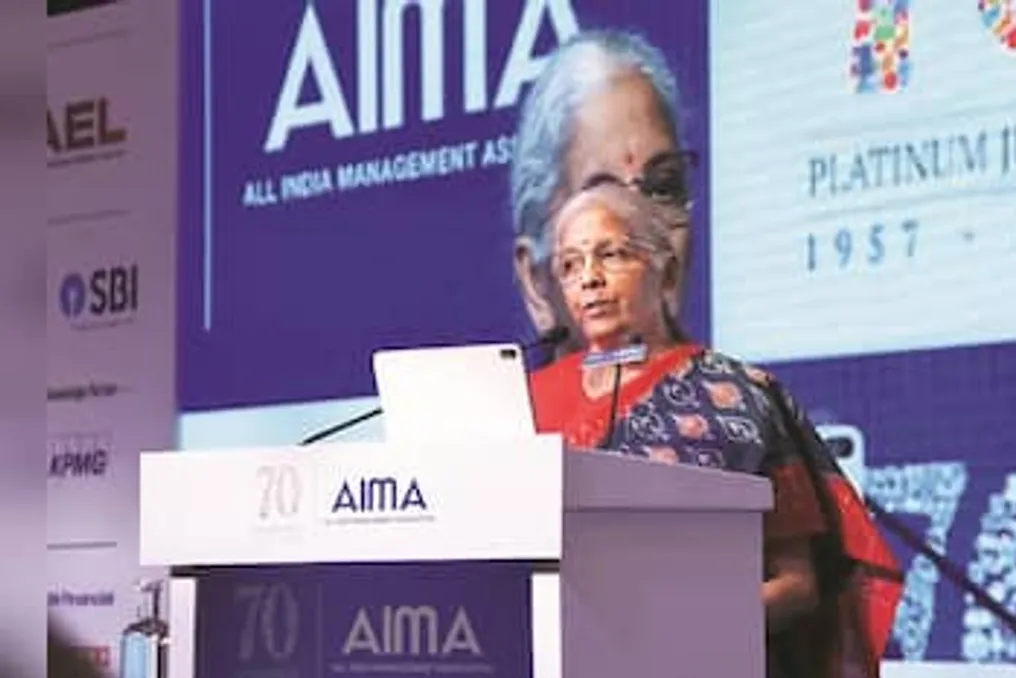
Finance Minister Nirmala Sitharaman noted that the next phase of consumption growth in India will be driven by improving citizens' standard of living and their transition into higher income brackets, where discretionary spending on goods accelerates.
On Tuesday, speaking at the 53rd National Management Conference of the All India Management Association (AIMA), Sitharaman emphasized that India's further consumption growth, which is the main driver of the economy, depends on increased wages and social mobility.
She also pointed out that demographic changes will alter household spending patterns. As the median age increases, family budgets are expected to shift towards healthcare, personal well-being, durable consumer goods, and quality services, due to decreasing youth dependency and increasing life expectancy.
Nevertheless, the minister cautioned the Indian corporate sector against developing a consumption strategy based solely on the formal urban elite. She reminded that India's consumption base is formed by working families in the agricultural, rural construction, transport, and informal entrepreneurship sectors, and that a strategy focused only on premiumization for urban consumers could undermine growth sustainability.
Private consumption, which accounts for more than half of India's Gross Domestic Product (GDP), grew by 7.2 percent in the fiscal year 2026, thanks to government tax incentives for incomes up to approximately 12 lakh (or 12.75 lakh for salaried employees), as well as rationalization of rates and reduction of tariffs under the Goods and Services Tax (GST). In the same fiscal year, India's GDP increased by 7.8 percent.
The minister added that while the government has created conditions to stimulate growth through tax concessions and other reforms, industries need to actively participate in supporting this growth by increasing spending on research and development (R&D) and building confidence.
Earlier, the Chief Economic Advisor (CEA) Ananta Nageswaran stated on Monday that India's economic growth can lead to significant transformations only if its benefits are equitably distributed between workers and corporations.
Sitharaman stated on Tuesday that the next phase of economic expansion will require Indian companies to focus on quality, innovation, and higher productivity, not just scale. She noted that India's total spending on research and development is 0.83 percent of GDP, significantly lower than the OECD average of 2.7 percent, as well as China's (2.6 percent) and the US's (3.5 percent).
Furthermore, she indicated that the private sector contributes only 36 percent to India's total R&D expenditure, compared to over 70 percent in leading developed economies, and urged companies to increase scientific research spending.
The minister called for a shift in ambition from 'Made in India' to 'Designed in India'—meaning creating products that are not only manufactured in the country but also conceptualized, designed, and technologically developed here before being launched in global markets. She also insisted on adapting management practices and curricula to emerging challenges, including geopolitical risks and supply chain risks.
Highlighting the unpredictable period in the global economy and the parallel shift in the architecture of global trade and supply chains, she stated that for India, resilience means having deep domestic potential, financial strength, and industrial scale so that global shocks can be absorbed without interrupting national development. She concluded that India's task for the next two decades is not merely to create more startups, but to help existing companies transform into large, professionally managed, and long-term enterprises.