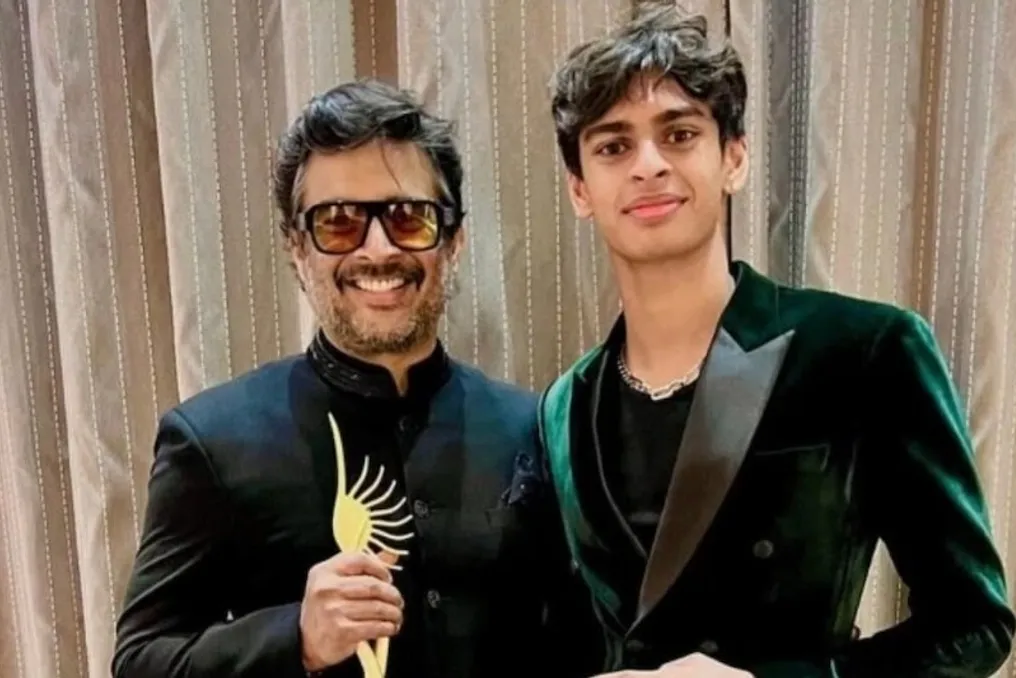
At the Asian Games, A. Madhavan's son, Vedant Madhavan, faced disappointment as his team could not qualify for the final. The Indian men's 4x200m freestyle relay team lagged by only 0.2 seconds from qualifying for the final.
The team, which included Vedant, Sadjan Prakash, Dakshan Shashikumar, and Anish Sunil, finished ninth out of 13 teams with a time of 7:24.32. The Qatar team took eighth place with a time of 7:24.10 and was the last team to qualify for the final.
After this, Vedant shared the results on his Instagram story, writing: 'Missed the final by 0.2 seconds and missed being the best Indian by 0.5 seconds — after the 200m freestyle event.' He posted this with a thank you emoji.
This result occurred during Vedant's debut at the Asian Games, but his participation in the competition is not yet over. He is scheduled to participate in the men's 200m freestyle race on September 23rd and the 200m backstroke race on September 25th.
Previously, the actor has often spoken about how he perceives defeats and failures, drawing on his experience in the film industry. In a conversation with journalist Sonia Shenna, Madhavan explained why it is harder to accept failure in cinema: the reaction or outcome is always visible to everyone.
Madhavan noted that in most types of business, success and failure occur within limited frameworks. However, in their industry, everything happens in public view. He recalled an instance where an ordinary person criticized a major star because they disliked a film. In Madhavan's opinion, such situations demonstrate how openly artists are exposed to public opinion when their work reaches the audience.
He emphasized: 'It is the nature of our industry; everyone has the right to comment. From an airport guard to a watchman, if they like your work, they will praise it. If not, their reaction says everything. It becomes your report. It shows how sensitive a position you are in as an artist.'
Madhavan's main point is that the failure of a work should not immediately be considered proof of a person's lack of ability. 'Therefore, where success might make you feel like a superhero, failure should be accepted as feedback—it reflects not your talent, but the decisions you made.'
Madhavan described failure as information that can indicate what went wrong. Instead of viewing it merely as a loss, he sees it as a signal to change his approach to work.
He stated: 'For me, my greatest teacher is failure. I welcome it. Because success achieved through compromise will never be as valuable as magnificent failure. If I gave 100% and still failed, it clearly shows that my understanding or method was wrong, and that is valuable data.'
The actor spoke about the mindset that shaped his approach to overcoming difficulties. 'Failures are not obstacles; they are like data points, and it is thanks to this mindset that my failures have never become a huge problem.'
He also added that the outcome depends on the perspective from which a person views the event. 'But more important than luck is how you understand failure. If you see it as an opportunity to learn something, rather than a defeat, everything changes.'
For Vedant, the inability to make the relay final is now an opportunity for learning, as he still has two individual competitions to participate in.