
Baselayer raises $35 million to scale AI agent identity infrastructure
Read more
Ventureburn
ventureburn.com

Baselayer raises $35 million to scale AI agent identity infrastructure

Baselayer has raised $35 million in a Series A funding round to expand its identity infrastructure for artificial intelligence agents. The round was led by M13, with participation from Torch Capital, Picus Ventures, Afore Capital, and Matt Thompson of Socure. In addition to securing funding, the New York-based company has launched its Agentic Identity Suite.

The platform's primary goal is to help financial institutions detect autonomous agents before they can complete transactions. Baselayer was founded in 2023 by Jonathan Avad and Timothy Hyde. Jonathan Avad serves as CEO, and Timothy Hyde is the CTO.

Previously, the company focused on business identity and risk infrastructure for financial institutions. Currently, the platform supports over 2,300 financial institutions and payment companies. Baselayer claims that its technology has helped clients prevent over a billion dollars in fraud losses.

As AI agent systems increasingly perform tasks previously assigned to humans—such as opening accounts, moving funds, making purchases, and conducting business operations—a new trust challenge arises for financial infrastructure. Traditional identity systems were built with people and companies in mind but are not designed to verify autonomous software acting on behalf of a third party.

The company aims to become the trust layer for institutions dealing with autonomous agents, as they need to know which specific agent is operating and who authorized its actions. Furthermore, they need to understand the agent's scope of authority. Baselayer states that static fraud controls can block legitimate users while ignoring sophisticated attacks. Its Agentic Identity Suite is designed to close this gap and assess the possibility of a secure transaction by an agent.

The system is intended to provide cryptographic verification around agents and the organizations they represent. Baselayer is extending its existing business identity network into the realm of the agent economy. The company already provides identity verification services and risk infrastructure for financial and payment enterprises. Its network includes over 2,300 institutions across the United States. Baselayer also collaborates with agent developers, card networks, and payment companies. Among its partners and clients are FIS, Prove, Socure, Exa, and Parallel Web Systems.

The company is involved in shaping new standards for agent authentication and identification, including the FIDO Alliance Authentication Working Group and the x402 Identification Working Group. Baselayer works alongside companies such as Cloudflare, Google, Visa, and Mastercard.

According to the company, common standards will become critically important as agent commerce expands. This funding comes amid large payment companies developing infrastructure for AI-driven commerce. Stripe reported that about 70% of API requests now come from AI agents. Visa, Mastercard, and American Express have also implemented agent commerce protocols, and Shopify has provided agent sales channels to approximately one million merchants. These developments point to the broader application of autonomous systems in commercial operations.

McKinsey predicts that agent commerce could redirect between $3 trillion and $5 trillion in retail spending by 2030. Baselayer believes that such growth will require more robust identity and fraud prevention infrastructure. The company plans to evolve around emerging standards while expanding its agent products.

Karl Alomar, Managing Partner at M13, noted that Baselayer already possesses valuable operational infrastructure, citing its network of financial institutions and existing risk data. Baselayer stated that the new funding will be directed toward expansion into this nascent market.

Similar stories

Factory raises $200 million at $5 billion valuation to scale AI software development
Read more
ventureburn.com

Factory raises $200 million at $5 billion valuation to scale AI software development

Factory has successfully raised $200 million in a new funding round, achieving a valuation of $5 billion. Investors in this round include Blackstone, Khosla Ventures, and Sequoia Capital. Insight Partners, Evantic Capital, and Sound Ventures also participated.

Factory was founded in 2023 by Matan Greenberg and Eno Reyes. Other investors included NEA, Mantis VC, and Clearlake. The round also attracted angel investors, including Nico Rosberg, Brad Gerstner, and Mark Benioff.

The new funding increases the company's total capital raised to over $400 million. This represents significant growth compared to the $1.5 billion valuation set in April. Thus, in five months, Factory's valuation has more than tripled; previously, the company had raised $150 million at that same valuation.

The latest capital raise reflects growing enterprise demand for autonomous software development tools. The San Francisco-based company aims to increase the degree of autonomy in software development. Its platform enables large enterprises to create, test, and maintain software using artificial intelligence agents throughout the entire development lifecycle.

Factory differs from platforms focused on individual coding agents because it provides enterprises with a unified system for managing software development. The platform allows companies to control the training process of their 'software factory,' as well as manage models and system deployment. Factory can operate through its managed cloud infrastructure, or clients can deploy it on-premises or in fully isolated environments, giving enterprises greater control over AI-driven development.

The company reports that its platform is used by hundreds of thousands of developers. Factory's clients include Nvidia, Blackstone, Royal Bank of Canada, Palo Alto Networks, and Adobe. This growing client portfolio underscores the increased interest from the corporate sector in AI-powered software development.

Enterprises are increasingly using AI to boost engineering productivity. Factory believes that companies are moving from using individual coding assistants to building broader software factories around autonomous systems. Matan Greenberg noted: 'Major enterprises worldwide are transitioning from individual coding agents to software factories,' adding that clients confirm the potential for rearchitecting software development systems, although the company is still in the early stages of this transition.

Factory's strategy is focused on creating autonomous software factories that operate continuously under human supervision. Enterprises can regulate measurable outcomes while AI performs development tasks. The company competes in the rapidly growing AI coding market. Factory plans to use the new capital to support further growth, focusing particularly on platform expansion and adoption within the corporate sector.

Positron AI raises $875 million to scale AI inference hardware
Read more
ventureburn.com

Positron AI raises $875 million to scale AI inference hardware

Positron AI has successfully raised $875 million in a Series C funding round, valuing the company at $5 billion. The company's core business involves developing hardware that makes the artificial intelligence inference process more energy-efficient and cost-effective.

The funding was secured in two stages: first, a Series C round of $375 million was closed, followed by a Series C-1 round of up to $500 million. The main round was led by NEA, Atreides Management, and Valor Equity Partners, with co-leads from Andra Capital and SemiAnalysis Capital participating. The second tranche was led by Jim Clark, founder of Silicon Graphics and Netscape, with participation from several institutional and strategic investors.

The capital raised will allow Positron to significantly expand its growing business in inference and add several experienced technology investors to its board of directors. Forest Basket from NEA and Gavin Baker from Atreides Management will join the board. Thomas Germoluk and Dylan Patel will also become directors.

As AI workloads increasingly shift towards inference, infrastructure is necessary for the continuous operation of models by every AI assistant, agent, and helper. Positron focuses on solving memory and power issues arising from this growth. The company's systems are designed with an emphasis on bandwidth and memory capacity, rather than raw computational power.

The company's next-generation systems utilize standard LPDDR5X memory, which reduces dependence on constrained high-performance memory supply chains. Positron claims its systems can achieve over 90% of available memory bandwidth.

Furthermore, the company focuses on high performance in tokens per dollar and tokens per watt metrics. Positron's architecture supports both air-cooled and liquid-cooled data centers, giving customers flexibility in deploying systems across various rack densities.

Positron already has clients using the first version of the Atlas system. Over 50 Atlas racks have been deployed in Oracle Cloud Infrastructure, where Parasail uses this power for its own inference services. Jump Trading and i3d.net are also production clients of Atlas.

The new funding will be directed towards developing the next generation of silicon chips. The Asimov chip is scheduled for fabrication using TSMC's N3P process by the end of 2026; TSMC describes N3P as an improved 3nm process. Production of Asimov is slated for the second half of 2027. Each Asimov chip will support between 288 GB and 2304 GB of memory, meeting the demands of increasingly complex AI inference workloads.

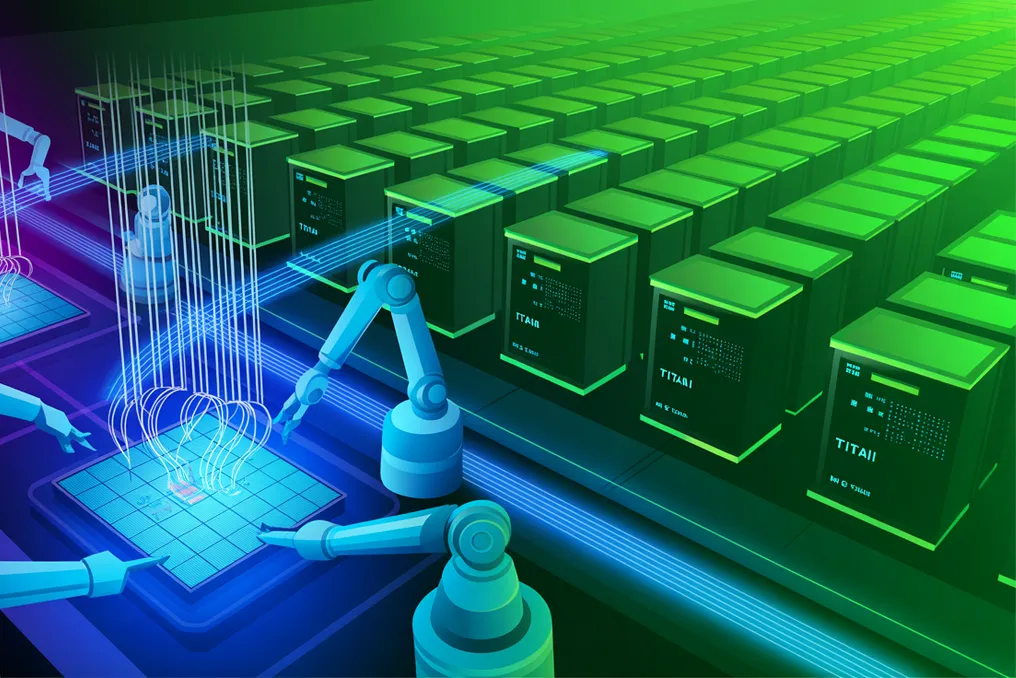
The Titan system will integrate four to eight Asimov chips into a single system and is designed to support models exceeding 16 trillion parameters. Titan will also target context windows exceeding 10 million tokens and can scale to thousands of nodes for larger deployments. Positron also plans to build a data center engineering facility with a capacity of over 2 MW and an emulation platform to support development, testing, and manufacturing readiness.

Positron intends to use the funds to secure LPDDR5X supply commitments, as well as to increase manufacturing capacity and system integration. Go-to-market operations will expand in parallel with production, helping the company meet the growing demand for inference infrastructure.

CEO Mitesh Agrawal noted that the Atlas deployments provided valuable customer insights that influenced the design of Asimov and Titan. The company is currently in a demanding execution phase, requiring it to complete silicon development while simultaneously scaling production and customer adoption.

Positron's strategy is focused on the economic efficiency of AI model operation. Its memory-centric architecture aims to reduce both energy consumption and infrastructure costs. The $5 billion valuation reflects investor confidence in the inference market.

Euno raises $23 million to scale its context platform for enterprise AI
Read more
ventureburn.com

Euno raises $23 million to scale its context platform for enterprise AI

Euno has successfully raised $23 million in a Series A funding round, which will be used to expand its artificial intelligence context platform. The round was led by N47, with participation from existing investors, including 10D. Founders and executives from technology companies such as Wiz, Cyera, Eon, Tavily, and Tableau also participated in the financing.

With this new round, Euno's total funding has reached $29 million. The company is currently actively increasing its presence among large corporate clients. Euno was founded in 2023 by Sarah Levy and Eyad Firstenberg. The company's operations are focused in San Francisco and Tel Aviv.

The founders possess extensive experience in cybersecurity, AI, and data infrastructure. Their previous work includes roles at Sight Diagnostics, Unit 8200, and LightCyber. Euno is currently hiring around 30 employees in the United States and Israel.

Enterprise AI systems critically depend on accurate and reliable information. However, AI agents often struggle to understand how organizations actually use their data. Euno solves this problem with an AI-native context platform.

The company's technology continuously studies processes for building, using, and managing information within organizations. The company positions its platform as the 'AI brain' for enterprise data, providing agents with the necessary context to navigate complex organizational systems. Euno analyzes metadata patterns to reconstruct institutional knowledge, allowing it to identify data meaning, origin, owner, and governance rules. The platform then supplies each AI agent with the required context to perform a task, limiting unnecessary access and increasing the reliability of automated decisions.

Furthermore, the platform learns from agents' interactions with the organizational context, creating feedback loops that continuously improve the platform's understanding. The company believes this can shorten lengthy processes for preparing for AI adoption. Traditionally, corporate teams manually maintained context, relying on data catalogs, semantic layers, and governance policies. Euno argues that such systems were originally designed for humans, whereas AI agents function differently because they can move autonomously between multiple systems.

Therefore, the platform integrates governance directly into its context infrastructure. It determines what information an agent can access based on its role and task. This approach helps enterprises maintain organizational boundaries during automated workflows and gives data teams greater control over increasingly autonomous AI systems. Euno has already attracted clients from the Fortune 500 list across various industries, including AlphaSense and the telecommunications company Zayo Group.

The new capital will primarily be directed towards supporting sales, marketing, and AI research. Euno also plans to significantly expand its technical team. N47 expresses confidence that the demand for enterprise AI infrastructure is rapidly growing, considering context indispensable for agents working with business data. Additionally, Euno received recognition from Gartner, being included in the 'Coolest Vendor Innovations in Data Management' list for 2026, where its constantly updated graph of enterprise context was noted for semantic data understanding.

This recognition boosts trust, as enterprises seek more robust AI infrastructure. Euno competes in the rapidly evolving enterprise AI market, where organizations increasingly want agents capable of independently performing complex tasks. Euno potentially could make organizational context the core layer of enterprise AI infrastructure. Nevertheless, greater autonomy introduces new data and governance challenges that Euno intends to solve through a continuously learning context layer. The company now has the funding to expand its technologies and commercial reach.

Popular