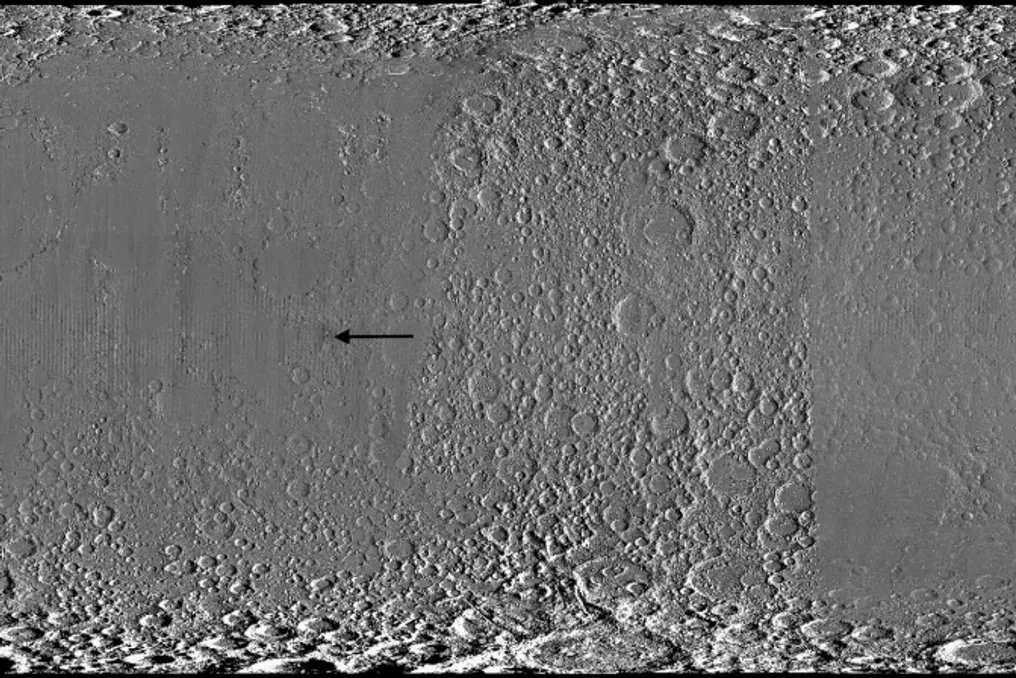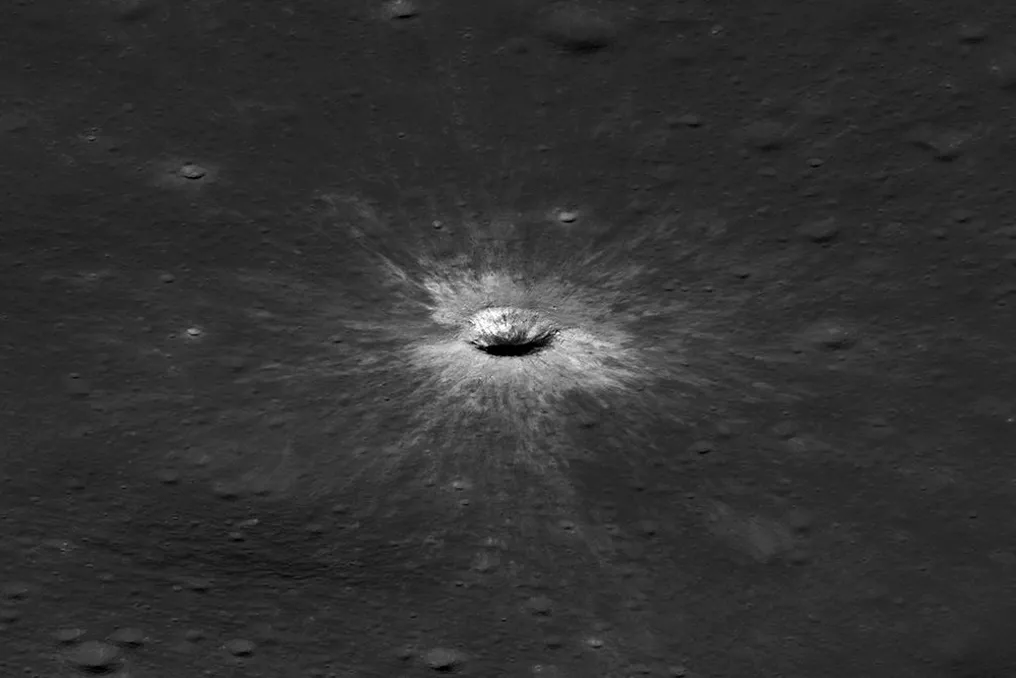
Between April and May 2024, a fragment of an asteroid or comet, with dimensions equivalent to a three to six-story building, collided with the Moon. This event resulted in the opening of a crater with a diameter of 222 meters on the satellite's surface.
This new formation, named McGetchin, is three times larger than the previous record crater and was detected by NASA. It is classified as an event that occurs, on average, once every century.
Although impacts are constant events in lunar history, caused by the collision of small bodies from the Solar System—such as asteroids, meteoroids, or comets—most existing craters are significantly smaller than McGetchin. With a width of about 222 meters, its diameter exceeds the length of two soccer fields, reaching approximately 43 meters in depth.
This achievement represents the largest newly formed crater recorded in the Solar System since humans began monitoring such structures. The impact generated surface modifications in a radius greater than 120 kilometers, although most of these changes left marks too small to be visible in orbital images.
The smallest craters that probes can register have a minimum width of nine meters and are formed by rocks slightly over one meter high. The final size of the crater depends directly on the energy of the impacting object, which is determined by its speed, density, and size, as well as the angle and type of lunar surface.
These craters remain well preserved due to the absence of an atmosphere, which prevents erosion caused by rain or wind. The LRO probe, launched by the American space agency NASA in 2009, has been collecting data on the Moon's topography, temperature, surface composition, and radiation environment for almost two decades, being designed precisely for such detections.
However, the discovery of McGetchin occurred by chance during a routine check of LRO probe data. One of the NASA scientists, Robert Wagner, while analyzing a lunar map on his computer, observed an exceptionally large and bright spot surrounded by a dark halo. This anomaly was confirmed after comparing images of the region before and after the event, indicating that the crater appeared on the eastern edge of the Moon between April 11 and May 22, 2024.
The name McGetchin is a tribute to Tom McGetchin, a pioneer of lunar science, who passed away in 1979. The full details of this discovery were published in the journal Science Advances last Wednesday (the 16th).