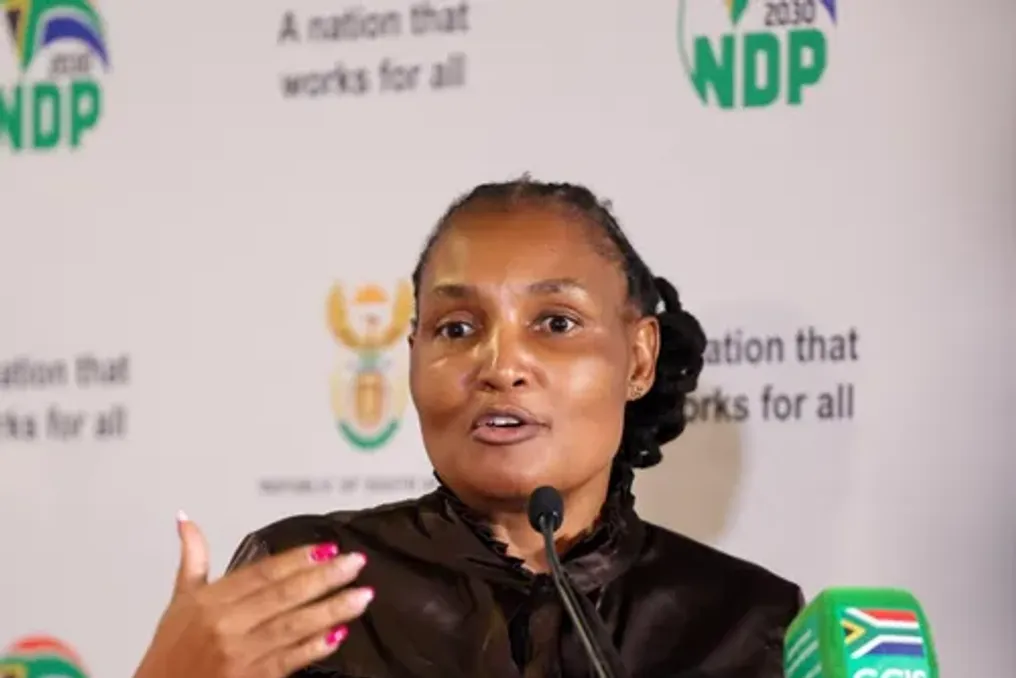
Housing Minister Thembi Simelane reported that 600 hectares across 120 land parcels in Cape Town could provide approximately 21,000 housing opportunities. Furthermore, 162,583 people have been registered in the city's housing needs register for at least five years.
Simelane specified that currently, about 400 hectares on 31 land parcels are being prepared for implementation and handover to the market.
These figures were presented by her in response to questions from parliamentarians, specifically ActionSA MP Darlene James and MK Party MP Zelna Abader, regarding housing issues in Cape Town.
This statement came amid criticism from GOOD Party mayoral candidate Brett Herron, who accused the DA of using a long-term social housing project for electoral campaigning, noting that the plot had been allocated for social housing nearly two decades ago.
On Monday, DA mayoral candidate and mayor Geordin Hill-Lewis used the Salt River Market venue to present his plan for governing Cape Town in the next term, doing so three months after the official handover of the facility to the company Communicare.
When questioned about the Western Cape government allocating land for the construction of nearly 5,000 social and affordable housing units, Simelane stated that information from the provincial Department of Infrastructure indicates the allocation of land for 4,380 social and affordable housing units.
She explained that these projects are at various stages, including procurement, enabling realization, and mitigating risks to obtain necessary building rights.
Among the seven projects named are Conradie Park, Oranjezicht, Leeulop, Stikland, and Amandela Place. The Minister emphasized that the process is in its earliest stages, and details beyond what has been mentioned are not yet available.
Thembi Simelane also noted that the timelines for the implementation and completion of each of these projects are unknown, but this information will be provided once the relevant parties make a final decision.
The Minister warned that consequences will be imposed if approved targets are not met by any officials or project implementers.
According to the Minister, the Western Cape Department of Infrastructure will monitor and oversee the projects in accordance with relevant sections of the Social Housing Act.
When asked about the housing backlog in the city, Simelane reported that 162,583 beneficiaries have been in the Housing Needs Register for at least five years, and 120,838 people are listed in the database for 20 years or more.
She stated that providing exact timelines for completely eliminating the housing backlog is impossible because it is a constantly changing target. Simelane explained that although housing opportunities are provided annually, new households continue to form, and additional residents register their needs, leading to a continuous increase in demand.
Instead of forecasting a date for complete backlog elimination, the city can more reliably predict its future housing provision potential based on factors such as the availability of suitable land, the number of hectares that can be developed, expected housing yield, infrastructure capacity, and the financial resources required to support housing construction.
Simelane added that such forecasts will allow the city to assess the number of housing units that can be provided in the medium and long term, as well as the associated land and capital investment requirements to respond to both existing and future demand.
She also mentioned that the city has identified frozen projects in both the social housing program and the Breaking New Ground (BNG) program. In the social housing sector, the affected projects collectively involve about 2,500 housing units. Regarding the BNG program, the Mahama Khayelitsha project is currently suspended and includes 261 upper structures.
The estimated development cost for the affected social housing projects is approximately 4 billion rand, while the Mahama Khayelitsha project requires an estimated budget of 45 million rand for the construction of 261 upper structures.