A team from Uzbekistan presented a concept for a future city at the finale of Global HackAtom, where nuclear energy is intended to power not only electricity but also desalination plants, industry, and a nuclear medicine center.
Participants were tasked with planning the city's development until 2050, and they had only 20 hours to develop projects and prepare for the final presentation. Ilya Perepelkin, the mentor of the Uzbek team 'Synthesis,' spoke about the competition and the solutions developed by the students.
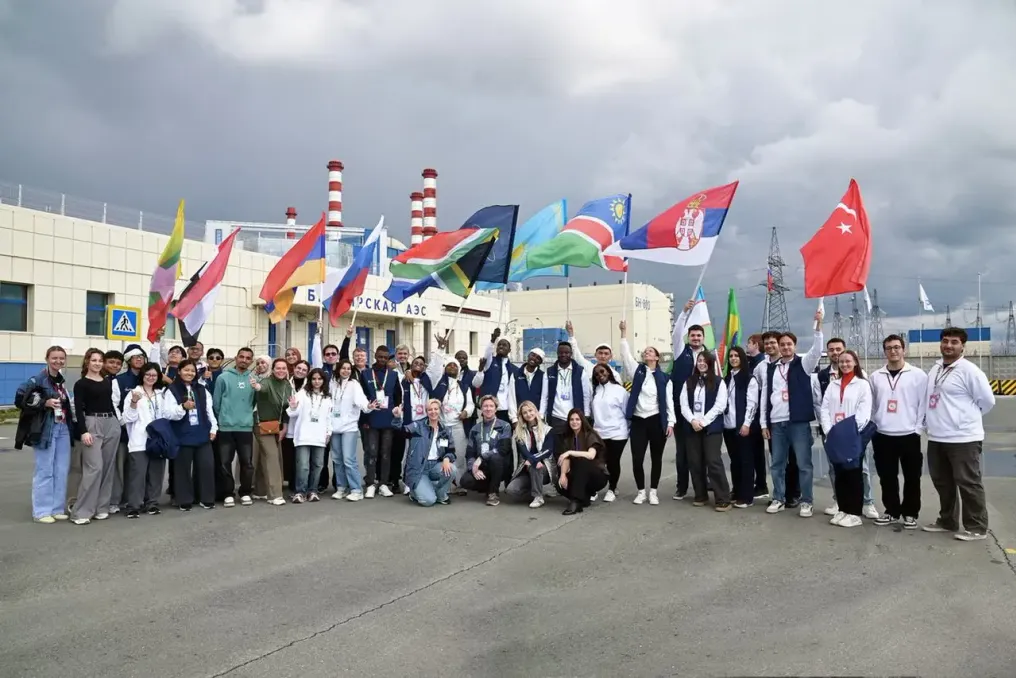
The finale of the international student championship Global HackAtom took place on September 14–15 in Yekaterinburg as part of the International Youth Festival. The event gathered over 80 winners of national competitions from 15 countries across Asia, Europe, Africa, and Latin America. Rosatom has been the organizer of the championship for the second consecutive year.
A few days before the finale, participants visited the Beloyarsk Nuclear Power Plant and its satellite city, Zarechny. At the plant, they inspected the power unit equipped with the BN-800 reactor.
Uzbek students were previously familiar with the research reactor at the Institute of Nuclear Physics of the Academy of Sciences of Uzbekistan. This visit allowed them to see a next-generation industrial power unit and a city whose life is directly linked to the operation of the nuclear power plant.
Ilya Perepelkin recalled that 'at the beginning of the hackathon, we already had experience communicating with other teams. The excursions gave participants the opportunity to get acquainted and learn more about each other. We discussed what topics the teams covered in the national stages and what they brought to the final.'
He noted that there was some nervousness before the start regarding the nature of the task and the team's ability to handle it. Participants had assumptions, but no one knew the exact topic.
After visiting Zarechny, participants assumed that the final task might concern a nuclear energy city, but the specific requirements were only known after the hackathon began. The city was supposed to be located on an ocean coast in a warm climate and a seismically active zone. Its development scenario started in 2027 and continued until 2050.
The team decided not to limit itself only to electricity generation. The students studied other potential applications of the nuclear power plant, including water desalination, industrial development, and other needs.
'We considered the nuclear power plant as the engine of the city's economy. We included water desalination because, according to the task, the plant had to be located on an ocean coast. We also provided for a nuclear medicine center. In our concept, petrochemical production was supposed to use heat from the nuclear power plant. We considered plastic production using this heat. The project turned out comprehensive, with all interconnected elements,' stated Perepelkin.
The team proposed dividing the city's development into stages related to its evolution. In the initial stage, small modular reactors were supposed to meet the first demand for electricity, serve desalination plants, and support social infrastructure.
As the city grew and new industries emerged, the construction of a large power unit was planned. This approach required the team to calculate the generating capacity not separately from the city, but based on which facilities would develop at each stage and how much energy they would require. Perepelkin described this concept as a 'city of integrated technologies.'
One of the principles was ensuring the city had its own electricity and fresh water, while industrial development was also linked to producing goods for export.
At the international final, participants met teams with significantly different backgrounds. The competition included not only future specialists in the nuclear industry but also students from biology and IT fields. Their diverse professional experience influenced how they approached the same task.
One of the projects that attracted attention was 'Nuclear Nomad' from a team from Kyrgyzstan, which proposed a concept for an autonomous floating nuclear city. This project took third place in the championship.
For the Uzbek students, the final was an opportunity to compare their engineering approach with the solutions developed by participants from other countries and academic fields. Although many initial assumptions might be similar within one university or educational system, the international format showed how differently teams can approach the same task and prioritize.
The concept had to be formalized into a complete presentation within 20 hours. The students distributed tasks among themselves, researched information, conducted calculations, and then combined the individual components into a single project. They finished the work almost on time.
According to Perepelkin, almost none of the team members slept during this time.
Every decision made influenced subsequent work. The chosen generating capacity determined the possibilities for infrastructure and industry, and plans for enterprise development, in turn, changed the city's future energy demand.
The students presented their project to a jury composed of representatives from the Beloyarsk NPP, the FESCO transport group, and Energia Razvitiya. In a short time, they needed to highlight the key elements of their work and explain why the team chose those specific solutions.
Perepelkin noted that one of the main goals of participating in the championship was the necessity of making decisions independently and taking responsibility for them. He added: 'An important task was organizing our thoughts. We needed to quickly move from idea to action and make a decision that would affect the entire project. I think this will help students make complex decisions in the future. Everyone worked on their part of the project. In my opinion, this developed independence, the ability to verify information, and conduct calculations.'
It is practically impossible to fully design a real city that is supposed to develop for decades in a single day, but this time was enough to demonstrate how young specialists and students from different countries envision the nuclear city of the future.
In this sense, Global HackAtom was not just a competition of ideas, but a model of a generation that will enter the industry in the coming years. The event brought together various cultural and educational environments, while participants demonstrated a readiness to combine technology, think long-term, and propose ambitious solutions.