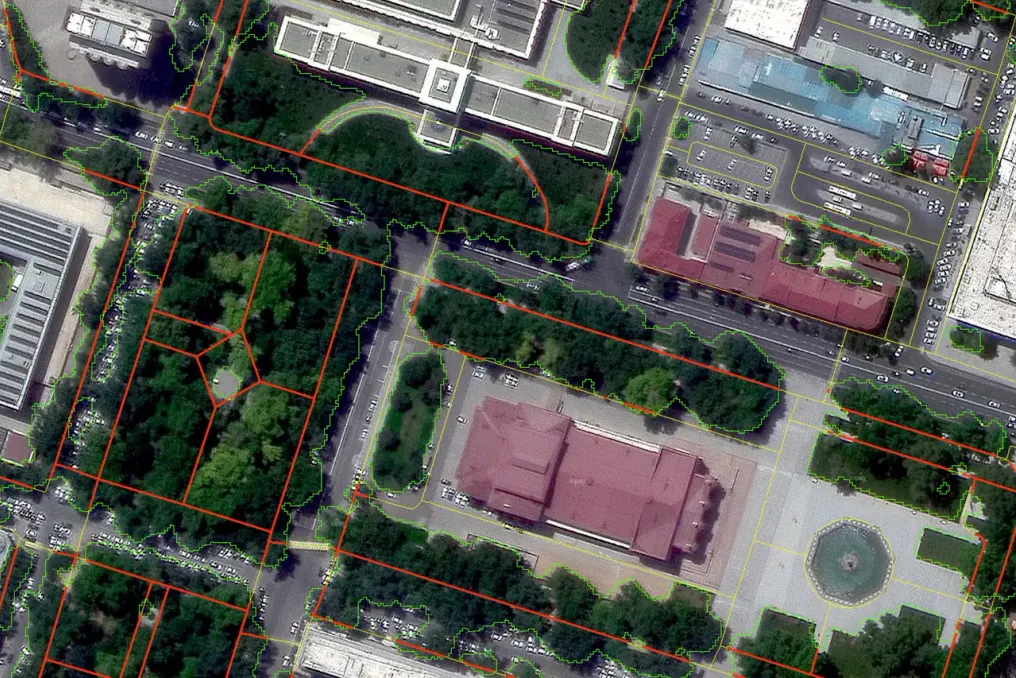
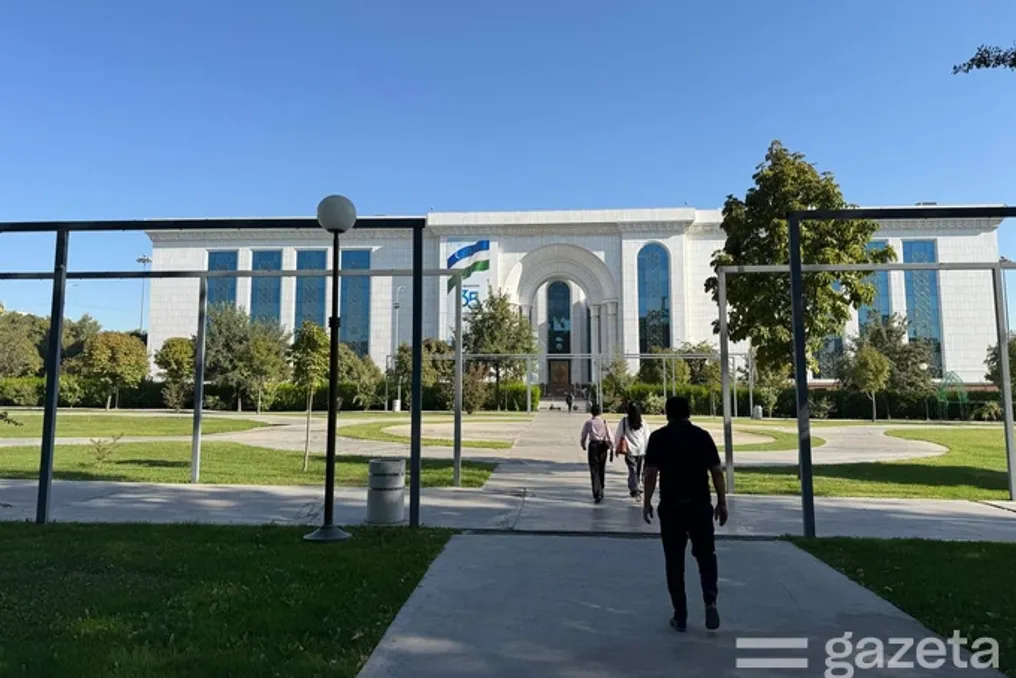
A decision has been made to convert a large green area of 1.3 hectares located near the National Library of Uzbekistan in the very center of Tashkent into a parking lot. This decision was formalized on September 14 by the city's Hokim, Shavkat Umurzakov.
The Capital Traffic Organization Center (CTOC) announced the plans on Monday, assuring residents that along with the new parking lot, pedestrian and bicycle paths will be established, additional greenery will be planted, and children's play areas, workout zones, and sanitary facilities will be created.
It is anticipated that the land plot will be put up for auction with a starting price of 514 million soums. The private partner who receives the right to operate the territory for a ten-year period will be obliged to take on investment obligations, as well as ensure the maintenance, improvement, and landscaping of this area. According to the documents, 20% of the revenue from parking fees must go to the city budget (although the document specifies a division of 10% for the city and 5% for the operator 'Pullik Tuxtash Joyi').
The CTOC stated that the goal of this project is not to increase the number of cars in the center, but to organize the existing traffic flow and free up public space from uncontrolled parking. CTOC representatives emphasized that the parking infrastructure must harmonize with the existing landscape, without harming pedestrians, green areas, or the public function of the territory.
Residents were also promised the construction of a new 720-meter sidewalk, although high-quality sidewalks already exist around and through this area, which are monitored by the landscaping service.
According to the CTOC, the lack of organized parking spaces in this area leads to chaotic parking, including stopping cars in multiple rows and on pedestrian zones. CTOC employees noted that representatives of nearby organizations have repeatedly raised this issue. However, they did not specify who has allowed such parking for years by employees of neighboring institutions: on sidewalks, shaded paths, and crosswalks, often in two or three rows, ignoring signs, and covering car numbers with papers or bags. Most of these cars remain there all day.
Order is maintained only in the paid parking zone Poytaxt Parking, but even there, drivers violate the rules and leave cars in prohibited places. The area planned for conversion into a parking lot is annually used for setting up a New Year's tree, holding flower festivals, and concerts. The CTOC assured that under the terms of the future contract, the territory will be provided to city authorities for holidays and public events upon request (for a period of up to 60 days per year).
Public Concerns
The public has begun actively questioning the CTOC and the authorities, despite repeated statements about the need to reduce the number of cars in the center and expand green and pedestrian areas.
Journalist Kobil Khidirov, writing on the Telegram channel davletovuz, expressed doubt about the official plan to create a square along with a parking lot, calling it an attempt to divert attention since the square supposedly already exists.
Mukhrim Aʼzamxujaev pointed out the lack of logic in building a parking lot, given that many state institutions, including the National Library, are planned to be moved to New Tashkent in the coming years. He also indicated that a paid parking lot already exists nearby, and the new 1.3-hectare area will not solve the problem because the root cause is different.
This journalist added a critical remark that the state intends to hand over land that is extremely valuable and serves thousands of residents every season for the storage of a few hundred cars.
Economist Botir Kobilov described the plan to create a parking lot between the Palace of Youth Creativity and the National Library in the city center as metaphorical and an act of wastefulness. He suggested that instead of a parking lot for cars that mostly stand still, a place for people to rest and walk should be developed, especially near the National Library.
Kobilov also warned that such parking lots could stimulate an even greater influx of cars into the city center, whereas a metro station is located nearby, and fewer incentives for entry should be created.
Economist Bezkhod Khoshimov concluded that building ground-level parking lots in urban centers is an outdated urban planning mistake, and it would be preferable to plant trees in this location.
Expert Opinions
Bobur Siradjev, an expert on infrastructure policy and sustainable mobility, questioned the effectiveness of parking in reducing the load on the city center, as it actually increases the number of parking spaces. He noted that currently, about 100–150 vehicles illegally park only on Buyuk Turon Street, while the new parking lot could accommodate 300–400 cars, contradicting the thesis of 'freeing up public space.'
The expert also stated that the area is poorly suited for walks during hot weather due to the lack of shade and trees, although in the evening, people with children can often be seen engaging in active recreation on roller skates, skateboards, scooters, and bicycles. Siradjev advised completely rethinking this place as a public space by implementing greenery, shading, and zoning changes.
Furthermore, the expert expressed bewilderment regarding the financial and technical conditions of the project, noting that even preliminary calculations show a disproportionately small share of economic benefit for the city given the stated parameters. An accurate assessment of the imbalance can only be made after developing a full business model considering demand, taxes, operating costs, and capital cost.
First Official Reaction
By Tuesday evening, the National Committee of Uzbekistan for Sustainable Urbanization and Housing Market issued a statement. The Committee stated that reducing existing green areas in the city center and constructing permanent structures on public spaces intended for resident recreation is absolutely unjustified.
The agency also emphasized that when creating parking lots, it is strictly forbidden to reduce green areas or worsen conditions for pedestrians.