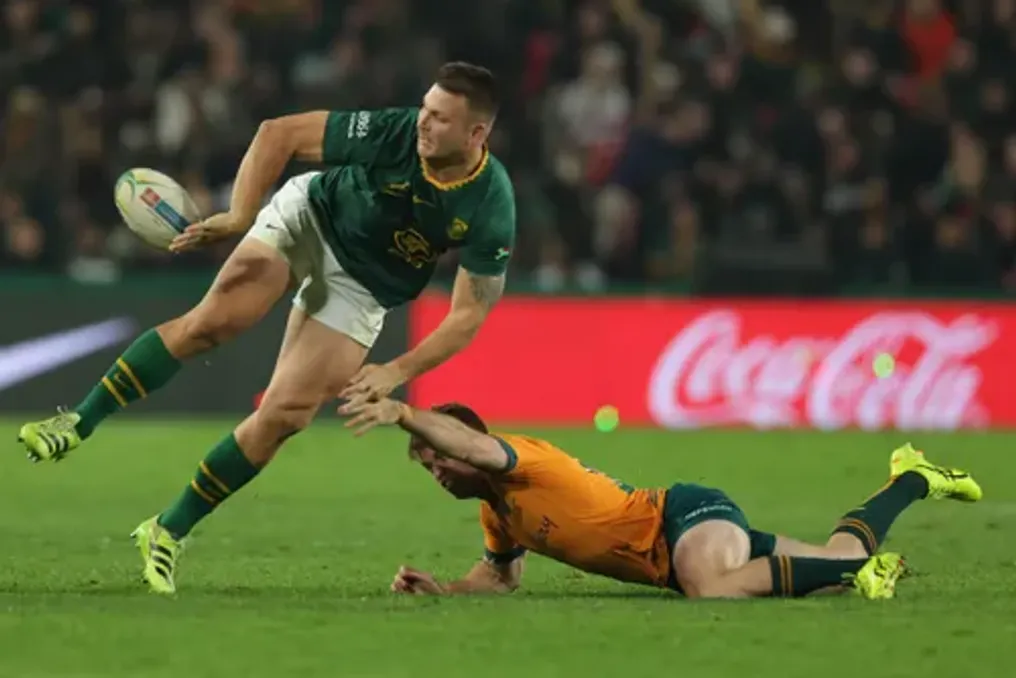
Rassie revealed why Andre Esterhoizen is suitable for captaining the Springboks in Perth
Read more
IOL
iol.co.za

Rassie revealed why Andre Esterhoizen is suitable for captaining the Springboks in Perth

Springboks' versatile player Andre Esterhoizen will lead the South African team against Australia on Sunday. Head coach Rassie Erasmus aims to expand his group of leaders ahead of the 2027 Rugby World Cup.

Rassie Erasmus believes that due to Andre Esterhoizen's versatility, experience, and leadership qualities, he is the ideal candidate for the captaincy of South Africa in the upcoming friendly match in Perth. Esterhoizen will be the 68th player to represent the Springboks.

In the match against the Wallabies, Erasmus made 13 changes to the starting lineup after a series of four matches against the All Blacks.

The 32-year-old athlete captains the Sharks in the United Rugby Championship (URC) and Champions Cup tournaments, establishing himself as one of the most multi-functional players in the World Cup squad. He has been used in the positions of centre forward, loose forward, and as a hybrid substitute player.

For Erasmus, handing over the captaincy to Esterhoizen is also part of a broader plan to develop the team's leadership structure before the 2027 World Cup. Alongside captains Siya Kolisi, Pieter-Steph du Toit, Eben Etzebeth, and other veterans such as Handre Pollard and Jesse Kriel, the Boks will ensure a strong core of leaders.

Reasons for Erasmus's choice of Esterhoizen

Erasmus explained during the press conference announcing the squad on Tuesday that the issue was not about choosing a captain, but rather how to bring together senior players so that everyone has a unified voice.

He noted that a player like Eben always brings the same positive atmosphere, wisdom, and calmness to the team, regardless of whether he is the captain. He also emphasized that Andre always knows what he is doing when he is on the field. Although Jesse Kriel is not currently playing, he was previously a captain, and Siya also held this position. Thus, the team is working on forming its leadership circle.

Erasmus added that Andre captained the Sharks and was the player who always took on any task, whether playing as a hybrid player or playing alongside Damian de Allende and Damian Willemse, sometimes playing a lot, and then agreeing to play as a forward and an influential player. The coach wants to see him in this situation against a strong Australian team.

In Erasmus's opinion, it is not only an honor for Esterhoizen to receive the captaincy but will also help the team in the future, approaching the World Cup, by having more players who understand what it means to lead the Springboks.

Erasmus also pointed out Esterhoizen's leadership qualities during his time at the Sharks, especially when the Durban franchise was going through difficult times. Despite a tough season in the URC and Champions Cup, under Esterhoizen's leadership as captain and head coach JP Pietersen, they showed strong performances.

Springboks made 13 changes

Considering the 13 changes to the starting lineup, the coach understands that the new team may need time to find its rhythm. Since many players had limited game time in the international season, the Boks will have to establish cohesion after Erasmus largely maintained previous combinations during the 'Great Rugby Rivalry' series.

Handre Pollard and Herschel Jantjies will form a new pairing in the playmaker and scrum-half positions. Furthermore, the Boks will field a young combination in the front row: hooker Johan Grobbelaar, tighthead prop Zacharie Potten, and loosehead Jan-Hendrik Vessels. Kanan Moody will also get the opportunity to play at outside centre, while Edwill van der Merwe will take his place on the wing.

Erasmus noted that the previous strategy of constantly using the same team against the All Blacks allowed them to gain momentum. However, he questioned how the team would learn about the potential of new players by the end of the year for the World Cup or the next World Cup if they continued this way.

He recalled the game in Argentina where many of these players participated, and it was a disjointed and uncoordinated performance. In his opinion, they will not start the game with maximum effort, but he is confident that they are highly motivated and want to play, as they have been in a state of rest for a long time. He also noted that since some players had game experience, he hopes the start will not be too difficult, and that Australia has not played for 300 minutes in the last three weeks.

Springboks squad against Australia

Starting lineup:

The starting XV includes: 15 Apelele FASSI, 14 Edwill van der MERWE, 13 Kanan MOODY, 12 Andre ESTERHOIZEN (captain), 11 Ethan HOOKER, 10 Handre POLLARD, 9 Herschel JANTJIES, 8 Marco van Staden, 7 Elrig Louw, 6 Paul de Villiers, 5 Franco Mostert, 4 Eben Etzebeth, 3 Zacharie POTTEN, 2 Johan Grobbelaar, 1 Jan-Hendrik VESSELS. Reserves: 16 Malcolm Marks, 17 Ox Nche, 18 Vilko Louw, 19 Lud de Jager, 20 Jasper Wise, 21 Morne van den Berg, 22 Sasha Feinberg-Mngomezulu, 23 Kwan Horn.

Similar stories

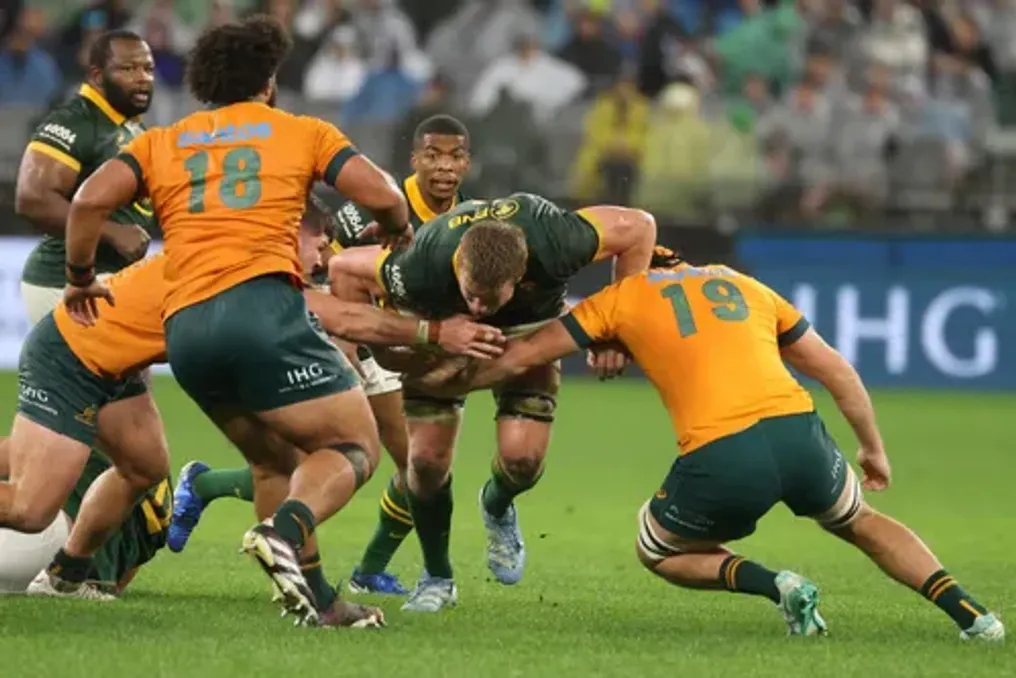
Test match between Springboks and Wallabies in Perth seen as preparation for the 2027 Rugby World Cup playoffs
Read more
iol.co.za

Test match between Springboks and Wallabies in Perth seen as preparation for the 2027 Rugby World Cup playoffs

The upcoming test match between the Springboks and the Wallabies in Perth provides the Springboks team with an opportunity to conduct practical training ahead of the 2027 Rugby World Cup playoffs.

Despite the immediate goal of winning away against the Wallabies, the coaching staff under Rassie Erasmus is already analyzing all logistical and game details in anticipation of defending the title next year in Australia.

The Springboks are scheduled to return to this venue in October 2027, where they will face Romania in the third group match of the World Cup, making this test match a strategic operational rehearsal.

The group match itself is expected to be predetermined, as the Boks are likely to easily defeat the Romanian team. However, it is the first playoff match in Perth that will command the full attention of the Springboks.

Since the Springboks are likely to finish first in Group B, they will face the best team that finished third in Groups D, E, or F in the Round of 16. Siya Kolisi's team is expected to meet one of the teams from Japan, Samoa, or Tonga in this match before a possible quarter-final clash against their long-time rivals, the All Blacks.

Playing in Perth next Saturday allows the Boks to adapt in advance to the specific environmental conditions and logistical features of the city. Furthermore, Western Australia has a large South African community, and the upcoming match will give the Boks insight into the loud support in 'Perthfontein' that they might expect in 2027.

When South Africa meets Romania next year, as well as whoever awaits them in the Round of 16, the opponents may differ, but the environment will remain the same. By conducting rehearsals at the stadium, hotels, and training facilities now, Erasmus ensures that his team eliminates unknown variables, striving to reach peak form by the start of the main World Cup stage.

In the World Cup campaign, where success is determined by minor advantages, this early reconnaissance in Perth could prove to be a subtle yet decisive edge.

Experts dispute James Dalton's criticism of Springboks player Sacha Pheenberg-Mngomezulu
Read more
iol.co.za

Experts dispute James Dalton's criticism of Springboks player Sacha Pheenberg-Mngomezulu

Some critics are questioning the achievements of 24-year-old playmaker Sacha Pheenberg-Mngomezulu, the Springboks team's flanker, despite the Springboks winning the series against the All Blacks 3-1. However, many believe that the opinion of former Springboks player James Dalton is mistaken.

Attack on the Giant

Sacha Pheenberg-Mngomezulu presents an exciting spectacle in modern rugby. Following the Springboks' victory over the All Blacks, a vocal minority began to doubt his achievements. Among them is James Dalton, a former Springboks hooker, who publicly stated that the flanker has 'average play' and 'lacks the X-factor' on the Omniaudioafrica platform.

Supporters of Pheenberg-Mngomezulu argue that Dalton may be unaware of the player's progress over the last three years, as this young talent is outstanding. His play is far from average, evidenced by his performances against Argentina in Durban last year, as well as his crucial contribution during the tour of Ireland and France in November.

The criticism following the four-match confrontation with the All Blacks is not surprising, given the high level of public attention the player at position 10 in the Springboks receives. Pheenberg-Mngomezulu himself admitted that he was not playing at his peak against New Zealand because he was recovering from an injury before the series.

During the first match at Ellis Park, the team showed rushed and nervous play, and much of the blame was placed on the midfielders. Nevertheless, it would be unfair to ignore the adjustments he made over the last three matches to change the course of the series.

What makes Pheenberg-Mngomezulu a generational talent is his exceptional spatial awareness and unparalleled athletic courage. He possesses a rare, fluid grace when handling the ball that cannot be taught. Whether he plays as a flanker or shifts to fullback, his vision allows him to spot opportunities two phases before they arise.

When the series culminated at M&T Bank Stadium in Baltimore, Pheenberg-Mngomezulu's true value was fully demonstrated. Sharing playmaking duties with Manu Libbok, he brought absolute calm and fluidity to South Africa's attack on Saturday.

The player's ability to confuse the opposition's defense created spatial freedom, allowing the main Springboks runners to operate freely. When Pheenberg-Mngomezulu plays confidently, the entire defensive line raises its level of play.

In addition to ball distribution, his individual skill set is remarkably complete. His burst acceleration allows him to break through gaps, and his physical strength enables him to hold onto the ball in contact. Add to this an unexpectedly aggressive defensive component for a flanker, and you have a player perfectly suited for modern play in all possible aspects.

Although his kicking game has slightly declined over the past two years, as confirmed by several errors in Baltimore, this is not a catastrophe for a player of his age and work ethic. These minor shortcomings will be corrected in the near future.

At 24, Pheenberg-Mngomezulu is still accumulating the necessary Test-level match experience to master game management against global giants like the All Blacks. Every legendary Springboks flanker went through their difficult learning periods.

The difference is that very few emerge onto the international stage with such an overwhelming set of natural gifts. The Springboks' attacking development over the last year has been greatly accelerated by Pheenberg-Mngomezulu's boldness in trying the unconventional.

One can criticize his play if necessary, but one must not forget: South African rugby possesses a gold mine of pure, unadulterated genius. The noise will pass, but the talent will remain forever.

Popular