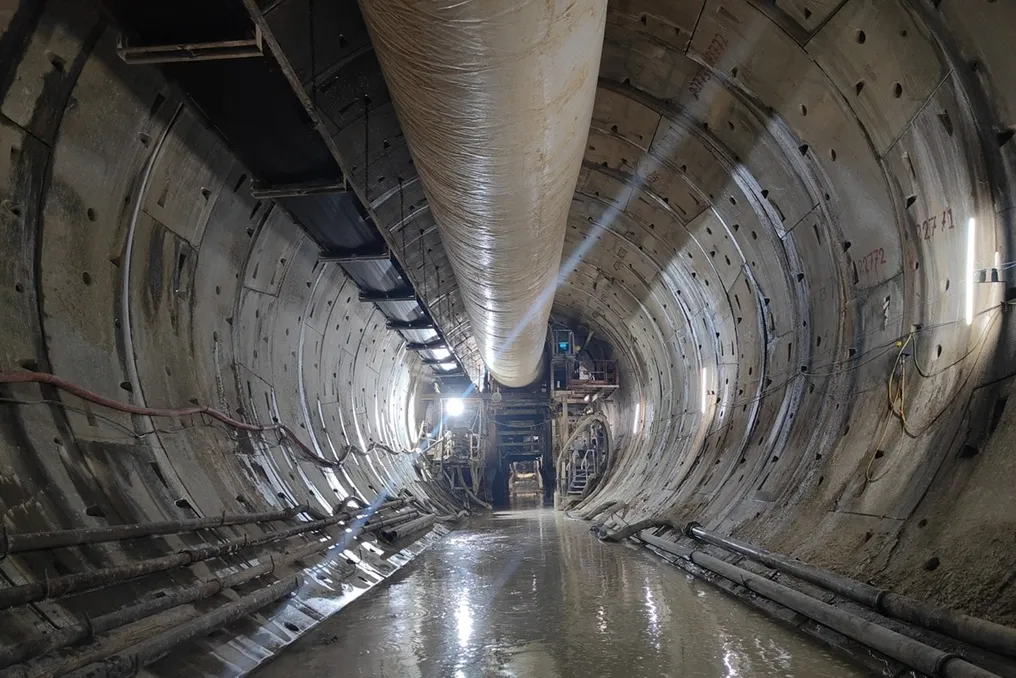
The Slimnabad Tunnel, one of the largest and most complex irrigation projects in Madhya Pradesh and one of the most challenging water tunnels in the country, is approaching its final stage. According to Chief Minister Mohan Yadav, this mega-tunnel, measuring 11.952 kilometers long and being constructed in the Katni region, is actively under construction.
Currently, physical work on the project is 96.66% complete, with only the final 1-meter breakthrough section remaining. Upon full commissioning, water from the sacred Narmada River will flow directly into 1450 villages across the Vindhya and Mahakaushal regions via the main Bargi Dayin embankment, permanently resolving issues with irrigation and drinking water.
According to mythological beliefs, after exiting Amarkantak, the Narmada and Sonbhand Tekli rivers split in opposite directions and separated forever. This tunnel is designed to pierce the Vindhya mountain range and deliver Narmada's water directly to the Son river basin.
This mega-project, which was suspended for 17 years, has achieved record speed thanks to prompt government decisions and budget approvals.
Drilling through marble, hard limestone, and dolomite at a depth of about 30 meters and a height of 40 meters presented a serious engineering challenge. Water leakage inside the tunnel reached up to 25,000 liters per minute, which led to the breakdown of heavy American equipment previously used.
Subsequently, the advanced German machine Heranenknecht and the special 'trem-grouting' technology were employed. The 10.14-meter diameter tunnel was built in an extremely safe manner beneath densely populated areas, national highways (NH), and busy railway lines without causing damage.
With the tunnel's operation commencing, water from the main Bargi Dayin embankment will begin flowing directly to the fields, leading to the irrigation of lands in five districts: the Satana district will see the largest area greened—104,970 hectares; the Maihar district will receive water for 54,227 hectares; the Katni district will irrigate 21,823 hectares; the Riva district will be irrigated by the tunnel over 3,084 hectares (with the overall goal for the Tontar, Lonhi, Sirmaur, and Semeria projects totaling 132 thousand hectares); and in the Panna district, 448 hectares of dry land will be revived.
As of March 2026, an irrigation capacity of 44,160 hectares has already been realized. By December 2026, the irrigation zone is planned to be increased to 87,433 hectares. The goal set for December 2027 is to ensure a complete irrigation system covering a total area of over 154,693 hectares (more than 1.54 lakh hectares).