Even after living in New York for over ten years and becoming completely accustomed to the fast pace and certain impersonality of relationships, the author is enchanted when traveling to other parts of the United States and discovering the country's diversity and warmth.
During a recent trip to the state of Georgia, she encountered hospitality, a calmer pace, and the charm of smaller cities. Atlanta, the capital, possesses these characteristics but adds a strong dose of urban energy, presenting a cultural, gastronomic, and artistic scene that ranks it among the most fascinating metropolises she has known in the country.
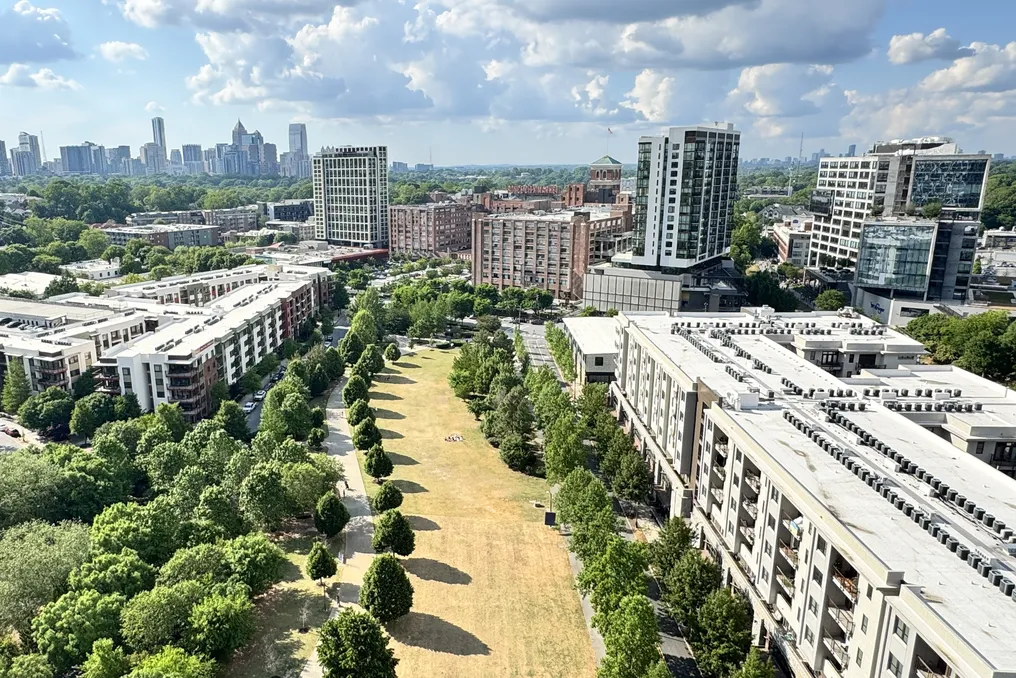
It is no coincidence that Atlanta received the nickname "The City in a Forest," as approximately 48% of its urban area is covered by trees, distributed throughout streets, parks, and residential neighborhoods. Many green areas remain integrated into the landscape instead of being completely replaced by urban growth, resulting in a metropolis with a green horizon where nature is more present than expected.
The combination of history, pop culture, urban art, green spaces, and the gastronomic scene was what captivated the author the most, leaving her feeling that she had discovered a richer and more varied city than she imagined, and falling completely in love with it.
Local residents pronounce the city's name with the two silent Ts, sounding similar to "Elana," and visitors quickly get used to this pronunciation.
Starting Points and Tourist Attractions
To begin exploring the city, the ideal spot is Centennial Olympic Park, built for the 1996 Olympic Games. Near this park, several important tourist attractions are located, such as the Georgia Aquarium, the World of Coca-Cola, the National Center for Civil and Human Rights, and the Martin Luther King Jr. National Historical Park.
The Georgia Aquarium provides an immersion into the underwater environment. The Ocean Voyager gallery is one of the world's largest aquatic exhibitions, featuring a 30-meter transparent acrylic tunnel and a large observation window where whale sharks, manta rays, giant grouper, and thousands of other fish could be seen.
The Sharks! Predators of the Deep exhibition is highlighted as one of the largest and most dynamic shark shows in North America, gathering well-known ocean predators, and was described as mesmerizing.
Next door is the World of Coca-Cola. For fans, it is an immersive experience in the history of the world-famous drink, which originated in Atlanta. In the interactive The Studios exhibition, visitors explore Coca-Cola's influence on areas such as art, music, fashion, sports, and entertainment, and can even create new versions of the bottle.
The Loft area displays a collection of nearly 200 historical pieces covering more than 135 years of Coca-Cola's memory and items from over 30 countries. A highlight is the Taste It! tasting room, where visitors can sample over 100 drinks from the Coke family from different regions, with flavors ranging from sweet to spicy and salty, including a creamy raspberry soda from Africa (launched in 1955), a cucumber-flavored Sprite from Romania, and a ginger drink from Tanzania.
The author, who hadn't consumed soda since 1995, made sure to toast and drink a glass at the World of Coca-Cola, enjoying the nostalgic atmosphere at the drink's place of invention.
Across the square is the National Center for Civil and Human Rights. This interactive and moving museum links the fight for civil rights in the United States to global human rights movements, considered an essential visit because Atlanta was the center of the Civil Rights Movement in the 1960s.
In each room, records of historical events are displayed, with a special focus on the trajectory of the Black population. A striking experience was a replica of a bar, where visitors listened to insults directed at a Black customer by white people through headphones, an experience described as moving and almost revolting.
Finally, the Martin Luther King Jr. National Historical Park, located in the historic Sweet Auburn neighborhood, is another must-see spot. There, visitors can see the religious leader's birthplace, the Ebenezer Baptist Church, where he and his father served as pastors, and the memorial with his remains.
Neighborhoods and the Atlanta Beltline
Cabbagetown is a historic neighborhood in Atlanta, established in 1881 around the Fulton Bag and Cotton Mill, a textile factory intended to house its workers. After the factory closed in 1977, the neighborhood declined, but in the following decade, a group of artists led a revitalization, transforming the area into a modern and charming spot, full of restaurants serving Southern specialties, such as burgers and hot dogs.
The Atlanta Beltline is a former disused railway line converted into a linear park. This park is adorned with urban art murals, bike paths, and pedestrian trails. Its outdoor trail circuit spans about 35 km and encircles the city, contributing to Atlanta's reputation as "The City in a Forest."