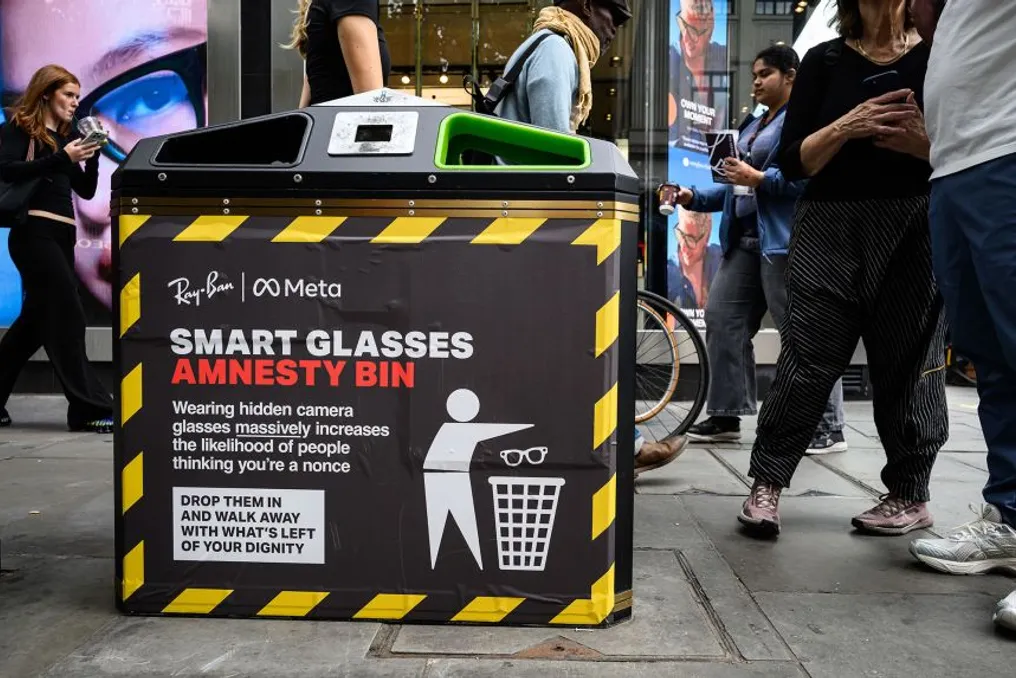
Growing privacy concerns in London over smart glasses
Read more
Egypt Independent
www.egyptindependent.com

Growing privacy concerns in London over smart glasses

Although bars, theaters, and restaurants in central London may seem like ordinary places, owners of many establishments are facing serious issues due to a new device that some consider potentially dangerous—smart glasses.

These glasses can record video, photos, and audio from the user's perspective, and their popularity is growing. Eyewear giant EssilorLuxottica, which collaborates with Meta on manufacturing the glasses, reported that seven million pairs of AI glasses were sold in 2025. According to The Information, at the upcoming Connect conference, Meta plans to introduce new camera-free smart glasses. Samsung and Google are also expected to unveil jointly developed smart glasses this autumn.

However, as this technology spreads, negative reactions are intensifying. Videos on social media showing men who appear to be filming women without their knowledge have raised questions about consent and whether existing privacy laws can keep up with technologies that allow people to record almost unnoticed.

Irina Raiku, Director of the Internet Ethics Program at the Markkula Center for Applied Ethics at Santa Clara University, previously told CNN: 'It is becoming increasingly difficult to protect yourself just by looking around and filtering things out. Thus, the entire concept of consent begins to fall apart.'

London, along with New York and Australia, is becoming an indicator of how society and business are reacting to technological development. Some hospitality and entertainment venues have introduced restrictions or outright bans, and advertising signs against smart glasses have appeared in some bus stops across London. One such sign mocks Kylie Jenner's advertising campaign for Meta glasses, depicting her as a skeleton on an X-ray with the slogan: 'We are always watching.'

This sentiment reflects a broader ban across Great Britain, introduced in August, prohibiting the use of smart glasses in courts. Some London residents told CNN that smart glasses cause them discomfort in places where people expect a certain degree of privacy, such as bars, restaurants, and other social settings.

The popular pub chain Wetherspoons has banned patrons from using glasses for recording. Zac, a student at the Wetherspoons pub in central London, told CNN: 'I don't want to be filmed when I'm just having a couple of pints.' He added that he had seen videos on TikTok where people seemed unaware they were being recorded, calling the recording LED coverage 'absurd.'

Serena, another Wetherspoons patron, expressed particular concern about the possibility of being filmed without knowledge and where the recording might end up. A Wetherspoons representative told CNN: 'Regarding Meta glasses, our instinct was to say: 'turn off the cameras.''

Meta claims that the camera on its glasses will not record if the recording LED is covered. In August, the company announced an update to its glasses to prevent users from attempting to cover the light after recording had started, after the glasses could previously detect if the light integrity was compromised. Meta also stated that it is preventing the spread of videos on social media where users use their AI glasses to stalk others.

A Meta representative stated in a statement to CNN: 'Of course, some places should not be filmed at all, and that is reasonable, but rules must be applied consistently. Our glasses have a light that turns on to notify people that a photo or video has been taken, which smartphones and other cameras do not have.'

Google had previously addressed this issue. More than ten years ago, the company attempted to popularize smart glasses with its now discontinued Google Glass, which sparked similar privacy concerns. Sameer Samat, Google's President of the Android Ecosystem, said that the company is not surprised by the recent pushback. He noted to CNN in August that details such as how the glasses signal recording and whether users can bypass these safeguards are 'truly, truly important,' and that Google takes these concerns into account when developing its glasses. Like Meta's glasses, future Samsung glasses running on Google software will have an interference-resistant privacy LED.

Samsung and Google declined to comment on CNN's inquiry.

According to Callie Schroder, Director of the AI and Human Rights Program at the Electronic Privacy Information Center (EPIC), solving the privacy issue will be complex. Many potential solutions—such as automatic blurring of people's faces during recording or requiring their legal consent before uploading videos—will be difficult to implement and still unable to completely eliminate risks.

One possible method is configuring the glasses to determine their location and automatically disable recording in sensitive areas, such as playgrounds and changing rooms. However, this would require the glasses to have autonomous environmental perception, which could also raise privacy issues.

At the Piccadilly Theatre in London, staff and audience members noted that smart glasses could undermine the experience of a live performance and negatively affect actors' livelihoods. Bradley, a waiter and theatre director, noted that much of the appeal of attending theatres lies in the performance remaining a mystery until the start, which could be threatened by covert filming.

A representative from ATG Entertainment, which manages several iconic West End theatres in London, told CNN that audiences would be asked to remove their glasses and delete any recordings if found with them.

The UK Cinema Association (UKCA) reported at the end of last month that many cinemas in the UK are also banning the use of smart glasses due to piracy concerns.

The growing concern comes amid technological companies continuing to invest heavily in wearable devices, betting that glasses capable of capturing and processing the user's surrounding world could become the next major consumer platform.

These glasses allow users to listen to music, take calls, and take pictures without using their hands, and some tech companies believe they could become the preferred way to interact with AI assistants in the future. A Meta representative told CNN that their glasses allow people to 'stay in the moment, from listening to music to live translation or wireless calls.' He added that the glasses provide a 'critically important new technology' for people with visual impairments, and restricting their use would be a 'serious step backward.'

Advocacy groups, including the Royal National Institute of Blind People (RNIB), warned that excessive regulation of smart glasses could deprive people with visual impairments or low vision of an important accessibility tool. According to RNIB, the new technology could help with daily tasks such as viewing menus in a restaurant, reading road signs, or describing a landscape.

According to research firm Counterpoint Research, the shipment volume of smart glasses grew by 212% year-over-year in the first half of 2026, with Meta leading the market with approximately an 84% share. Schroder, Director of Human Rights at EPIC, believes: 'I think there is a huge fear of falling behind in the race of these new technologies. I also think that tech companies find it very easy to get into a bubble.'

Similar stories

The role of urban design in female safety: lessons from four public space studies
Read more
archdaily.com.br

The role of urban design in female safety: lessons from four public space studies

Public space is often idealized as a neutral and universal environment; however, the experience of accessing it is marked by inequalities. Many women constantly need to assess risks when moving through the city, considering factors such as visibility, proximity to people, lighting quality, ease of transport access, escape routes, and the possibility of harassment. Such assessments are influenced by both the physical characteristics of the environment and social dynamics. Safety, in this context, involves urbanistic aspects, such as built form, conservation, mobility, governance, and allocation of public resources. Although the built environment is not the primary cause of gender violence, it has the power to increase vulnerability and normalize unequal access, especially to public spaces.

For experts in architecture and urban planning, it is crucial to differentiate between designing for security control and designing for a sense of security. While control strategies focus on surveillance, policing, and flow management, daily urban safety depends on people's ability to be seen and to see, on clear routes, and on public spaces that welcome activities throughout the day and guarantee long-term maintenance. Design must, therefore, modify the circumstances under which public life occurs.

Various projects demonstrate how material care and collective memory can alter the use of infrastructure. In Tripoli, the renovation of a public staircase illustrates this point. In Cairo, the modernization of a neighborhood street highlights the effect of lighting, paving, seating, and maintenance on daily routines. In Orange Farm, a small nine-square-meter pavilion converts an abandoned corner into a meeting and visibility spot. In Bogotá, tactical urban interventions, based on gender perspective mapping, underscore the value of physical change, especially when future maintenance is uncertain. These examples reinforce that safer public spaces emerge from the interaction between design, use, governance, and attention directed towards women.

In the Qobbe neighborhood of Tripoli, Lebanon, the Charaani staircase connects a low-income residential area to the historic center and the city's markets. This neighborhood carries scars from conflicts that persisted until 2014. During consultations conducted by the firm Emergent Vernacular Architecture (EVA Studio), women mentioned that dangerous individuals used to circulate on the steep staircase and occupy strategic positions overlooking the neighborhood. With the resurgence of public life and increased traffic on the staircase, the challenge was to make this vital infrastructure habitable again for women and their community.

The EVA Studio team began work with diverse focus groups, gathering women, men, youth, elderly people, Lebanese citizens, and Syrian refugees. The process avoided treating the community as a uniform block, recognizing that the same place can be experienced differently depending on gender, age, national origin, and usage habits. The final solution for the staircase integrated infrastructure restoration with the use of locally produced hydraulic tiles—a material traditionally associated with Lebanese interiors and courtyards—along with the planting of lemon and orange trees, referencing the historical cultivation of citrus in Tripoli. A mural, created in collaboration with the family and neighborhood, signed by local artist Alfred Badr, honored an 11-year-old girl from the neighborhood who had died years earlier.

The Charaani project suggests that care can function as a form of spatial infrastructure. Elements such as decorated tiles, landscaping, and public art might be seen as mere aesthetic adornments, but in this case, they made visible the investment in a historically neglected space. Post-use reports indicated improvements in the sense of safety and cleanliness, as well as an increase in the use of the renovated route and its consolidation as a daily meeting point. However, this does not imply that mere urban beautification can solve the political and social issues that cause insecurity or perceived risk.

In Ezbet Khairallah, Cairo, the street functions as an extension of social and domestic life, used by residents to rest, negotiate, play, and celebrate. Poor lighting, damaged surfaces, neglected facades, and lack of seating had weakened the daily occupation that once animated the street, leading the community to associate it with harassment, drug use, and other risks. The rehabilitation, led by Ahmed Hossam Saafan and developed with the community networks of the Dawar El Ezba cultural center, placed the role of the street at the center of discussions.

During the project development, it became clear that basic needs such as paving, infrastructure, and lighting were more urgent than introducing new architectural languages. Despite this, the process introduced new paradigms for transforming urban dialogue, a central concept of the Dawar El Ezba Cultural Center. The intervention implemented direct measures: recovery of infrastructure and facades, new paving, lighting, landscaping, benches, and a modular and removable children's playground. Its architectural language sought local references rather than creating a new visual identity. Wooden benches reinterpret the mastaba, and window patterns evoke Ancient Egyptian architecture. Materials and labor were sourced locally whenever possible. Over a two-year period, participatory workshops continuously adjusted the design as new priorities emerged. The result strengthens the pre-existing role of the street as shared social infrastructure, creating better conditions for daily community occupation.

The project establishes a useful distinction between repair and transformation. The actions with the greatest impact on increasing women's safety were the simplest: lighting that improved visibility, paving that facilitated movement, seating that encouraged outdoor stay, and maintenance that signaled continuous care for the space. Project reports link the rehabilitation to urban revitalization and a decrease in harassment and antisocial activities—although such results should be viewed as reported effects, not as proof of a direct architectural causal link. Magdy El Khouly Street demonstrates that safety depends on the everyday infrastructure of public life.

In Orange Farm, south of Johannesburg, the Drieziek intersection had been classified by Amnesty International South Africa as a critical point of gender-based violence. The location was unlit, largely empty, and used for waste disposal, with little activity to generate visibility and safety for residents. The intervention proposal came from the Digital Disruptors initiative of Amnesty International South Africa, led by local young activists, including residents who had suffered or witnessed gender-based violence.

The Frankie Pappas International office proposed the House of the Pink Spot, a lightweight structure of only nine square meters. Built with accessible materials, such as bricks, telephone poles, and plywood, the pavilion offers seating, shade, lighting, Wi-Fi, and visual signage, becoming a prominent pink urban landmark. The space serves multiple functions: meeting point, study area, children's playground, informal theater, and dance floor. Materials were acquired locally, and community members participated in the construction and painting of the signage. Completed in two weeks, the intervention relied less on architectural sophistication and more on the concentration of practical reasons for people to gather there.

The Pink Spot project illustrates that human presence must be stimulated—a vital spatial dimension for safety. Shade, seating, connectivity, and comfort encourage the community to gather, while the height and color of the structure ensure its visibility, even from a distance. None of these elements alone prevents gender-based violence, nor does the transformation of a single corner solve its broader structural causes. Its relevance lies in changing the conditions of the place, transforming an urban void into a space of collective use. The great architectural feat is not the pavilion as an isolated object, but the public life it helps to host. Architectural solutions for safety in public areas like this intersection are essentially human and communal; the designer's role is to help mobilize the community to use and value the space.

In Bogotá, the Me Muevo Segura initiative addressed women's safety at the urban network scale. Under the leadership of the District Secretariat for Women and the Bicistema initiative, the project initially used the SafetiPin tool to map streets and bike paths based on factors such as lighting, visibility, pedestrian flow, public transport access, and road condition. This spatial data was supplemented by participatory workshops that recorded experiences that mapping alone could not capture, such as incidents of harassment and intimidation. Pilot interventions were developed in four neighborhoods—Kennedy, Suba, Teusaquillo, and Tunjuelito—where institutional distrust and a long history of lack of investment made community participation indispensable for the success of any design proposal.

The purpose of these interventions was to create safe urban environments for women and girls in public spaces and on public transport. Although focused on gender, the project demonstrates that designing with women in mind benefits the entire population. Post-occupation evaluations showed the limits of the intervention: with the reduction of programmed activities and active management, graffiti returned, and parts of the transformed spaces began to deteriorate. This observation weakens the idea that a successful physical intervention guarantees lasting safety, given that public space evolves over time, maintenance fails, activities cease, and usage patterns change. The Bogotá case reinforces that participatory diagnosis and design identify where intervention is needed, but the isolated project cannot sustain the conditions it creates. For architects and urban planners, questioning who maintains the space, who schedules its activities, and who is responsible for it is fundamental in any urban design proposal.

These projects challenge the notion that designing for female safety is limited to a set of isolated concrete architectural solutions. Lighting, visibility, seating, active facades, and accessible routes are crucial, but their effectiveness depends directly on the continuity of community involvement and space governance.

Popular