When Brazil is mentioned, most people picture the dense forests of the Amazon. However, this country also has another place whose ecosystem is significantly different from the Amazon. Here, in addition to dense forests, there are vast water areas, swamps, and numerous lakes. This area is called the Pantanal.
The Pantanal is a huge swampy territory in South America. Most of this area is located in Brazil, but it also extends into Bolivia and Paraguay. During the rainy season, a significant part of the Pantanal is covered with water. When the water level drops, lakes, meadows, and marshy lands become visible again.
It is this variable climate that makes this region unique. Within one territory, you can find the green anaconda, caiman, jaguar, capybara, and many species of birds.
The green anaconda is also one of the most impressive sights in the Pantanal. It is one of the largest snakes in the world, which prefers to be near bodies of water. Its heavy body allows it to move easily through the water and hide in it while waiting for prey. The water also helps it cope with the heat. Swampy areas like the Pantanal are ideal for it.
Often, the anaconda hides in the water so well that it is difficult to spot from a distance. The appearance of such a large snake in calm water looks like a scene from a movie.
Nevertheless, one cannot conclude that the anaconda attacks all people. It is a wild animal, and its behavior towards humans depends on the circumstances.
Caimans: why do their eyes glow at night?
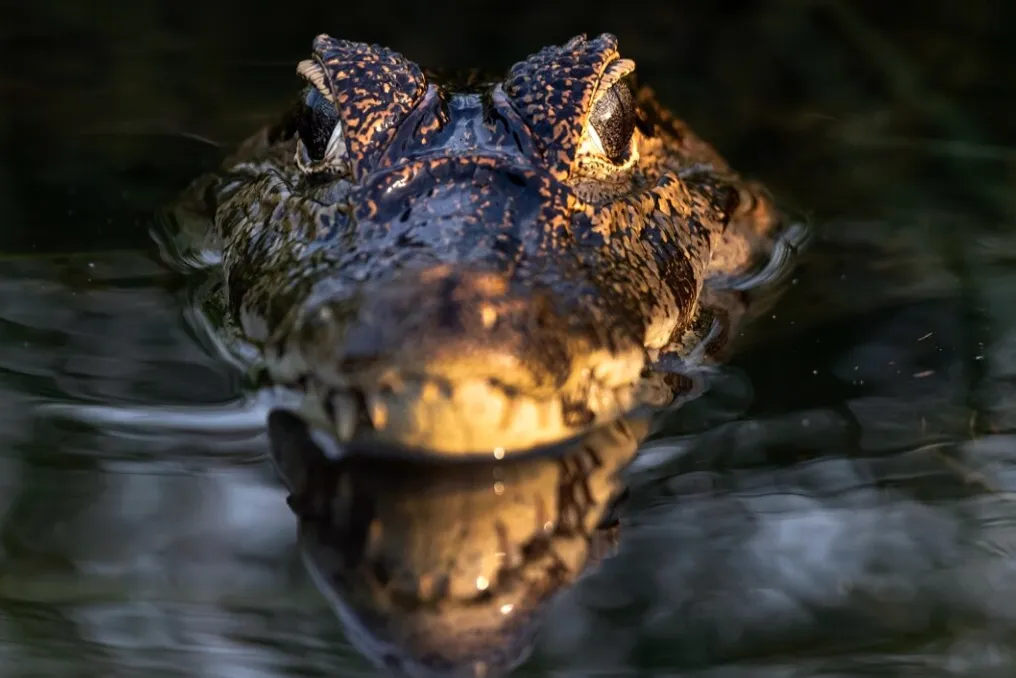
There are also many caimans living in the Pantanal. These animals resemble crocodiles externally and live in rivers, lakes, and other water zones. At night, when a flashlight beam falls on their eyes, they begin to glow. This happens due to a special layer behind their eyes that helps them see in low light conditions and reflects light.
This is why in the dark waters of the Pantanal at night, only the glowing eyes of caimans can be seen from afar. This sight adds even more mystery to the place.
This territory is known not only for anacondas and caimans; jaguars are also found here. The Pantanal is among the world's renowned places for observing jaguars in their natural habitat. Forests, meadows, and water areas coexist here.
Sometimes jaguars can be seen resting, drinking water, or hunting on the bank of a river or lake. Observing them near water is considered special because it is not always easy to see a jaguar in such open areas.
The most distinguishing feature of the Pantanal is its water regime. During the rainy season, water floods rivers and small streams, and large areas become submerged. After the water recedes, small ponds and lakes appear everywhere. These water zones contain a large number of fish, which provides easy access to food for birds and other animals.
Thus, the appearance of the Pantanal completely transforms with changes in the weather.
There are also many capybaras in the Pantanal, which are among the largest rodents in the world. These animals are often found in herds near the water. Additionally, a giant otter lives here, which swims very fast in the water and hunts fish. The Pantanal is also home to a very beautiful blue bird called the hyacinth macaw. Among the wildlife of this place are also animals such as the giant anteater and the armadillo.
The Amazon is known primarily for its dense tropical forests, whereas the Pantanal is defined by its vast water and swampy territories. This is why photographs of these two places look very different. In the Pantanal, water, open grassy areas, and forest can be seen simultaneously. Thanks to this unique setting, there is an opportunity to observe wild animals in open areas and photograph them.
This is the main feature of the Pantanal: sometimes you can see a green anaconda hidden in the middle of the water, sometimes the glowing eyes of a caiman at night, and sometimes a jaguar roaming by the river. These species make this place one of the most interesting wildlife reserves in the world.