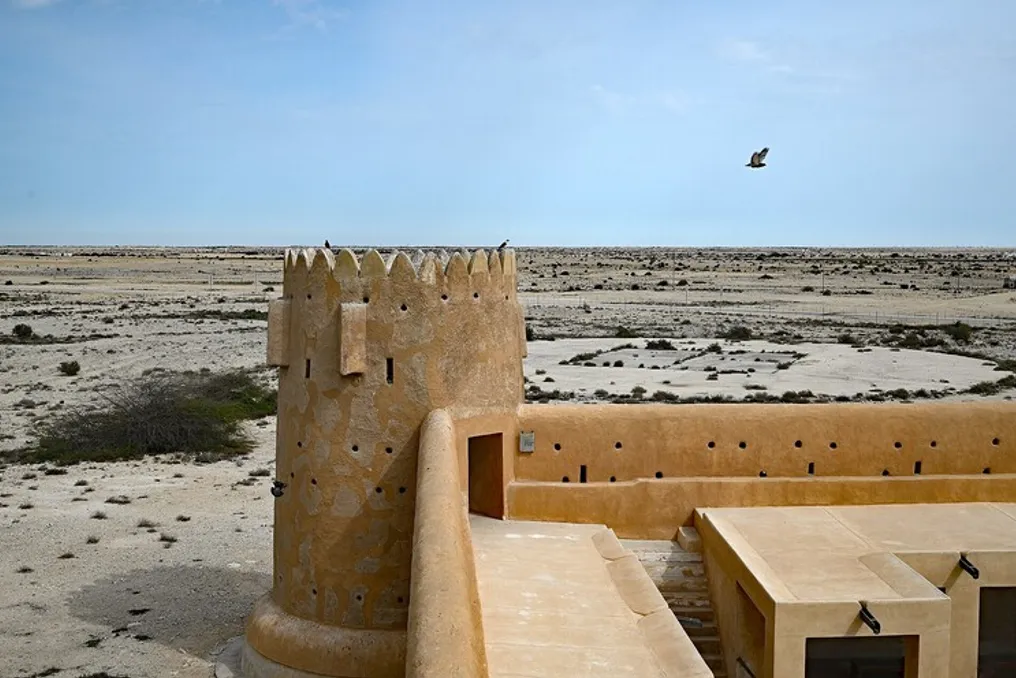
For many communities in the Persian Gulf region, the very act of residing implied the necessity of leaving home. Families moved between desert pastures, coastal settlements, wells, fishing grounds, and pearl diving ports depending on the season and sources of sustenance, regularly returning to familiar places.
In Qatar, historical accounts describe migrations in autumn and winter across Al-Barr (the desert), followed by a return to coastal settlements with the start of the pearl diving season in summer. The National Museum of Qatar illustrates this history with an annual chart of movements between the sea and the desert.
Home could extend across multiple locations occupied at different times of the year, expanding into a wider geography of places that were abandoned and resettled during seasons. Today, many modern projects in the Persian Gulf region aim to create contrasting climatic and spatial conditions within a single permanent urban system.
Home Was Not a Point
Seasonal movements across the Arabian Peninsula followed various routes dependent on pastures, water availability, trade, livestock, and the marine economy. Archaeological studies in Qatar describe diverse cycles among groups such as Al-Naim and Al-Murrah, as well as urban dwellers who also migrated to the desert in winter. The city, coast, desert, and pastures constituted a single economic geography.
Pearl diving expanded this territory towards the sea. From Doha and Manama to Dubai and Abu Dhabi, boats departed from Gulf ports during the summer diving season, connecting communities with oyster beds and maritime trade routes. The summer movement was directly linked to the pearl harvesting season. The landscape changed throughout the year, and patterns of occupation changed with it. No single settlement was meant to provide all seasonal conditions; people moved between places suitable for different times of the year and livelihoods.
Repeated journeys made routes, wells, and temporary camps familiar, even if they left few or no permanent structures. The route between the winter pasture and the summer settlement was significant precisely because it was repeated. Wells gained meaning through constant return. Camps achieved continuity even after their structures disappeared.
Architecture That Could Depart
Bayt al-Sha'ar, or 'house of hair,' was built specifically for this pattern of movement. This Bedouin tent, made from woven animal fibers, supported by poles and stretched with ropes, was light enough to be dismantled and transported as communities moved. Kuwait's heritage inventory describes this structure as easily transportable and registers its construction, sewing, and assembly as collective practices.
Its simple design relied on precise ecological knowledge. Panels of sheep's wool provided enclosure while responding to climatic changes, and individual sections of the textile structure could be repaired or replaced as needed. UNESCO documentation on Al-Sadu weaving records the sheep's wool panels of the tent among the textile practices used to produce these structures. Inside the tent, textile partitions could divide areas for reception, family life, and private life, without turning the dwelling into a rigid sequence of rooms. However, this mobility depended on constant access to the territory outside the tent.
When Territory Became Fixed
During the 20th century, the territory traversed by these communities was reorganized. Oil extraction, the formation of the modern state, highways, national borders, formal employment, and permanent housing gradually transformed the landscapes through which populations moved. Studies in Kuwait and Saudi Arabia map this change through the sedentarization of Bedouins between the 1940s and 1970s.
Governments and international agencies stimulated sedentarization through housing programs, agricultural employment, and jobs in the developing oil economy. Modern architecture and experimental farms integrated this process of settling down. Permanent settlements reorganized access to services, work, infrastructure, and land. Highways accelerated movements while directing them into increasingly formalized networks. Borders turned territorial crossings into administrative passages. Fixed housing concentrated daily life in places designed for continuous habitation. Seasonal movement continued, however, increasingly detached from the means of subsistence that previously required it.
Returning Without Leaving Forever
The winter camp continues to be part of this seasonal pattern across the Gulf. Families still leave cities in milder months to settle in desert camps, and the Bayt al-Sha'ar remains in the tradition of seasonal camping. Kuwait's cultural registry indicates its continuous use during the camping season, even after the dwelling ceased to function as the primary architecture of nomadic life.
The purpose of this mobility has changed. In the past, movements were tied to livelihoods distributed across the territory. Today, a modern camp mostly serves as a temporary retreat from consolidated urban life. Infrastructure, vehicles, electricity, water supply, and recreation areas increasingly accompany these camps. The desert remains a destination, but the city travels with the residents. Seasonal movement has gradually shifted from providing sustenance to leisure. Escape has become something that can be planned before finally returning to urban routine.
Building the 'Other Place'
Modern projects in the Persian Gulf region are increasingly attempting to offer contrasting climates and landscapes without requiring people to leave the city. Artificial islands, air-conditioned indoor landscapes, cooled public spaces, and resort areas create conditions distinctly different from the surroundings. Conditions that were previously only achievable through movement can now be reproduced within permanent structures.
The LINE is an exceptionally clear example of this. NEOM described the project as a linear urban development stretching across desert, mountainous, and coastal landscapes, organized without traditional roads and designed to provide daily amenities within a short walk. Its proposal included microclimates designed to balance shade, sunlight, and ventilation, in addition to what its official material called an 'ideal climate year-round.'
The proposal aimed to integrate diverse environmental conditions into a single urban system. Historically, living in different environmental conditions required traversing the territory. In The LINE, many of these conditions had to be created within the architecture itself. Its ecological strategy utilized shade, ventilation, and controlled microclimates. High-speed mobility aimed to reduce travel time within the project, while access to surrounding landscapes was included in the proposal.
There is no direct link between Bayt al-Sha'ar and the The LINE project. The parallel lies rather in how both respond to environmental changes. Bayt al-Sha'ar depended on movement across the territory. The The LINE project proposed concentrating multiple environmental conditions within permanent infrastructure.
When Escape Becomes Permanent
Romanticizing mobility offers little benefit. Seasonal pastoral life involved scarcity, hard labor, and environmental uncertainty, alongside freedom of movement. Permanent settlement brought health, education, infrastructure, work, and security guarantees that mobile landscapes could not always provide. The old model allowed populations to react to environmental changes through movement itself. Bayt al-Sha'ar could be dismantled, transported, repaired, and rebuilt.
Routes, pastures, wells, and camps remained familiar due to continuous seasonal use. This same ambition is manifested on a monumental scale in new Gulf mega-projects. Their technical goals are increasingly focused on ensuring year-round employment despite heat, distance, and seasonal fluctuations.
Leaving did not necessarily mean abandoning home, as it survived in absence. Routes were traveled again, seasonal spots revisited, and structures like Bayt al-Sha'ar could be rebuilt after relocation. Modern architecture has become increasingly capable of supporting habitation in constantly changing conditions. Bayt al-Sha'ar, on the other hand, depended on a different capability: it could be disassembled, transported elsewhere, and restored when its inhabitants returned.