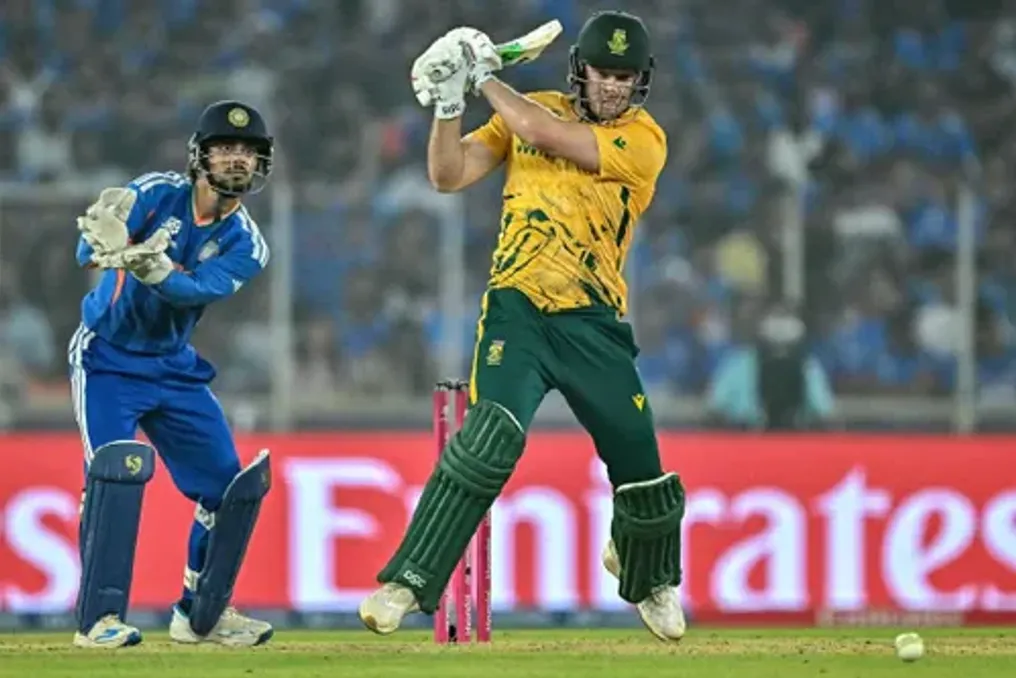
David Miller confirms commitment to Proteas squad ahead of crucial ODI series against Australia
Read more
IOL
iol.co.za

David Miller confirms commitment to Proteas squad ahead of crucial ODI series against Australia

Experienced batsman David Miller is aiming to secure a spot in the South African team for the upcoming Cricket World Cup on home soil, welcoming the internal competition and accepting his role as an unsigned player.

As matches against Australia are always high-stakes events, there is also the smaller matter of making an impression before next year's Cricket World Cup on home ground. David Miller hopes to be part of that squad.

Therefore, strong performances against Australia in the three-match One Day International series, starting in Kingsmead, Durban, on Wednesday, take on added significance.

As a long-standing middle-order anchor for Proteas, the 37-year-old Miller may be competing for his place amid an influx of young talent such as Tristan Stubbs, Matthew Breitschke, and Dewald Brevis.

Being the oldest player in the current squad, Miller has openly welcomed the emergence of these rising stars.

Miller stated that the competition is very healthy, as many players are performing well and showing initiative. He noted that in his personal process, executing what works for him, giving himself the best chance, thorough preparation, and team support wherever possible, are important.

He emphasized the need to trust what has been successful in his career without putting excessive pressure on himself, as he knows his worth and capabilities. For him, it is important to maintain focus and concentrate fully on the main objective. Miller believes that selecting players for the World Cup is always difficult for selectors, coaches, and the players themselves, but having a large pool of quality players is better than lacking them. He is genuinely happy that South African cricket is in such a healthy state.

When it comes to facing a long-time rival—against whom Miller has scored three of his seven ODI centuries—the left-hander enjoys the challenge. He mentioned that he likes playing against Australia because they have always been an extremely competitive team composed of highly skilled individual players.

Personally, he feels that clashing with such teams and players is the essence of the game; one always wants to test oneself against the best in the field. It is a matter of raising one's level when it matters most. He wants to be mentally prepared, knowing that he has overcome difficult situations in his career against elite opponents, and use that experience wherever possible.

Miller is no longer under a national contract with Cricket South Africa, preferring to spend his final years participating in various lucrative T20 leagues around the world. Nevertheless, the batsman insists that his commitment to national colours remains unwavering.

He disclosed that he lost his contract with Cricket South Africa, and while this is unfortunate, he acknowledges that it is part of modern sport. Miller clearly outlined his motives regarding playing for South Africa: he still wishes to represent his country and constantly makes himself available. He stressed that everything goes through the organizer and Conrad Shukri. In his case, he has maintained regular contact with Shukri over the past few months, and the entire process has been completely transparent. He loves competing with the best in the world, so wearing the Proteas jersey is what he will always prioritize.


Similar stories

Graham Smith warns Proteas about Australia's strategy to target experienced players in cricket rivalry
Read more
iol.co.za

Graham Smith warns Proteas about Australia's strategy to target experienced players in cricket rivalry

Former South African captain Graham Smith warned the Proteas team that Australia is likely to employ its traditional tactic during the upcoming tour of South Africa: focusing on the most experienced players to subsequently weaken the younger athletes.

In an exclusive interview with IOL, Smith stated that the characteristic of the Australian team is to target the most experienced and leading players. He noted that if they manage to control these players, it will allow the younger members of the team to develop more.

Although the Proteas are considered favorites, especially in Test series matches at their home ground, this rivalry is always unpredictable. The situation is complicated by the fact that Proteas' batting leader, Kagiso Rabada, is in question regarding his participation in the Test series after being dropped from previous ODIs.

As a result, South Africa may have to rely more heavily on the rest of its bowling attack. Smith expressed hope for KG's full recovery, while emphasizing the importance of players like Marco Jansen, who is a key all-rounder for the team. He also pointed to the significant role of Keshav Maharaj, who helps Temba [Bavuma] in his role as captain to be more experimental and secures important victories for the team.

Since world Test matches rarely last five days due to bowler-friendly pitches, the batting line will bear a large responsibility. Smith questioned whether players such as Aiden [Markram], Ryan Rickelton, and others can score the necessary runs, considering there are sufficiently strong bowlers available.

The tour includes three ODI matches and three Test matches. The first ODI match is scheduled for September 24 in Durban, and the first Test will begin on October 9.

Jefferies forecasts $60 billion defense potential in India and begins coverage of two companies
Read more
business-standard.com

Jefferies forecasts $60 billion defense potential in India and begins coverage of two companies

Global broker Jefferies has forecasted a double-digit Compound Annual Growth Rate (CAGR) for India's defense spending in the medium term, citing increasing global geopolitical tensions. Furthermore, the broker has started covering two private players in the defense sector, despite noting the high valuation of state-owned counterparts.

In its analytical report, Jefferies estimated that India's domestic capital expenditure on defense will grow at a CAGR of 16 percent from fiscal year 26 to fiscal year 30. This figure exceeds the projected 10% CAGR for overall defense capital expenditure, driven by the government's ongoing push for import substitution.

The total domestic market is valued at over $60 billion over four years. Against this backdrop, the Nifty India Defence index rose by 2.5 percent on Tuesday, reaching 9,998.7, marking the fourth consecutive day of growth and an increase of over 29 percent since the beginning of the year.

The report also notes that defense exports are gaining momentum due to the operational testing of Indian systems, such as the Akashteer command and control system and BrahMos missiles, during Operation Sindoor, which has enhanced export reliability. Forecasts include a 11% CAGR growth in defense exports from FY26 to FY30, amounting to 584 billion rupees.

According to the report, private sector participation is steadily increasing: the share of privately listed players in defense revenues grew from 9 percent in FY23 to 16 percent in FY26. This was made possible by the Ministry of Defence shifting its approach from appointments to competitive bidding under the Defence Procurement Policy 2026.

Company Coverage Details

Jefferies assigned a 'Buy' rating to Solar Industries with a target price of 28,160 rupees, based on an expected 31% CAGR in profit by FY30, as its defense business share is set to grow from 27 percent to 40 percent of sales. Similarly, Astra Microwave was initiated with a 'Buy' rating and a target of 2,055 rupees, based on a forecast of 28% PAT CAGR against a 19% revenue CAGR.

India's primary missile manufacturer, Bharat Dynamics, received a 'Hold' rating with a target price of 1,280 rupees. Jefferies noted that the stock is trading at a premium despite persistent execution challenges, although it forecasts a 30% EPS CAGR by FY30.

Among the companies already covered, Jefferies maintained a 'Buy' rating for Hindustan Aeronautics (target 6,800 rupees), Bharat Electronics (490 rupees), and Data Patterns (5,545 rupees), pointing to strong order visibility in the sector, even if current valuations already account for a significant portion of near-term growth prospects.

Popular