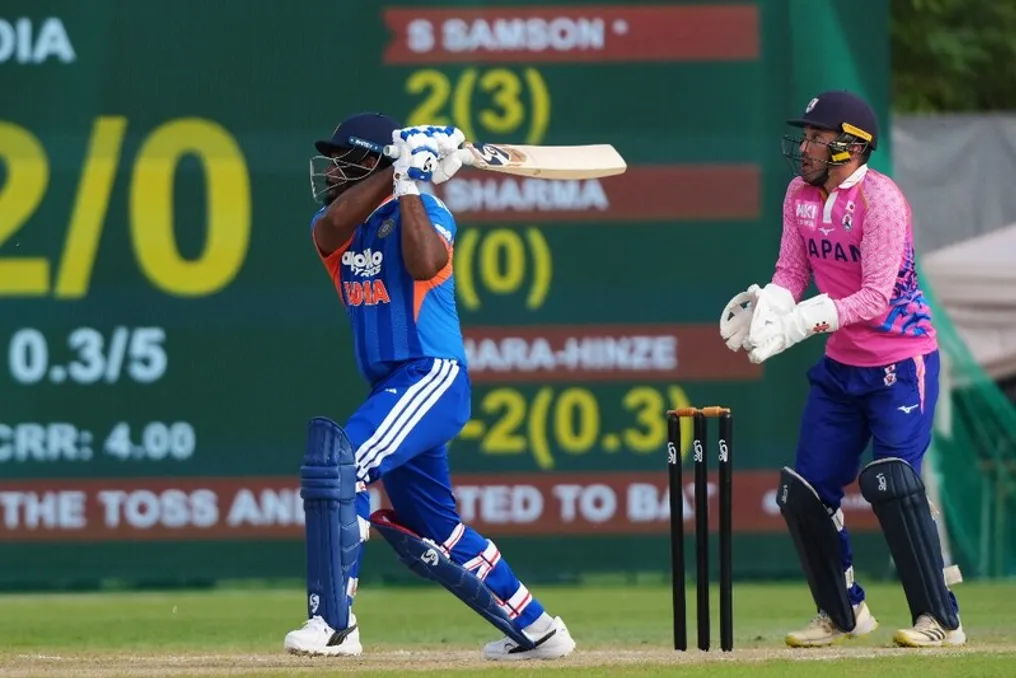
Despite the perceived large gap between India and Japan, the match at Sanno International Stadium on Tuesday, played in a five-over format, completely changed perceptions of the upcoming rivalry. The Japanese team, whom many considered incapable of facing Indian bowlers, managed to keep India under pressure until the final delivery. Ultimately, India won by only two runs, but this result raised several questions.
One of the most significant issues was Vaibha Suryavanshi's inability to participate in the match. Due to rain, the game was shortened to five overs. Under these conditions, India kept its starting pair of Sanju Samson and Abhishek Sharma, leaving Vaibha out of the squad. Abhishek returned after coming onto the field without scoring a single run, while Samson managed only 9 runs.
India had the option of using Vaibha for an aggressive game approach, but the team management decided to stick with the established starting combination. The situation was complicated by the fact that the Indian attack stumbled, losing four batsmen while scoring 32 runs in five overs.
Since Vaibha Suryavanshi was not in the squad, he was seen on the field during the match distributing water to the players. The young batsman, from whom bright shots were expected, served solely as a 'water boy' in this game. He was visible on the field handing water to the players, and his facial expression was captured by the camera.
This match also held significance in the context of celebrating the 75th anniversary of diplomatic relations between India and Japan. Both teams are preparing for participation in the Asian Games, where India is scheduled to start its tournament in the quarterfinals. Thus, this confrontation served as an opportunity for India to test its readiness for the Asian Games.
When the match was shortened to five overs due to rain, the question naturally arose as to why the young and explosive batsman Vaibha Suryavanshi was not used. However, the Indian team retained the opening pair of Sanju Samson and Abhishek Sharma, and Vaibha did not get a spot in the squad. The result was the halting of India's score at 32 runs against the Japanese spinners.
The problem for the Indian batsmen was not the strength of the known bowlers, but the Japanese spinners, against whom it was expected that the Indian players would hit powerfully. The pitch was humid, and the ball spun more than expected, which became a weapon for the Japanese bowlers.
Charlie Hara edged Abhishek Sharma for zero. Abhishek attempted a slog sweep but lost his timing. Following this, Ibrahim Takahashi forced Samson to play in the air for 9 runs, and he was caught at mid-wicket. Ishan Kishan also returned with three runs; he continued to try hitting against constant spin and was caught at mid-off.
Captain Shreyas Iyer scored 16 runs, but even he could not play freely due to the slow pace and spin of the pitch. In the Indian innings, only three-quarters were scored.
With such a small target of 32 runs, one might have assumed India would finish the match by several runs. However, in this unusual five-over contest, this small score became a pressure point for India. In the third over, Ravi Bishnoi earned 10 runs for Japan, and Washington Sundar conceded seven runs in the fourth over. In the last over, Japan needed only eight runs.
It was the experienced Akshar Patel who saved India. With over 150 IPL matches of experience, Akshar did not give the Japanese batsmen a chance to flourish in the last over. He placed the ball in such a way that Shirai Patmore and Benjamin Ito-Davis were unable to hit powerful shots.
Due to the rain, the pitch was also slow, which complicated matters for Japan. On the last delivery of Japan, a boundary was required, but Akshar Patel prevented this. Shirai Patmore tried to hit over the line, but the ball hit the pad and went towards the fine leg, and the batsman could only run one run. Thus, Japan's hope for a historic comeback ended, and India won a very tense match by a margin of two runs. Disappointment was evident on the faces of the Japanese batsmen, as they were confident they were very close to one of the greatest turns in cricket.
The drama in the last over intensified when umpire Chris Torgate called two wide balls against Patmore, who was attempting a reverse slog. India's captain Shreyas Iyer expressed disagreement with the on-field umpire Chris Brown. The decision on the second wide was ultimately overturned. This meant that in the final moments of the match, India was fighting not only against the Japanese batsmen but also against the decisions of the umpires.
Vaibha remained out of the game, but the match raised a second question.
