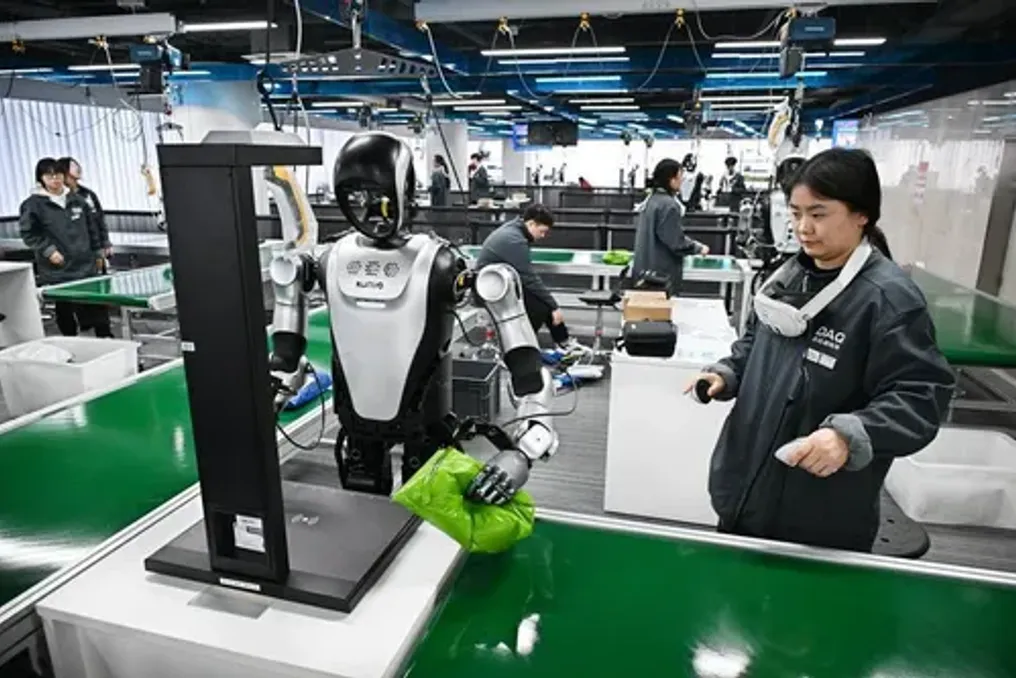
A new wave of professions, recently recognized by the Ministry of Human Resources and Social Security, is transforming the labor market in China. For instance, in Xiamen City, Fujian Province, 25-year-old Zhu Shaodong works as an embodied intelligence robotics technician—one of China's newest officially recognized professions.
Zhu explains that robots do not remain stationary on the factory floor; their task involves training robots to operate in real-world conditions. This role requires skills in programming, AI perception systems, and robotics, as well as the ability to quickly troubleshoot issues, whether they relate to software, hardware, or external conditions.
During the past Spring Festival, he directed a human-robot performance on Xiamen's pedestrian street after training the robots using motion capture data from professional dancers until their movements became smooth and synchronized. Zhu expressed delight at the official recognition of the embodied AI robotics specialist as a new profession, noting that his company focuses on robot training, maintenance, and further development, while the industry develops rating standards for this new specialty.
In central China, in Hunan Province, sports data analyst Su Xin and his team created an AI-based sports data analysis system that allows basketball enthusiasts to feel like stars. When college student Li Zhe made a three-point shot on a court in the new Xiangjiang district, his phone notified him with an edited AI clip containing detailed shooting statistics and a success diagram.
Su, who is a basketball fan and previously held a doctorate in engineering sciences, developed this system, named Qixuai, with his classmates after playing together. Since its launch in 2022, the system has collaborated with over 2,000 basketball courts and served more than 5 million users, and it is expanding into North America, Europe, and Southeast Asia. Versions for tennis and badminton are currently under development.
Su emphasized that AI innovations perfectly align with modern sports participation methods, allowing all sports enthusiasts to be noticed and recorded, thereby providing a technological impetus to national fitness.
In northern China, in Hebei Province, Gu Junming, an incense maker, has dedicated over 40 years to mastering the traditional craft of incense production, which is an intangible cultural heritage of the province, combining phytotherapy, folklore, and the art of aromas. As a representative of the custodians of this craft, Gu has improved classic recipes by replacing hard-to-obtain peach ingredients with peaches from Korla in the Xinjiang Uyghur Autonomous Region to perfect the age-old incense recipe. He also participates in developing industry standards for this craft.
To bring incense making out of ancient texts into daily life, Gu has joined forces with cultural brands, collaborating with the Forbidden Gardens and the Temple of Heaven to create joint cultural and creative products from incense. Furthermore, he conducts free heritage classes in schools and communities, introducing the public to the materials and culture of incense. Gu noted that since the incense maker profession has been recognized as a new specialty, it will help guide the traditional craft toward a more professional and standardized path of development.