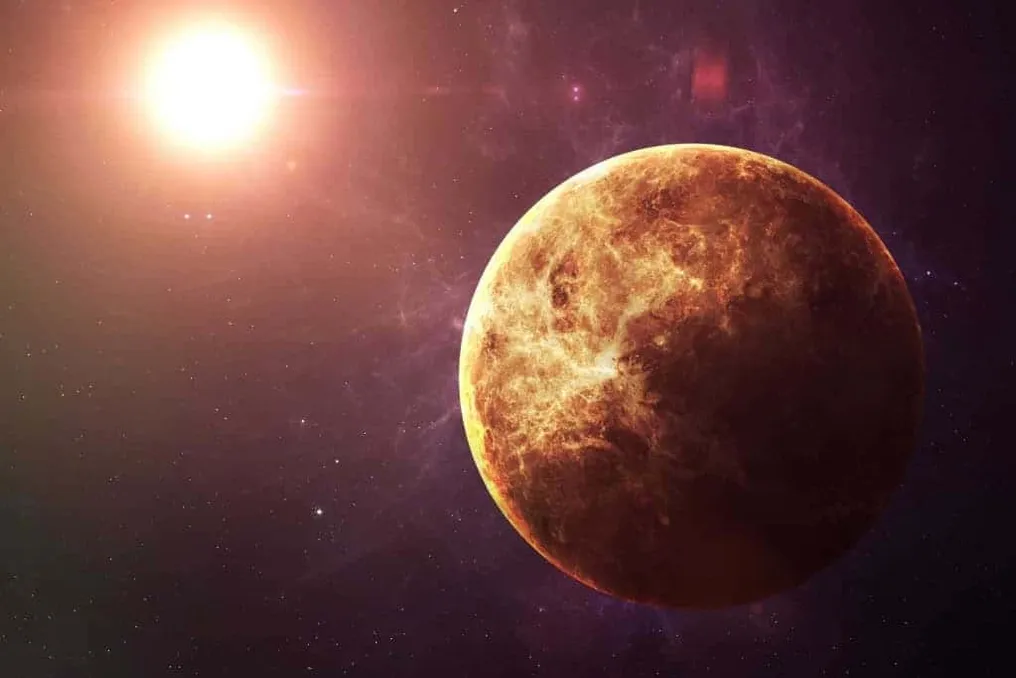
Scientists from the University of California, Riverside (UCR), located in the United States, used computational simulations to analyze what might have happened to a hypothetical natural satellite of Venus. The study, published in The Astrophysical Journal, points out that the planet's slow rotation could lead the satellite to progressively approach until colliding with Venus. This hypothesis aids in the investigation of planetary evolution and the past conditions of the planet.
Venus does not currently have a moon
Although Venus does not possess any moon in the present, the new research does not offer definitive confirmation on whether it ever had a satellite. However, it demonstrates that if a satellite existed, it could have disappeared without needing a massive impact for its destruction.
The key to understanding this phenomenon lies in how Venus rotates, which is useful to compare with Earth. While our planet completes one rotation in about 24 hours, Venus takes approximately 243 Earth days. This disparity affects the orbital dynamics of a possible satellite around each celestial body.
Unlike Earth, where the Moon is gradually moving away, simulations for Venus suggest the opposite: the interaction between the planet and the satellite could force the moon to continuously approach, culminating in a collision with the planet.
To validate this idea, researchers developed computer models by adjusting different rotation speeds for Venus and varying the sizes of a potential moon. They simulated satellites with masses ranging from half to ten times the mass of the Earth's Moon.
The results indicated that, in various modeled scenarios, the satellite ended up on a trajectory toward the planet. It was observed that the larger the moon, the faster this process of approach would be.
The scientists also investigated what would happen if Venus had rotated at much higher speeds in the past. Under these circumstances, some satellites could maintain orbit for long periods, but the problem would arise as the planet lost rotational speed.
The simulations only establish the possibility of this scenario but did not present concrete evidence that a moon actually existed. Furthermore, proving events that occurred billions of years ago is complex, given that much of Venus's surface has been renewed throughout its history, erasing traces of ancient events.
A potential clue might be hidden within the planet's interior. Studies on the Earth's internal structure have already identified signs that may be linked to the major impact responsible for the Moon's formation; something analogous on Venus could help clarify its history.
A collision between Venus and a moon would have been an event of extreme magnitude. Such an impact would have the potential to modify the planet's rotation and influence its geological and climatic evolution. This is relevant because Venus may not always have had characteristics similar to the extremely hot planet we know today. Researchers continue to seek to understand how it reached its current state and whether, at some point in the past, it presented conditions more conducive to life.