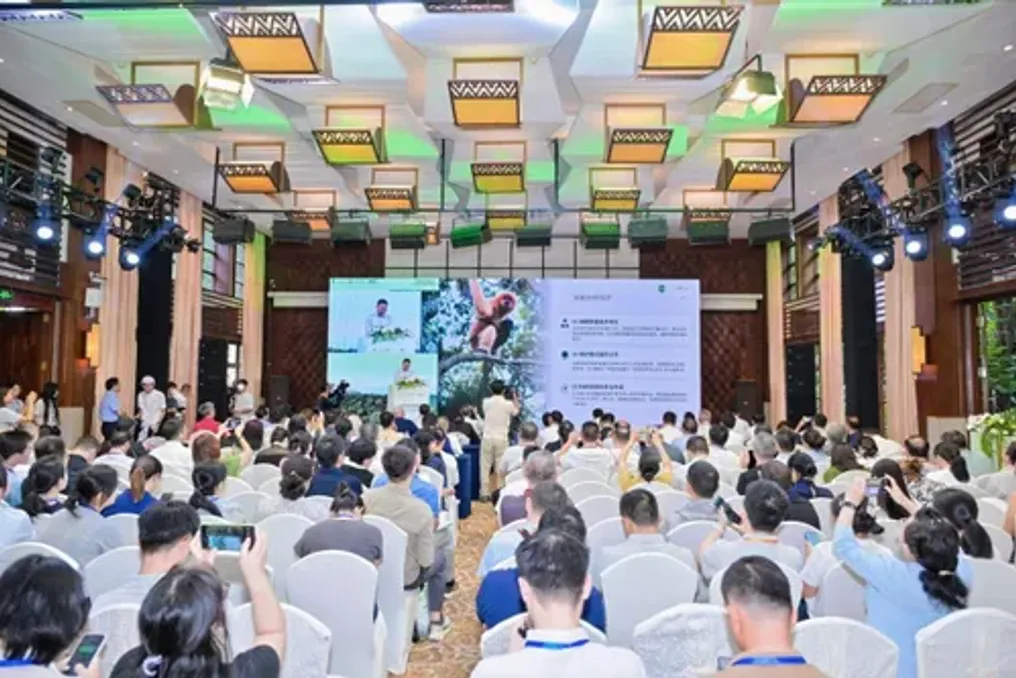
Hainan Tropical Rainforest National Park presented its five-year achievements since its establishment. These results were announced by Zhu Shiren, Deputy Director of the Hainan Tropical Rainforest National Park Administration, at the International Symposium on Tropical Rainforest National Parks, held on September 11 in the Baotingli and Miao Autonomous Region, Hainan Province, Southern China.
One of the most significant successes was the increase in the population of the Hainan gibbon—one of the rarest primates in the world. If there were only seven individuals in two groups in the early 1980s, the population grew to 44 individuals in seven groups by the end of 2025, making this population the only one in the world demonstrating continuous growth.
In recent years, Hainan has transformed the national park into a flagship project for national ecological conservation pilot zones. Environmental protection remained a priority. According to Zhu's statements, 1,975 residents from 459 households living in the core area of the park were relocated, and 25 small hydropower stations in this zone were decommissioned. Furthermore, a phased and categorized management system for 248,300 mu (approximately 16,553.33 hectares) of plantation forest was implemented, with 265 million yuan (about $39.5 million) allocated for ecological compensation.
Over the past five years, 91 new species of wild plants and animals have been discovered in the national park. Hainan has also strengthened the gibbon protection system by establishing the National Center for Gibbon Conservation and Research and an Academic Committee, which has elevated the protection of rare species to a more scientific, standardized, and professional level. Concurrently, the province created an integrated space-air-ground ecological monitoring network for 24/7 observation of tropical forests.
Currently, the national park effectively protects over 95% of Hainan Island's primary forests and over 55% of its natural forests, with the overall forest cover rate in the park stably maintained at 95.9%. Water quality indicators in major water bodies and ambient air quality, rated as good or excellent, remain at 100%, and the concentration of negative oxygen ions exceeds 8,000 per cubic centimeter year-round, placing the national park's ecological environment among the best in China.
Hainan has also worked to transform ecological assets into economic value. The gross ecosystem product of the national park increased from 204.513 billion yuan in 2019 to 208.966 billion yuan in 2024, calculated annually for the national park as an independent spatial unit. The park is the only national park in China selected for the second round of pilot programs for realizing the value of ecological products.
The carbon credit labeling project, launched in early 2026, is projected to absorb 326,900 tons of carbon over 20 years, with nearly 2,600 tons already sold online. Hainan has selected and certified 36 signature products from the national park in two batches. After the first 14 products began using the exclusive labeling, partner enterprises recorded a 20% to 30% increase in monthly sales.
Leveraging the rich resources of the national park's tropical forests, Hainan has developed five premium ecotourism routes and constructed a scenic road spanning 466 kilometers that encircles the national park, connecting several high-quality attractions in nine cities and counties along the route. These steps aim to deepen the integration of conservation activities and cultural tourism.
Hainan has simultaneously pursued ecological protection and improved living conditions, allowing local communities to benefit from nature conservation. Over the past five years, the province received 179 million yuan in central government funding for comprehensive improvements to living conditions in 56 villages. Priority was also given to hiring local residents for nature conservation work, with 1,593 people employed as permanent eco-rangers.
The province has improved the ecological compensation mechanism by introducing a trans-regional ecological compensation system between the nine cities and counties covered by the national park and neighboring cities and counties. 11.62 million yuan in central fiscal funding was secured to implement differentiated compensation for non-state public forests, benefiting 372 communities and 6,194 farms.
Over the past five years, Hainan has deepened international exchange and cooperation in tropical rainforest conservation. It successfully hosted the International Symposium on Tropical Rainforest Conservation and the first meeting of the Global Gibbon Network (GGN), and reached a memorandum of cooperation agreement with the Picos de Europa National Park. Hainan's approach to gibbon conservation has been recognized by the IUCN as a global model for rare species protection and is being promoted internationally.
At the eighth IUCN World Conservation Congress, the proposal for gibbon protection presented by Hainan was adopted by an overwhelming majority vote, becoming the first international resolution dedicated exclusively to gibbon conservation. The GGN secretariat is permanently based in Hainan. Hainan has revised and implemented provisions for the Hainan Tropical Rainforest National Park, and a leading group for national park construction has been formed. The province has also divided the national park territory into over 1,500 grid blocks to ensure compliance with regulations for better tropical forest protection. Zhu noted that Hainan will continue to strive towards global standards, aiming to make the national park a global benchmark for tropical forest protection, biodiversity management, and international cooperation in environmental progress.