
Shanghai AI Lab releases scientific multimodal model Intern-S2-397B with memory decoder
Read more
Pandaily
pandaily.com

Shanghai AI Lab releases scientific multimodal model Intern-S2-397B with memory decoder

Shanghai AI Laboratory has introduced its open-weights, science-oriented multimodal foundation model, Intern-S2-397B, on the Hugging Face and ModelScope platforms. The announcement followed a presentation at the Putian Innovation Forum on September 13, 2026, and a laboratory briefing on September 21.

The official English name of the laboratory is Shanghai AI Laboratory / Intern-S2. This release differs from recent lab publications, such as Atria Dawn, Intern Physical World Model W0, and NCP-ArchPreview, as it represents the release of weights for a scientific model architecture, rather than an announcement of another agent or world model.

The Intern-S2 model is designed to perform long-horizon scientific tasks and agent cycles. Lab materials emphasize the inclusion of a pluggable Memory Decoder, which allows domain modules to be attached without retraining the entire base model. For instance, using Intern-MemDec-4B in biological experiments increased average scores on Biological Instructions from approximately 56.92 to 60.32 while maintaining overall results at the level of the base model.

Hugging Face indicates that the Intern-S2-397B card contains about 403 billion parameters. The model underwent visual pre-training on pages of raw scientific literature, multi-domain scientific reinforcement learning across more than 20 fields, and long-horizon agent reinforcement learning in isolated environments. Support for deployment is provided through LMDeploy, vLLM, and SGLang, and the official Intern API endpoint is documented.

Shanghai AI Laboratory reports that Intern-S2 is deeply optimized in conjunction with Huawei's Ascend computing stack regarding computation, communication, and memory aspects. Furthermore, the model will be integrated into the lab's Intern DuanYan scientific discovery platform, which covers life sciences, materials, semiconductors, and related disciplines. According to vendor statements, Intern-S2 ranks first among open-source models in knowledge, code, and agent sets, demonstrating strong performance in biology and materials science tasks; however, these figures are currently internal lab data pending independent testing.

For research groups, the end result is access to the downloadable Intern-S2-397B weights, accompanied by documentation on the Memory Decoder and a note on collaboration with Ascend. Thus, this is an open multimodal foundation model updated for community use, not merely an announcement based on a closed API.

Similar stories

UzMedExpo-2026 exhibition featuring medical technologies, including AI bracelets and simulators takes place in Tashkent
Read more
sputniknews.uz

UzMedExpo-2026 exhibition featuring medical technologies, including AI bracelets and simulators takes place in Tashkent

At the international exhibition of medical equipment and pharmaceuticals, 'UzMedExpo-2026,' which is taking place from September 15 to 17 at 'UzexpoMarkaz' in Tashkent, modern solutions for the healthcare sector are being demonstrated.

Among the presented innovations are AI bracelets, digital medical records, and medical simulators. The exhibition highlights technologies and tools designed to improve the healthcare system.

The company 'Sino AI' presented an artificial intelligence-equipped device—a 'bracelet.' This gadget collects data on heart rate, sleep, stress levels, blood pressure, blood oxygen saturation, and ECG. The collected information is then analyzed in an application and saved in the system.

A representative of 'Sino AI,' Sherzod Khujaev, noted that the bracelet does not diagnose diseases but only provides warnings, drawing attention to conditions such as diabetes, oncological diseases, and stroke, so people can learn about health problems in advance.

According to Khujaev, the team is currently expanding the device's functionality, specifically developing NFC capabilities, which will in the future allow the bracelet to be used not only for health monitoring but also for travel payments.

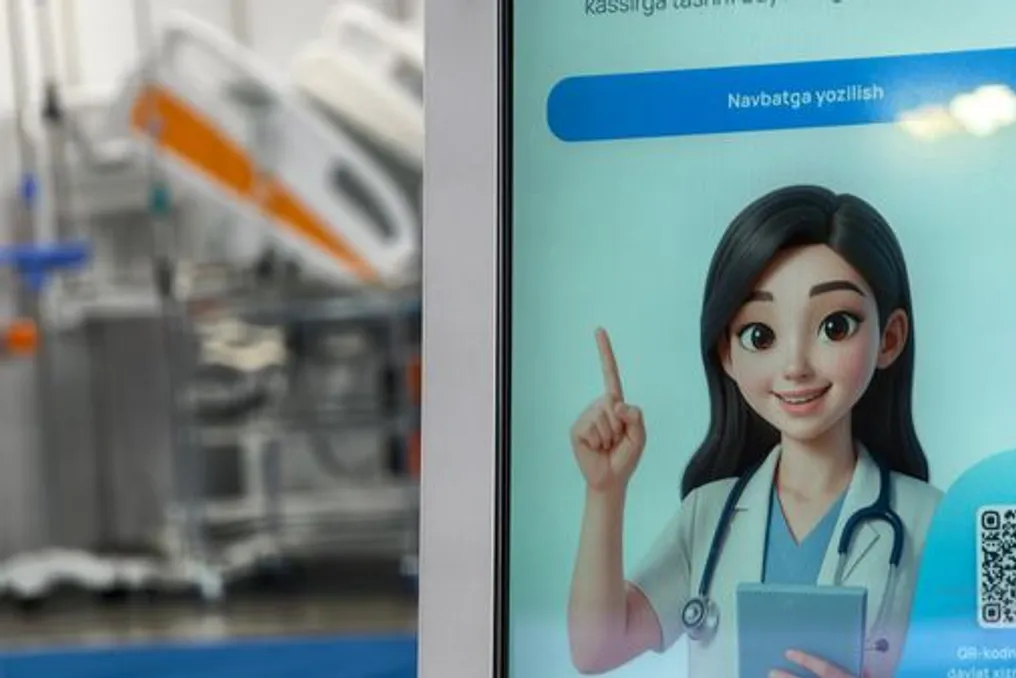
Another participant in the exhibition is the 'Dmed' project from 'Uzinfocom,' which aims to solve issues within the medical system itself. Through an application, users can find a clinic, book an appointment, and receive information about services and tests. Medical history is stored electronically, and medical documents are officially processed through the system, eliminating the need to provide paper certificates to employers.

Sherzod Gulomov, head of sales at 'Dmed,' explained that the system is designed to support the patient at all stages of their stay in the clinic: from registration and payment to choosing a doctor and viewing test results. The platform is integrated with all state medical institutions, and the company is currently connecting private clinics. The application is available free of charge for patients in Uzbek, Russian, and English.

Products for healthcare professionals were also presented at the exhibition. The company 'GEOTAR U MEDIA' showcased electronic educational materials and simulation equipment for doctors and students. This company has already developed concepts for localizing simulator production in Uzbekistan.

Ruslan Khaskhanov, a representative of 'GEOTAR U MEDIA,' reported that the simulators closely approximate real anatomical parameters and have undergone various tests, including exposure to cold, heat, and a three-meter fall. 'GEOTAR U MEDIA's' library contains over two thousand medical books and textbooks, and the company plans to seek partners to translate educational materials into Uzbek.

At the exhibition booths, visitors can examine products from companies from Uzbekistan, Russia, India, Germany, and other countries.

Shanghai AI Lab releases preliminary version of Atria Dawn model, based on MoE architecture with 744 billion parameters
Read more
pandaily.com

Shanghai AI Lab releases preliminary version of Atria Dawn model, based on MoE architecture with 744 billion parameters

The Shanghai Artificial Intelligence Laboratory has introduced Atria Dawn Preview—an agentic language model designed to support complex research and engineering processes, rather than just demonstration chats. This preliminary version is built upon the Mixture-of-Experts (MoE) foundation with 744 billion parameters, identified as GLM-5.2.

The model features a 256K context window and is distributed under the MIT license. Checkpoints, both standard instruction-tuned and quantized in FP8-instruct format, are available on Hugging Face and ModelScope platforms. Furthermore, API access is provided to users in international and Chinese regions.

According to the model documentation and an accompanying arXiv paper, the system was trained using a Verifiable Experience Pipeline. This pipeline connects tool-mediated reasoning with executable environments and externally verifiable results. The core concept involves a complete execution cycle: problem analysis, solution design, tool invocation, code and experiment execution, result verification, and failure recovery within a continuous feedback loop from the environment, rather than simply receiving a single answer.

The laboratory has grouped the model's capabilities for scenarios covering discovery, creation, delivery, and cybersecurity. These scenarios include deep research, software development, preparation of structured office materials, and authorized security auditing.

When evaluated across 16 benchmarks presented by the laboratory, Atria Dawn Preview demonstrated the highest score in five tasks. These include AutomationBench with a result of 53.8, BrowseComp with 92.5, DeepSearchQA with 96.0, BFCL v4 with 77.0, and CyberGym with 86.5. Other metrics remain competitive but are not dominant compared to state-of-the-art agent base models.

This release differs from previous developments by Shanghai AI Lab, such as Intern W0 and related NCP works. Dawn is positioned as an open agentic partner for multi-stage scientific and engineering projects, and along with the weight release, public assets were provided on GitHub and the dedicated Atria project website.

Developers can download weights for local use through frameworks like SGLang and vLLM, or utilize regional API consoles. Codex-style clients can interact with the Responses API using text-only mode settings. Nevertheless, teams are advised to reproduce the AutomationBench results and toolchains independently for long-term tasks, and to verify licensing and deployment conditions. It is important to take the 'preview' label seriously, as the agent's reliability outside published datasets remains an open question while the lab transitions from task assistants to collaborative project work.

Shanghai AI Lab introduces Intern W0 physical world model for robotics with force and tactile feedback
Read more
pandaily.com

Shanghai AI Lab introduces Intern W0 physical world model for robotics with force and tactile feedback

The Shanghai Artificial Intelligence Laboratory has released the Intern W0 physical world model. This stacked system is oriented towards robotics and is designed to transfer the behavior of large models from digital planning to physical, contact-rich operation.

The laboratory emphasizes that W0 was initially developed with the goal of integrating data from vision, force, and touch. This allows the robot to perceive, predict, act, and correct its actions in parallel, instead of following a rigid cycle: first perception, then planning, then movement.

This model differs from the laboratory's previously published collaboration with LUMIA Lab from Shanghai Jiao Tong University, which focuses on predicting next-level concepts rather than force-based physical control.

The release of W0 is defined by two key elements. The first is native sensory perception of force and touch, which integrates contact feedback into the action selection and perception process alongside data from vision and body proprioceptive state. Vision determines approach directions and target points, while force and touch update grip quality and register slippage after contact begins. Proprioceptive state tracks position and movement.

The second principle is duplex interaction, which maintains a continuous flow of multimodal inputs, including language instructions, visual observations, force/touch feedback, and body state. Simultaneously, the model generates semantic understanding, predictions of future states, and motion commands. The asynchronous architecture with a multi-speed mode allows for background updating of long-term planning while high-frequency action updates continue to react to fresh observations, thereby reducing the interval between environmental change and motion correction when vision alone is insufficient.

Researchers note that this combination helps in tasks requiring high precision, such as determining grip stability, correctness of contact settling, or how the next micro-correction should look. Model W0 is already integrated with the Intern InkStone scientific discovery platform—the English product name presented on the lab's portal. It functions jointly with the Intern S2 large science model.

Together, they have provided support for closed loops in both wet and dry laboratory conditions. These loops covered directed evolution of proteins for gene editing, organic synthesis of mepivacaine, and preparation of lipid nanoparticles, including dynamic tuning of process parameters during nanoparticle work, which is mentioned in secondary sources as early evidence of science-oriented physical AI.

For groups involved in chemistry, biology, and materials science, W0 is viewed as a tool for automated experimental cycles, not as a consumer robot demonstration. It remains to be seen how broadly the duplex force and touch control generalizes across different laboratory instruments and wet lab protocols, which will determine whether the Intern stacked set becomes the default layer in Intern InkStone workflows or remains tied to previously demonstrated closed-loop cases. The laboratory presents these cases as the beginning of the path from schematic derivation to instrumental experimentation, not as a ready-made product catalog.

Popular