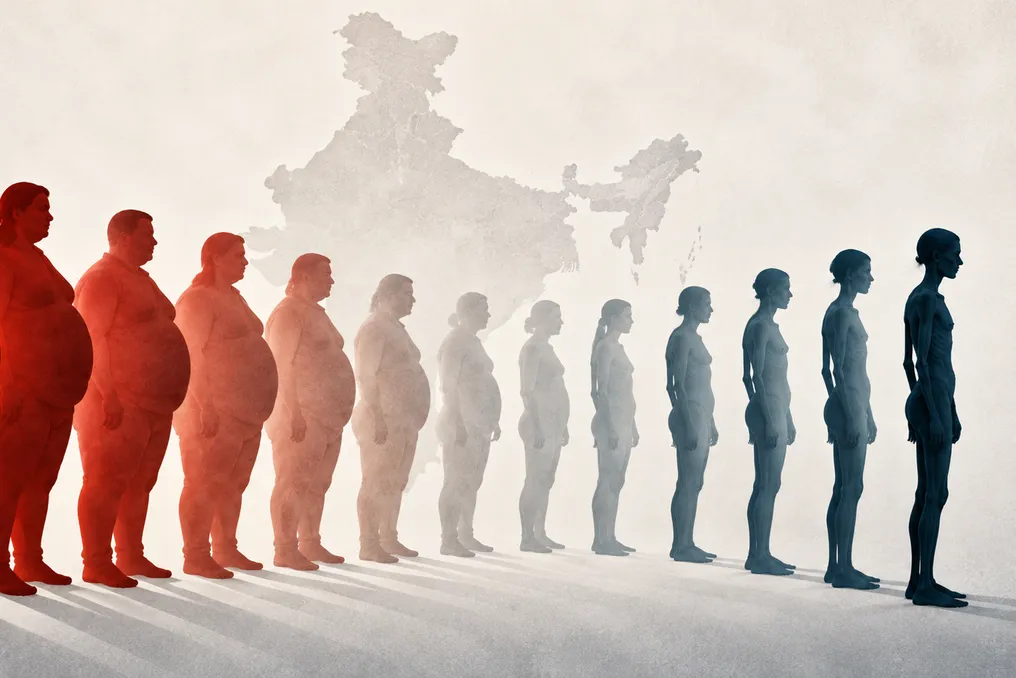
Study in India shows increase in both underweight and overweight populations
Read more
The times of India
timesofindia.indiatimes.com

Study in India shows increase in both underweight and overweight populations

Although an inactive lifestyle is often cited as the cause of rising obesity, which is widely discussed in the modern digital world, data from the latest National Family Health Survey (NFHS-6) indicates a more complex picture. These data show that the proportion of people with a normal Body Mass Index (BMI) in India has stopped decreasing, while the number of people with overweight and obesity is growing.

As a result, the share of women with a normal BMI decreased from 57.3% to 49.6%, representing a drop of 7.7 percentage points.

BMI is calculated by dividing weight in kilograms by the square of height in meters. According to the NFHS classification, a BMI below 18.5 is considered underweight, and a BMI of 25 or higher is considered overweight or obese. Since the report does not specify the normal range between these values, the publication TOI calculated it by subtracting the two published shares from 100.

Reversal Trend in Low BMI

NFHS-6 is the first round in which the proportion of people with underweight BMI has increased among both sexes and men. The male share, which was previously lower than the female share in every previous round, has now equaled it at 19.7%. Regarding overweight, it has continuously risen: among women, it increased from 12.6% to 30.7% since NFHS-3, and among men, from 9.3% to 27.3%.

State-wise Situation

When comparing by state, the NFHS-6 report showed that only seven out of 35 states and territories had a calculated normal BMI share below 50% in NFHS-5; however, this number rose to 16 in NFHS-6. Thus, in 16 states, more than half of women aged 15–49 either are overweight or suffer from underweight. The situation for men has changed: if only one state, Puducherry, had a share below 50% in NFHS-5, then 11 such states were found in NFHS-6.

Urban vs. Rural Differences

State-level data indicate that this problem is not limited to a few isolated areas. Dr. Sajadjit Banerjee, a specialist in internal medicine and geriatrics based in Kolkata, notes that as a city doctor, he observes a predominant trend towards weight gain. Patients increasingly seek advice regarding semaglutide and tirzepatide medications after reading about them, whereas those whose BMI remains within acceptable limits are advised to change their lifestyle.

Analysis at the district level also showed that a normal BMI can conceal muscle loss and excess fat, and blood sugar levels have also increased.
Similar stories

Chandigarh leads India in household expenditure, surpassing Mumbai and Delhi
Read more
timesofindia.indiatimes.com

Chandigarh leads India in household expenditure, surpassing Mumbai and Delhi

According to a study, the average household in Chandigarh spends about 19 lakh rupees annually. This city has become the leader in India for per capita household spending levels, according to the report The Many Urban Indias, prepared by People’s Research on India’s Consumer Economy (PRICE) in collaboration with Tata Sons.

The study analyzes how households in India's 100 largest cities earn, spend, save, and take loans. Chandigarh demonstrates the highest average household expenditure level in the country, surpassing India's largest metropolitan areas in this metric.

In the report, Chandigarh is classified as a Frontier city, which falls under the category of smaller urban centers among India's 100 most populous cities. It is among the most high-spending urban centers in the country, alongside Thiruvananthapuram in Kerala. Furthermore, the report highlights the financial standing of households in Chandigarh, noting high savings levels and low debt levels.

In the study, high-income households are defined as those whose annual income exceeds 36 lakh rupees at 2025-26 prices. The share of such households among the 100 cities has increased to 12%, compared to 3% a decade ago.

Although Bengaluru has the highest average income, Chandigarh leads in consumption. Cities were divided into categories: 'Big Six'—cities with a population over 10 million; 'Boomtowns'—from 2.5 to 10 million; 'Breakout cities'—from 1.5 to 2.5 million; and 'Frontier cities'—from 0.5 to 1.5 million. Chandigarh falls into the Frontier category, while Delhi, Mumbai, and Bengaluru are in the 'Big Six'.

Nutritional deficiencies are found not only in thin people but also in obese people; expert opinion on skipping food for weight loss
Read more
www.aajtak.in

Nutritional deficiencies are found not only in thin people but also in obese people; expert opinion on skipping food for weight loss

It is being observed nowadays that nutritional deficiency is not limited only to thin individuals. Even if a person has excess weight and appears normal externally, their body may still lack vitamins, protein, iron, or other essential nutrients.

A recent metabolic health study conducted in Delhi-NCR highlighted this situation. The study found that 55.7 percent of millennials were overweight or obese, while 70.8 percent of people aged 45 or older had elevated levels of visceral fat, which is dangerous fat accumulated around the organs. Many of these obese individuals also suffer from vitamin deficiencies.

Some people are making dietary changes with the aim of losing weight. Dr. Ejaz Ilmi, Senior Consultant and Head of the Metabolic Diseases Department at Pacific One Health Hospital, states that it is not appropriate to associate nutrient deficiency only with thin people, as this problem is clearly visible in obese people as well.

This problem is increasing due to urban lifestyle. Market food, packaged foods, and high-calorie diets fill the stomach, but they often do not contain adequate amounts of protein, fiber, vitamins, and minerals. A study conducted on adults in Delhi-NCR also found a high prevalence of severe Vitamin D deficiency in the urban population. Furthermore, a link has been established between excess fat accumulation around the abdomen and Vitamin D deficiency.

According to dietitian Kanika Malhotra, weight loss does not just mean reducing the quantity of food. Many people reduce bread, rice, or whole meals in an attempt to lose weight quickly, which can lead to a deficiency of protein and essential nutrients. According to her suggestions, it is important to include various types of foods in the daily diet to provide better nutrition to the body, including adequate protein, vegetables, fruits, lentils, whole grains, fiber, and essential vitamins and minerals.

Popular