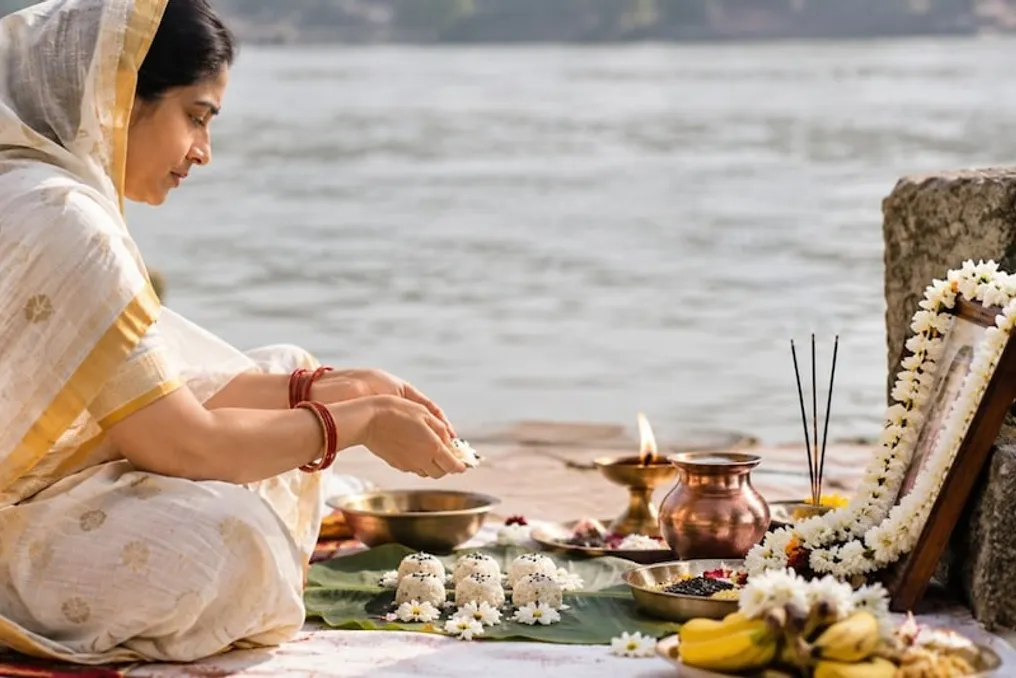
According to the Garuda Purana: Can women perform Sharaddha, Tarpan, or Pindapada?
Read more
Aaj Tak
www.aajtak.in

According to the Garuda Purana: Can women perform Sharaddha, Tarpan, or Pindapada?

The Garuda Purana emphasizes the great importance of Sharaddha, Tarpan, and Pindapada for achieving peace for the souls of ancestors. Usually, these rituals are performed by male family members, which has led to the notion that women are not entitled to perform Sharaddha or Pindapada. However, religious scriptures contain various rules on this matter, depending on specific circumstances.

In Hindu tradition, rites such as Sharaddha, Tarpan, and Pindapada are performed after a person's death to show respect and fulfill one's duty towards the deceased. The question arises: can a woman perform these rites if there are no sons or male heirs in the family?

What does the Garuda Purana say about women performing Sharaddha?

The Garuda Purana discusses the importance of the Sharaddha ritual and the person who performs it. One verse states that in the absence of a son, the wife, daughter-in-law, and other close relatives can perform Sharaddha. The verse reads: «Putrābhāve vadhūḥ kuryāt āryābhāve śiṣya eva vā...»

The meaning of this statement is that in the absence of a son, the wife or daughter-in-law can conduct Sharaddha depending on the prevailing circumstances. If even they are absent, other family members such as a brother, nephew, or grandnephew can do it. If there are no such close relatives, tradition provides for the Sharaddha to be performed by a student, friend, or another worthy person.

This indicates that considering Sharaddha exclusively a prerogative of men is not entirely accurate. Nevertheless, there are differences in the methods of performance and the rights to Sharaddha across various traditions and theological views.

Can women perform Tarpan and Pindapada?

In religious traditions, priority is usually given to a son or a close male relative when performing Sharaddha and Pindapada. However, in cases where there is no son or under special circumstances, the possibility of performing these rites by a wife, daughter-in-law, or other suitable family members is mentioned. Therefore, it cannot be asserted that a woman is completely deprived of the right to Sharaddha or Pindapada in all situations. The method of performance may vary depending on the family's situation, local traditions, and relevant religious opinions.

Did Mata Sita perform Pindapada for Raja Dasharatha?

An example of a case where women performed Pindapada is the story of Mata Sita and Raja Dasharatha. According to this story, common in religious traditions related to Gaya, Shri Rama, Lakshmana, and Mata Sita arrived in Gaya during exile, where Sharaddha was supposed to be performed for Raja Dasharatha.

The narrative states that Shri Rama and Lakshmana went to fetch materials for the Sharaddha. At that moment, Mata Sita saw Raja Dasharatha and wished to perform the Pindapada before time ran out. Subsequently, Mata Sita, taking sand as a witness, along with Ketaki flowers and Vatvriksha wood, performed the Pindapada for Raja Dasharatha. This story is widely known in the religious traditions and mythological representations of Gaya and is used as an example of Pindapada performed by a woman.

Thus, religious texts and traditions mention the possibility of women performing Sharaddha according to circumstances, especially in the absence of a son or another close male heir, when it is done by the wife or daughter-in-law. However, the methods of Sharaddha and Pindapada may differ across different sects and family traditions. Therefore, it is considered appropriate to follow family traditions and the advice of a qualified Acharya before performing the ritual in a specific situation.

Similar stories

Women need to stop conforming to others' agendas and awaken their inner strength
Read more
iol.co.za

Women need to stop conforming to others' agendas and awaken their inner strength

The author argues that it is time for women to abandon following others' norms and start living in accordance with their true essence. As a life transformation coach with twenty-six years of experience, the author often ponders what is possible when a person stops living according to societal templates imposed upon them and starts living based on their authentic 'self.'

Especially women, whether they realize it or not, are subjected to humiliation and exploitation, and they are dictated how they should dress, behave, and speak. This conditioning is so deeply rooted that today some women continue to do this to other women, especially those who refuse to be modest and fit into someone's agenda.

A natural question arises: whose interests does our desire to 'fit in' serve? The answer is obvious—those who benefit from it.

For centuries, patriarchy, described as 'wounded or toxic masculinity,' held control over women. From an early age, they are instilled with the necessity to submit to family expectations, social norms, and religious dogmas. None of this created conditions for women to truly flourish.

Instead, they were told: 'Conform. Do what is expected. Put everyone else first.' They were taught to serve the needs, moods, and desires of others.

This list of expectations includes being a good daughter, a good wife, a good mother, a successful professional, a person who keeps everything under control, remembers everyone's birthdays, is always present, and ready to give. The author again asks whose interests this list serves and urges readers to consider where they stood in this line of expectations.

It is time to wake up. It is necessary to start questioning imposed norms instead of quietly agreeing. This is not a revolution, but rather an evolution that begins within the woman herself.

It is time to awaken the goddess within. This goddess represents a sacred part of the personality: bright, joyful, playful, creative, intuitive, wise, and caring. She is also a part of the personality possessing sovereignty. She knows her worth, is capable of saying no, has high standards for herself, realizes her potential, is absolutely true to herself, defends her beliefs, and radiates confidence. She embraces pleasure and leads other women on this wonderful journey toward their own divine state.

Some people, both men and women, may resist this awakening, especially if the conditioning is very deep. However, this change will not be suppressed. Many will look at you with admiration and respect, seeing you as a guide for other women ready to awaken their divine feminine energy.

Toxic men may oppose this process. But a man in his divine masculine state will provide safety, structure, and support for the women in his life, allowing the divine femininity to unfold in all its glory. He understands that with her rise, he rises too.

An era is dawning for the manifestation of both divine femininity and the divine masculine principle. The divine masculine principle is leadership, but it is based on kindness, not control. He is proud of his role as provider and protector not out of egoism, but out of love.

Too many men live in a state of wounded masculinity, unable to lead, provide, or protect, waiting for women to tell them what to do, support them, and take care of them. This state also requires healing, and it is achieved when women embrace their divine femininity.

A woman shining in her glory and greatness, knowing her worth and purpose, attracts the Divine Masculine principle in a man. He takes on the role of provider and protector, and the cycle closes. No more gender struggle, no more competition for power. Instead—wholeness, dignity, and fullness of being. From this arises sacred partnership—the next stage of our evolution.

Popular