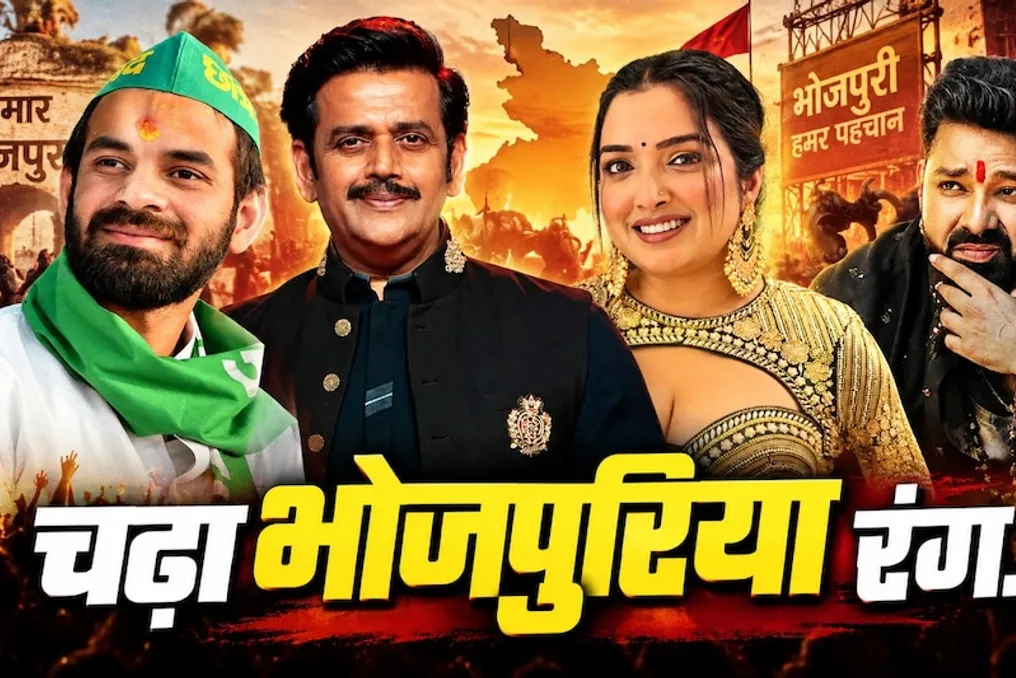
The Influence of Bhojpuri Flavor on Reality Shows: Are Regional Stars Becoming the Engine of Ratings in Indian Shows?
Read more
Aaj Tak
www.aajtak.in

The Influence of Bhojpuri Flavor on Reality Shows: Are Regional Stars Becoming the Engine of Ratings in Indian Shows?

As Ravi Kishan noted, in the entertainment industry, what is visible sells, and every star's career is not static; sometimes they are at the top, and sometimes at the bottom, which is the reality of the cinematic world. Once, the Bhojpuri industry looked down upon itself in the eyes of the Hindi entertainment industry, underestimating and questioning the level of the Bhojpuri industry. However, the situation has changed.

Today, Indian shows have to turn to Bhojpuri stars to boost ratings (TRP). Viewers prefer to see authentic, real people rather than a Westernized and modern lifestyle. This is why Bhojpuri flavor has appeared in Hindi television shows, which is linked to the changing perspective of producers towards Bhojpuri stars. Perhaps for the first time, the math of the industry has changed.

Producers aim to attract performers whose popularity extends not only to the glossy world of Mumbai but also to various parts of the country, from UP and Bihar. The Hindi industry shows a preference for Bhojpuri and Purvanchali stars. The cheap, authentic touch of Bhojpuri has become a new ingredient in the television format.

The main characteristic of Bhojpuri stars is their naturalness. Whether it is a rustic style conversation or natural participation in games, their simplicity and the fandom from UP-Bihar help them in shows. This is also beneficial for reality shows, as the language barrier is not a major problem here. The audience accepts the Bhojpuri flavor, which is facilitated by the spread of content on OTT platforms, bringing regional content, languages, and stars from these regions to light. Millions of views of Bhojpuri stars' songs serve as proof of their stardom, and their participation in reality shows gives the show a unique flavor.

Nevertheless, attracting Bhojpuri stars can sometimes result in losses for producers. An example is Akshara Singh, who participated in 'Big Boss OTT Season 1'. She is a big star of the Bhojpuri industry but could not succeed in the show. Similarly, Kehkesari Lal Yadav also turned out to be an unsuccessful participant in the 'BB' house. Despite the huge star status of these two artists, they appeared subdued in the 'BB House'. Perhaps they could not adapt to such a large format or among mainstream actors, so the participation of Bhojpuri stars cannot be considered a guarantee of high ratings. They need to fit the format.

Ravi Kishan participated in the reality show 'The Alliance' to fulfill his duty to his daughter Riva. Although Riva herself was not there, her father made a sensation. Many years ago, fans saw Manoj Tiwari in the most dangerous season of 'Big Boss', and his daughter Riti appears in 'Big Boss 20'. Furthermore, he will appear in the reality show 'Pati Patni Aur Panga 2' with his second wife. Dinesh Lal Yadav also participated in 'Big Boss' decades ago, and recently he was seen in the show 'Bhojpuri Bawaal'. Pawan Singh, Amrapali Dubey, Kajal Raghavani, and Rani Chatterjee also appeared in this show. Amrapali is currently participating in 'Big Boss 20', and her rival Kajal Raghavani will appear in 'Rise and Fall'. In addition to these celebrities, Tej Pratap Yadav, son of Lalu Prasad Yadav, will also be in 'Rise and Fall'. He demonstrated great entertainment in 'Bhojpuri Bawaal', and now it is interesting to see what success he achieves in this show.
Similar stories

After Tamannaah Bhatia, Sharvari Waghm also celebrated Chhath Maiya festival, showing long sindoor on her forehead
Read more
www.aajtak.in

After Tamannaah Bhatia, Sharvari Waghm also celebrated Chhath Maiya festival, showing long sindoor on her forehead

Large-scale scenes related to festivals are often seen in the Bollywood film industry, but the great folk festival 'Chhath' rarely appeared in mainstream Indian films. Nevertheless, a change in trend is now being observed in Indian cinema.

Within one month, the vibrant cultural and majestic depiction of the Chhath festival was presented in two large and expensive Indian films, which won the hearts of the audience.

Following the film 'The One' starring Siddharth Malhotra and Tamannaah Bhatia, the new movie 'Ye Prem Mol Liya' by renowned director Suraj Bajaiya also presented the worship of Chhath Maiya with great respect and beauty.

Bollywood actress Tamannaah Bhatia is currently being actively discussed due to her upcoming film 'The One'. A significant part of this film is based on events taking place in Bihar, and in the plot, Chhath is not just used as a background but is explored very beautifully.

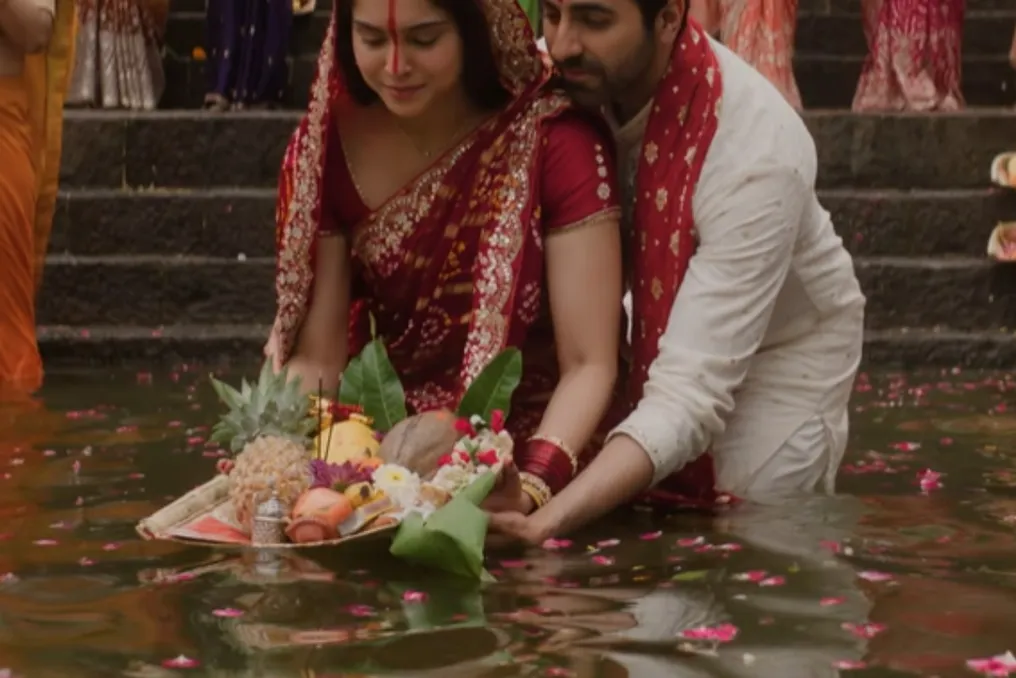
Tamannaah Bhatia's traditional look in a red saree, with a long sindoor on her forehead and a basket for offerings in her hands, is very popular on the internet. This is one of the few instances in Bollywood where this important festival of Bihar has received such a significant place in a major project.

Immediately after Tamannaah Bhatia's film attracted attention, footage from Suraj Bajaiya's new film 'Ye Prem Mol Liya' appeared. Suraj Bajaiya, known for creating films about family and cultural values, also paid great attention to the significance of this great festival in his narrative.

'Ye Prem Mol Liya' showcases crowds of pilgrims on the riverbanks, couples adorned in red attire, and the traditional way of making offerings, captured with great cinematic beauty in photos taken from the song, which is suitable for the big screen.

This is the second instance within one month where two major film studios have presented the traditions of celebrating Chhath in such a grand manner in their big movies.

While the film 'The One' featuring Siddharth Malhotra and Tamannaah Bhatia is fully ready for release in theaters on September 25, 2026, the film 'Ye Prem Mol Liya' under the direction of Suraj Bajaiya will be released on big screens on November 27, 2026. These traditional and cultural posters and photographs associated with both films have caused huge excitement among fans even before the premiere.

Film 'Bedari' banned in Pakistan due to similarity with Indian film 'Jagriti'
Read more
www.aajtak.in

Film 'Bedari' banned in Pakistan due to similarity with Indian film 'Jagriti'

In 1956, the film 'Bedari' was screened in Pakistani cinemas. It achieved enormous success, filling all halls. This film, directed by Rafiq Rizvi and starring Ragini and Santosh Kumar, became a blockbuster thanks to its songs, especially the song 'Ao Bachcho Seir Karen Tumko' performed by Salim Razi. The song became extremely popular among children across Pakistan.

However, the film was soon banned. Some viewers felt a strange sensation, as if they had seen this film before, and discovered that not only the plot but also the melodies of the songs were familiar to them. It soon turned out that 'Bedari' was an exact copy of the Indian film 'Jagriti', released in 1954, and 'Jagriti' itself was a remake of the Bengali film 'Parivartan'.

The most interesting connection in this story relates to Ratan Kumar. His real name was Syed Nazir Ali Rizvi, and he was considered a popular child actor in the Bombay film industry. Born in 1941, he began performing at the age of just five. Family friends and writer Krishna Chander gave him the role of a child actor in the film 'Rakh'. After this, Ratan Kumar worked in several famous films, such as 'Boot Polish' and 'Baiju Bawra', before getting the role of Shakti in Satyen Bose's film 'Jagriti'.

When 'Jagriti' was released in 1954, Ratan Kumar was about 13 years old. Two years later, in 1956, he moved to Pakistan with his family. Many relatives of his family had already settled in Pakistan after the partition. Limited job opportunities in India also contributed to the family's decision to move to Pakistan.

After arriving in Pakistan, Ratan Kumar's elder brother, Wazir Ali Rizvi, founded a production company called 'Hayat'. The first film of this company was 'Bedari', and it was here that the story took an unexpected turn. The film 'Jagriti', in which Ratan Kumar himself acted, was recreated in Pakistan under a new title and in a new context.

'Bedari' featured Ratan Kumar in two roles. He played Ajay, whose name was changed to Jaffar in the Pakistani film. Furthermore, the character Shakti from 'Jagriti' was renamed Sabar Ali. Notably, despite the change in names, the essence of the characters was preserved: both Ajay and Jaffar mean 'victory' in Hindi and Urdu, respectively.

However, the similarity between the two films was not limited to the plot and characters. The most striking similarity was in the songs. In 'Bedari', the original melodies and harmonies were largely retained, but the lyrics were altered. Instead of Indian nationalist references, Pakistani nationalist motifs were added.

For instance, the famous song from 'Jagriti' sounded like: 'Ao Bachcho Tumhen Dikhaen Janki Hindustan Ki'. In 'Bedari', this song was changed to 'Ao Bachcho Seir Karen Tumko Pakistan Ki'. Similarly, where the original featured 'Vande Mataram', 'Bedari' used 'Pakistan Zindabad'.

Another song from 'Jagriti' contained the lines: 'De Di Hme Azadi Bina Kadg Bina Dhaal, Sabarmati Ke Sant Tune Kar Diya Kamal'. In 'Bedari', these lines were replaced with 'De Di Hme Azadi Ki Duniya Hui Haran, Ai Kaide-Azm Tera Ehsan Ha Ehsan'. Thus, instead of Mahatma Gandhi, Muhammad Ali Jinnah appeared.

This process was not limited to a couple of songs; in many songs of the film, the original melodies were preserved while the lyrics were changed, replacing the Indian context with a Pakistani one. How was the truth about 'Bedari' revealed?

Initially, the similarity between the two films might have gone unnoticed because there was a ban on the public screening of Indian films in Pakistan at the time. Consequently, most of the Pakistani audience could not see 'Jagriti'. Later, a member of the Pakistani censorship board informed Donna about this situation, noting that Lahore filmmakers created 'Bedari' in 1956, which was a carbon copy of 'Jagriti' in terms of plot and songs, utilizing the ban on the import and public screening of Indian films.

Initially, 'Bedari' enjoyed great commercial success in cinemas. However, after some time, viewers began to realize its true nature, understanding that the film they were watching bore a resemblance to a previously existing Indian film in terms of plot and melodies. Following this, protests against its public screening began, and the situation escalated to the point where the Pakistani censorship board immediately banned 'Bedari' and restricted the screening of its songs.

Did this affect Ratan Kumar's career? For a long time, there have been speculations that after moving to Pakistan, Ratan Kumar sought to establish himself in the local film industry, and perhaps that is why he participated in creating a film similar to 'Jagriti' in a new form. Nevertheless, Ratan Kumar, being a very popular child actor, could not achieve the same level of success as a leading adult actor.

Popular