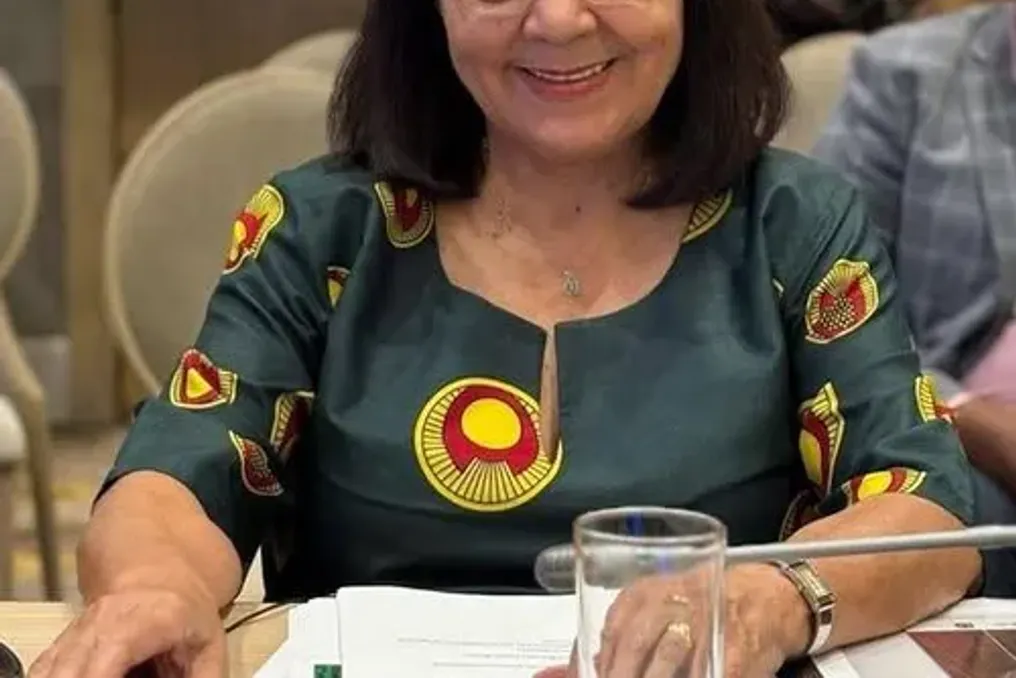
Tourism Minister Patricia de Lille urges tourists to explore South Africa beyond popular attractions
Read more
IOL
iol.co.za

Tourism Minister Patricia de Lille urges tourists to explore South Africa beyond popular attractions

Tourism Minister Patricia de Lille strongly recommends that visitors to South Africa explore lesser-known places, including the Kgodumodumo Dinosaur Interpretation Centre in the Free State province.

Despite the abundance of beautiful destinations in South Africa, Patricia de Lille calls on travelers to discover more than what the country offers, whether it be dinosaur fossils in the Free State or local cuisine.

Speaking at the global launch of Club Med South Africa in Durban to IOL, De Lille emphasized the need for collaboration between the government and the private sector to promote South Africa, while also urging the tourism industry to offer guests new experiences.

De Lille noted that the government invests only 1 billion rand in the country's marketing, whereas the private sector invests 30 billion rand, stressing that they cannot compete but must cooperate.

Discovering South Africa beyond typical tourist spots

According to De Lille, one way to attract both new and repeat visitors is by focusing attention on less known tourism products. One such site she highlighted is the Kgodumodumo Dinosaur Interpretation Centre in the Golden Gate Highlands National Park in the Free State.

This centre, opened in June 2025, combines paleontology, archaeology, geology, and cultural heritage, presenting exhibitions dedicated to the prehistoric past of South Africa. It is also located in an area known for some of the oldest known dinosaur embryos.

De Lille asked: 'Did you know that we have the Kgodumodumo Dinosaur Interpretation Centre in the national park called Golden Gate in the Free State?' She added that many dinosaur eggs and embryos have been found in this area, and that they built this centre.

The attraction has already shown its popularity. SANParks reported that since its opening, the centre has welcomed over 8000 visitors, most of whom were domestic tourists. De Lille believes that such attractions can give repeat visitors another reason to return to South Africa.

She concluded: 'So it is our task, the task of all of us, to show new products that people will want to visit. Especially our repeat visitors to South Africa.' Furthermore, she joked about those who think dinosaurs only exist in Hollywood blockbusters, remarking: 'Not that nonsense from Jurassic Park.'

Visitors can find the Kgodumodumo Dinosaur Interpretation Centre in Glen Rinnen within the Golden Gate Highlands National Park in the Eastern Free State, South Africa.

De Lille's favorite choice during Heritage Month

Naturally, the discussion of Heritage Month could not ignore the topic of food. When asked what she ate during Heritage Month, De Lille immediately spoke about her love for traditional South African dishes such as pap n vleis, chakalaka, and koeksters.

She shared that she likes steamed bread with cucumber and carrot the most. 'And then drinking it down with sauce and steamed bread. That's my favourite,' she said.

Similar stories

The 'Mini-tourism' Concept: How to Notice Hidden Attractions Instead of Popular Spots
Read more
iol.co.za

The 'Mini-tourism' Concept: How to Notice Hidden Attractions Instead of Popular Spots

In South Africa, the problem is not overtourism, but the concentration of too many visitors around a small number of the most famous tourist attractions. The solution, according to an expert, is not to deter guests from iconic places, but to encourage them to look at the places they are already visiting in a new way. This mindset is the basis of the concept called 'Mini-tourism' (Tiny Tourist mindset).

The idea of 'Mini-tourism' arose as a response to the pressure of overtourism in Europe. Its main premise is simple: to go beyond the traditional bucket list and start showing curiosity towards smaller and less obvious experiences that give a place its authentic local flavor.

The author considers this idea particularly relevant for South Africa because, despite having outstanding attractions, the most popular routes are overcrowded. For example, on Table Mountain, 98% of tourists walk around the cable car station. This raises the question: what else can they see if they look further?

Essentially, 'Mini-tourism' represents a compact approach to travel. It includes visiting a local supermarket for unusual chip flavors, walking through a neighborhood dog park, or searching for a pool, cafe, bookstore, or sports club used by locals. As the report states, 'Mini-tourism' is a slower, scattered curiosity that celebrates micro-attractions and allows one to get to know a place through its details.

This does not mean completely abandoning iconic places. Kruger Park, Cape Point, and Union Buildings play an important role in an economy of attention where an iconic image can serve as a quick way to attract attention. One striking photograph can motivate someone to buy a plane ticket. However, once the postcard has served its function, one can move into the hyper-niche segment, where personal interests transform the experience of being in a place, allowing one to find their company on the other side of the world, rather than just taking a picture.

Recently, one of the author's colleagues visited Cape Town. Although the author suggested riding the cable car up Table Mountain, the colleague declined, deciding to watch an Aston Villa match—a kind of ritual during trips. As a result, he took an Uber to Bellville, watched the match during a power outage, and spent the evening with locals. He noted that it was thanks to this approach during business trips that he received some of the best local experiences.

The author has his own approach: he always looks for opportunities for open-water swimming. This led him to the urban lakes of Berlin and, closer to home, to the Konvile municipal pool near George, known for its beautiful late 1970s architecture. Neither of these places would likely make it onto a standard bucket list, but both were memorable for offering a different way to get to know a place.

Recently, the author took a train trip to Kalk Bay. A round-trip ticket costing 24 rand provided a safe, clean, and slow journey, the opportunity to observe people, and enjoy unparalleled views, offering a completely different perspective on a well-trodden route. The author hopes this will become an independent attraction. And speaking of the same coast, the question arises: why does Miller's Point, undoubtedly one of the most beautiful semi-urban campsites in the world, remain empty most of the year?

The need is not to build new attractions, but to become better at discovering, curating, and promoting those that already exist. This also changes the role of people providing tourism services. Guides must truly know their clients and understand their hyper-niche interests, rather than just following a standard bucket list. A friend of the author, a guide, once discovered that her client was passionate about sustainable development. Instead of taking him on a typical tour, she organized an excursion to the Cape Town municipal recycling plant. It was unforgettable and very specific.

The author recalls the phrase about diving safety: 'look up, look down, and look out for yourself.' Underwater, this is a practical safety check. As a traveler, he considers it excellent advice: look up and notice the ordinary shop windows that no one photographs. Look down and choose the R24 train instead of Uber. Look out for yourself and ask someone sitting on the steps of the Union Buildings where the best place to eat is.

None of this requires building anything new. The Kalk Bay train runs several times a day. Miller's Point is empty most of the year. Around our most famous attractions live locals who lead lives that tourists rarely see. The question is not whether South Africa has enough tiny, ordinary, yet remarkable things—it is obvious that it does. The task of those working in tourism strategy is to turn these 'Mini-tourism' micro-attractions into new main attractions, treating the ordinary with the same seriousness as the iconic.

The author wishes Miller's Point would receive the same attention.

Popular